
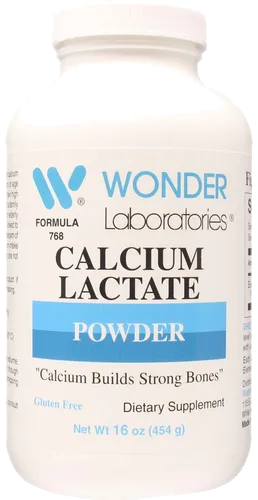
Wonder Laboratories Calcium Lactate Powder Review
Wonder Laboratories Calcium Lactate Powder is presented on this page as a calcium supplement for bone health. The product page states that regular exercise and a healthy diet with enough calcium help women roughly 11 to 35 years of age maintain good bone health and may reduce their risk of osteoporosis later in life. It also says that for persons with a family history of osteoporosis, menopausal women, or elderly men and women, adequate calcium intake is linked to reduced risk of osteoporosis by slowing the rate of bone loss. The page notes that daily intake above 2000 mg is not likely to provide any additional results. The Supplement Facts list a serving size of 1 level teaspoon with 171 servings per container. Each serving provides 400 mg elemental calcium, which is 30 percent daily value, from 2650 mg calcium lactate. Three level teaspoons contain 1200 mg elemental calcium, 90 percent. Directions say to take 1 level teaspoon three times daily with meals, mixed with juice or other liquids. The product is listed as Made in USA in an FDA Registered Facility using Good Manufacturing Practices. The SKU is 7681 and the UPC is 099528768165. The price shown is $7.98 with a size selection.
We don’t sell supplements. We help you make decisions and get the best price.
Lowest prices
We may earn a commission from some store links. How we choose.
Finding the lowest prices at the stores now. This takes a few seconds.
Study, Trial or Testing Result Summary
Members Only15 human studies · 5 improved
The evidence on calcium for bone health is mixed. A large 2025 review of eleven trials in nearly 44,000 women with osteoporosis found that calcium taken with vitamin D modestly improved bone density in the pelvis. It did not improve spine or hip density and did not reduce fractures [1]. In a small older trial, 40 women who had broken a wrist took 1 gram of calcium a day for a year and saw no effect on thigh bone mineral compared with a dummy pill [2]. In another trial, 39 older women with severe bone thinning took 1200 milligrams a day for two years, and their bone mineral stayed stable [3]. A six year study of 698 older women found that calcium from food was not linked to bone loss [4]. Surveys of older adults linked more calcium from food with higher bone density, in one case only in women [5][6]. This product gives 355 milligrams of calcium per serving, which is below the 1 to 1.2 grams a day used in the trials unless several servings are taken [2][3]. Animal and cell studies are never counted.
See all 15 studies →Hide the studies
- Across eleven trials with 43,869 postmenopausal women with osteoporosis, calcium plus vitamin D modestly improved pelvic bone density but not spine, femoral neck or total hip density, and did not reduce fractures.The effects of combined calcium and vitamin D supplementation on bone mineral density and fracture risk in postmenopausa…
- In a review of 25 observational studies of healthy men aged 50 or older, evidence linking calcium intake to bone density or bone loss was inconsistent or weak.Risk factors for low BMD in healthy men age 50 years or older: a systematic review.
- In nine trials of postmenopausal women without osteoporosis, vitamin D with or without calcium improved vitamin D status and some bone turnover measures, but only one study showed fewer fractures, so a fracture benefit could not be confirmed.Supplementation of vitamin D isolated or calcium-associated with bone remodeling and fracture risk in postmenopausal wom…
- In 39 older women with severe osteoporosis, 1200 mg of calcium daily with or without 25-hydroxyvitamin D for two years kept bone mineral content stable in both groups, with improved bone mineralization rate in both groups.Histomorphometric effects of calcium or calcium plus 25-hydroxyvitamin D3 therapy in senile osteoporosis.
- In 40 postmenopausal women with wrist fracture, 1 g of calcium daily for one year had no significant effect on femur bone mineral content compared with placebo.Bone mineral content in women with Colles' fracture: effect of calcium supplementation.
- In 2904 US adults aged 60 and over, higher dietary calcium was linked with higher lumbar bone density, but this link held in women and not in men.Association between Dietary Calcium Intake and Bone Mineral Density in Older Adults.
- In 1479 elderly Japanese men, greater milk intake was linked with higher hip and femoral neck bone density and lower bone turnover, though this link weakened after accounting for calcium intake.Greater milk intake is associated with lower bone turnover, higher bone density, and higher bone microarchitecture index…
- In 1098 adults aged 65 and over, higher dietary calcium intake was linked with higher bone density at the hip and spine, while higher urinary sodium was linked with lower bone density.Dietary intake, blood pressure and osteoporosis.
- In 698 placebo-group women over 65 with osteopenia, averaging 886 mg of dietary calcium a day over 6 years, calcium intake was unrelated to bone loss at any site.Dietary Calcium Intake and Bone Loss Over 6 Years in Osteopenic Postmenopausal Women.
- In a survey of 452 women in Alaska, dietary calcium intake was low (about 306 mg a day on average), but the survey did not test calcium supplements, so it shows no effect of calcium on bone.Risk factors for osteoporosis in Alaska Native women: a cross-sectional survey.
- Among 173 adults aged 35 to 50, about a quarter had osteopenia; bone density correlated with exercise in women and in the opposite direction in men, and no calcium-specific result was reported.Bone Mineral Density Among Men and Women Aged 35 to 50 Years.
- In 116 obese pre- and post-menopausal women, daily calcium and vitamin D intake was low, especially among premenopausal women with osteoporosis, but the study did not test whether calcium improved bone.Dietary Pattern and Bone Health in Pre and Post-menopausal Obese Women.
- In 52 Parkinson's patients compared with 52 matched controls, lower bone density was seen, and insufficient calcium intake was among the factors related to low bone density.Prevalence and risk factors of osteoporosis in patients with Parkinson's disease.
- In 70 people taking meds, a dedicated bone clinic found many with bone loss; early results showed bone density rose 3 to 5 percent with drug and lifestyle measures, including calcium and/or vitamin D in 44 people.Read the study on PubMed (10678299) →
- In 42 Iranian adults with hemophilia, low bone density was very common, and only cigarette smoking was significantly linked to it, not calcium intake.Bone mineral density in hemophilia patients.
Review Totals and Summary
Members Only1 reviews · 100% positive
Overall, buyers of Wonder Laboratories Calcium Lactate Powder are happy with it. The ratings total across the stores is about 1, a single five-star rating, so this is a very thin picture and cannot show how typical any one experience is. **What buyers say it did for them:** The one rated review comes from someone recovering from a fractured femur with poor bone growth. They say that once they started the lactate form they "saw immediate growth." Another buyer plans to use it on warts and says it "worked with my brother." Both are personal accounts, and I can't vouch for either. Two other buyers mix it into homemade pet food and call it "very healthy for them." **What they complain about:** Nothing in the reviews or store summary is negative. The store page says it carries no complaints and does not mention any downside. The only caveat is that the evidence is tiny: the store summary notes that one customer's experience cannot show how typical the result is. **Taste, smell, form:** Nobody comments on taste or smell. On form, buyers like the powder for measuring and mixing. One says it is "the easiest to measure," and another says "The powder is easy to use." The store page itself does not mention mixing, texture or serving size. **Value for money:** No one discusses price or value. Buyers do mention delivery, though. One received an order placed on a Saturday around 2am by Monday, and others praise "Fast shipping" and "quick service." One says they "Will buy again." **Who it seems to suit and who it did not:** It seems to suit people who want a powder they can measure out themselves. Examples include owners making homemade pet food and people taking it for bone recovery or, in one case, planning to try it for warts. No one reports that it did not suit them. With so few reviews, I can't say who might be disappointed. **Other forms:** No reviews of gummies, capsules or other forms appeared in what I was given, so nothing had to be left out. **Bottom line:** The feedback is uniformly positive, mostly about easy measuring, usefulness in pet food, and fast shipping. The health claims rest on single personal stories, and there is too little feedback to judge taste, price or how well it works for most people.
Biohacker Summary
Members Only6 of 10 recommend it
The panel is split on calcium, the main ingredient, and only a few of the ten recommend it outright. Three recommend it for bone health, citing daily intakes of 1,000 to 1,200 milligrams and extra attention for postmenopausal women, and one takes a calcium and magnesium pill, while another takes calcium citrate with high oxalate meals. Several others lean toward food sources such as sardines, dairy, kale and leafy greens, and warn that supplements may raise heart and artery risks, kidney stones, or fail to build bone; one said he does not prescribe them at all, and another advised people to stop them. Cautions also include taking calcium with vitamin D, A and K2 so it does not end up in soft tissue, keeping a balance with magnesium (suggested at two to one), and knowing that tea tannins and acid blockers cut absorption. Forms named were calcium citrate and calcium carbonate, and the panel did not discuss calcium lactate.
See all 10 biohackers →Hide the biohackers
Dr. Eric Berg · Calcium · warns
- Warns that bone loss cannot be fixed with just calcium, as bone is primarily collagen with other essential minerals.
- Dr. Berg includes calcium carbonate among the synthetic supplements to avoid.
- Warns against calcium carbonate, also known as limestone, stating that while it lowered hip fractures in a study, it also increased kidney stones and is not good for arteries, requiring the body to work hard to use it.
- Notes that tannins in tea bind calcium, blocking its absorption.
- Indicates that horizontal thin white lines near the base of the nails are indicative of low calcium.
- Warns that calcium carbonate can build up in the arteries and kidneys and increase the risk of a heart attack.
- Dr. Berg mentions that fermented dairy contains vital nutrients, including calcium.
- States that calcium and magnesium are intrinsically linked and work in combination with vitamin D to support the body's calcium balance.
- Explains that calcium triggers muscle contraction, while magnesium is needed to relax the muscles afterward.
- Warns that too much calcium can cause high blood pressure by causing arterial contraction.
Siim Land · Calcium · neutral
- Lists dairy and sardines as sources of Calcium.
- Notes that Boron reduces calcium/magnesium loss.
- Recommends a high calcium intake for bone health.
- Places calcium supplementation in the 'bad tier' due to its association with increased cardiovascular events, recommending dairy or bones as easier ways to get calcium, though it can be useful for postmenopausal women with low bone density.
- Mentions that eating enough calcium matters for bone density, but states that it alone won't transform bone density.
- Warns that calcium is linked to a higher risk of heart disease, though people with low calcium status and intake can take it safely.
- Warns that calcium supplements increase the risk of heart disease by raising blood calcium levels too high, leading to hypercalcemia and more calcium being stored in the arteries, and also increase the risk of arrhythmias.
- Warns against calcium supplementation for most people due to its association with increased cardiovascular events, but notes it can be useful for postmenopausal women with low bone density who don't consume dairy.
- Discusses Calcium as a supplement.
- Recommends consuming calcium from dairy, tofu, leafy greens, and bones, as it is a key nutrient required for ATP synthase in mitochondrial energy production.
Thomas DeLauer · Calcium · neutral
- Notes that milk contains 120mg of calcium, while sardines contain 351mg, highlighting a 3x difference.
- Recommends getting calcium, along with vitamin D, zinc, and magnesium, from foods like sardines, as they are important for inflammatory pathways in the gut.
- Explains that eating sardines with their soft bones provides a serious hit of calcium, which is a perfect combination for bones and may contribute to satiety.
- Mentions that magnesium and calcium should not be taken together as they cancel each other out.
- Tries to get multivitamins without calcium or with a low amount, as he believes supplemental calcium impacts the absorption of other vitamins and minerals and is not as beneficial as hyped. He cautions against it for most people due to the risk of coronary artery calcification.
- Recommends getting calcium from dairy sources like milk, yogurt, kefir, and cheese in the morning to support neurotransmitter synchronization crucial for deep and REM sleep, noting that low dietary calcium is linked to insomnia.
- Warns that calcium competes with magnesium for the same absorption channels, advising to separate magnesium intake from calcium supplements or dairy by at least an hour or two.
- Recommends providing the body with adequate dietary calcium, not a calcium supplement, to ensure a clean, strong spark for efficient insulin release.
- Warns that calcium and magnesium should not be taken together as they cancel each other out, though some products use delayed absorption to mitigate this.
- Warns that most people consume too much calcium relative to magnesium, which can disrupt the balance needed for proper bodily function, comparing it to an electrical circuit.
Dr. Mark Hyman · Calcium · recommends
- Notes that calcium is in bones but is also essential for nerves, muscles, and the heart, and low levels can affect muscle function and heart rhythm.
- States that green leafy vegetables are great sources of calcium.
- Notes that calcium needs are lower than advertised and that stress, soda, and excess sugar can drive calcium loss.
- Does not prescribe calcium supplements at all, teaching people to get it from whole foods instead, because calcium supplements don't work for building bones or preventing fractures, and it's bone quality, not density, that matters.
- Warns that acid blockers inhibit calcium absorption.
- Lists calcium as another important nutrient that people can be tested for and measured.
- States that high doses of calcium supplementation in the elderly were not really impacting bone density, as osteopenic patients still became osteoporotic.
- Warns that meds (meds) impair the absorption of calcium, which increases the risk of hip fractures and osteoporosis.
- Recommends calcium citrate, about 600 milligrams a day, for bone health, noting that much can also be obtained from diet through leafy greens, sesame seeds, tahini, and chia seeds.
- Dr. Hyman notes that while calcium deficiency is not common in terms of blood levels, insufficient intake can lead to osteoporosis as the body pulls calcium from bones. He advises caution with calcium supplementation due to potential heart issues.
Dr. Rhonda Patrick · Calcium · neutral
- Mentions that kale delivers calcium, a micronutrient many diets fall short on.
- Notes additional gaps in calcium.
- Reports that alcohol use disorder is associated with a 20-50% greater prevalence of Calcium deficiency.
- Around 38% doesn't meet the requirement for calcium.
- Takes a calcium-magnesium pill because he believes people tend to be short of both and that the body cares about the ratio of these similar molecules.
- States that 1,000 milligrams of calcium per day is the recommended intake for bone density, and supplementation is an option if this requirement is not met.
- Takes a calcium, vitamin K2, and vitamin D combination supplement in the morning, providing about 600 mg of calcium and another 1,000 IUs of vitamin D.
- Dr. Rhonda Patrick discusses calcium needs.
Dave Asprey · Calcium · neutral
- Notes that when energy intake is too low for training demand, nutrient intake often falls short, especially for calcium, which is associated with reduced bone health.
- Explains that calcium provides the raw material for bones, but it isn't a standalone input and needs a whole system to be effective.
- Notes that people take calcium for their bones.
- Warns that taking calcium without vitamin D, A, and K2 can lead to calcium going into tissues, causing bone spurs and other issues, and recommends a two-to-one ratio of calcium to magnesium.
- Recommends taking calcium citrate during a high oxalate meal to bind the oxalate in the gut.
- Notes that people often take calcium for bone health.
- Believes calcium supplements are overrated, as most people need more vitamin K2 and vitamin D instead.
- Advises taking iron and calcium separately because they will bind together.
- Takes extra calcium to help deal with the burden when eating chocolate or anything with higher levels of oxalates.
- Discusses calcium citrate as a counter to oxalate crystals, specifically when consumed through dairy, but questions if it's the primary form of calcium in dairy.
Ben Greenfield · Calcium · neutral
- Is considering whether he needs a calcium supplement because lead can displace calcium in bones, affecting bone strength.
- Mentions calcium as a common deficiency.
- Recommends adequate intake of calcium for bone strength.
- Is using calcium chloride mixed with PRP before injecting for the P-shot.
- Advises people to stop taking calcium supplements as part of the Root Cause Protocol.
- Warns that in high doses, calcium without the right cofactors can raise cardiovascular risk by contributing to arterial calcification instead of bone strength, and may increase the risk of osteoporosis.
- Explains that 10X separates calcium and zinc into different micro beads, releasing them at different rates and locations in the digestive tract to prevent competition and optimize absorption.
- Covers calcium as a key supplement for kids.
- Warns of calcium deficiency on a carnivore diet, as there is not an appreciable amount in meat, and recommends eating fish with bones or taking a calcium supplement or bone mineral matrix.
- Notes that excess calcium intake can contribute to calcium buildup in the arteries.
Peter Attia · Calcium · recommends
- Recommends calcium as one of the 'big three' micronutrients for bone health, suggesting a daily intake of 1,000 to 1,200 milligrams, which can be supplemented with calcium carbonate or calcium citrate.
- Explains that bone is 50 to 70% mineral, predominantly calcium, and that virtually all of the body's calcium is contained within bone, making bone important for calcium homeostasis.
- Recommends calcium for bone health, stating that teenagers probably need about 1000 milligrams a day.
- Discusses bone acting as a reservoir for calcium and how resorption and formation release calcium into the blood when needed.
- Notes that bone is 50 to 70 percent mineral, with calcium being the predominant mineral, and virtually all of the body's calcium is contained within bone.
- Recommends getting about a gram of calcium a day from organic bone meal, which provides calcium hydroxyapatite, the form humans are meant to consume.
- Suggests that calcium is one of the other signals involved in regulating mitochondrial number, beyond AMPK activation.
- States that in postmenopausal women not on estrogen, calcium and vitamin D have no protective effect against hip fracture because the problem is not the shell of the bone, which is fed by calcium and vitamin D, but the internal girder network.
- Notes that compelling evidence links calcium to reduced risk of osteoporosis, which can impact mortality from specific causes.
Bryan Johnson · Calcium · recommends
- Recommends calcium as a mineral that, along with phosphorus, magnesium, and boron, is deposited to fortify the bone structure after the collagen scaffold is in place.
- Agrees that a little extra calcium is probably okay, especially for women, to really hit home for bone mineral density.
- Recommends prioritizing calcium intake for postmenopausal women to help maintain bone density and reduce the risk of osteoporosis.
- Bryan Johnson takes Calcium daily as part of his Longevity Mix, which supports healthy bones and teeth.
- Recommends continuing with calcium to support bone health during the follicular phase.
Andrew Huberman · Calcium · neutral
- Discusses "hard water" and the role of magnesium and calcium in cardiovascular health.
- Adequate intake of calcium is vital for bone health.
RAL Summary
Members OnlyTier 4 for Bone Health
The review summary quotes several written reviews about pet food, warts and fast shipping, even though only one rating was counted and no written reviews could be read, so that text cannot be trusted as feedback on this product for bone health. Its reviews are set aside, so it is graded on its studies alone. Human studies support Calcium (5 of 15 human studies showed an improvement), but there are not yet enough reviews to confirm it (0).
- Emerging: not enough evidence to rank higher yet.
Where the evidence disagrees: 7 of the 15 human studies found no effect.
More Details
Members OnlyBody systems · Combine with · Possible side effects
Body systems: Skeletal system
Combine with: For bone health, pair calcium lactate with vitamin D3 to improve calcium absorption, vitamin K2 (MK-7) to help direct calcium into bone rather than soft tissues, and magnesium to support bone mineralization and calcium balance. Boron and collagen peptides can add structural support. If the real goal is blood pressure support, consider adding magnesium (glycinate or citrate), potassium from food or a moderate supplement, CoQ10, omega-3 fish oil, and beet root extract, and consult a healthcare provider, especially if taking meds. Split calcium doses (500 mg or less at a time) and keep them separate from iron, meds, and certain meds.
Possible side effects: No major side effects reported.
Supplement Facts
Calcium 355 mg
| Calcium | 355 mg |
Directions: Directions: As a dietary supplement, take 1 level teaspoon three times daily, with meals, mixed with juice or other liquids.
Label source: NIH label database · Report a label change
Show entire label

More bone health products
Members OnlyThe highest ranked for the same goal
Read more
Our articles on this subject
- What Supplements and Vitamins Should Not Be Taken TogetherArticle · Sep 7, 2026
- When Is the Best Time to Take Vitamins and Supplements?Article · Jun 15, 2026
Graded November 5, 2026 by the Reverse Age Lab evidence engine, from human studies, real reviews and our biohacker panel. How we grade. Is this medical advice? No. Rala organizes the published evidence; go over any change with your doctor, especially if you take meds.
Privacy policyConsumer health dataAffiliate disclosureTermsDo Not Sell or Share My Personal InformationCookie settings