
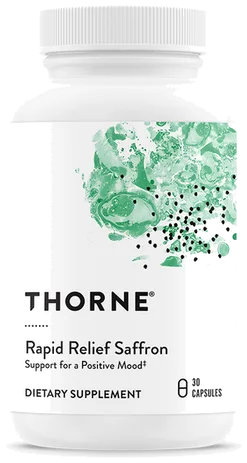
Thorne Research Rapid Relief Saffron Review
Thorne Rapid Relief Saffron is a stress response supplement in capsule form, presented as a fast-acting option for people who want support for a calm, balanced response to stress. The product page describes everyday pressures that affect mood, focus, sleep quality and daytime energy, and positions this capsule as a way to help a person stay composed, grounded and clear-headed during demanding moments. The formula centres on Safr'Inside™, a saffron extract from the stigma of the Crocus sativus flower. Each one capsule serving contains 30mg of this extract, and each container holds 30 servings. The page explains that saffron has a long history in traditional medicine, particularly for antioxidant benefits and support of a positive mood, and it names crocins and safranal as key bioactive compounds. The extract is described as clinically studied, patented and standardized to 0.2% safranal, which the brand calls the most essential compound for stress management and mood benefits. The page lists several claimed benefits, including fast-acting support for the body's response to stress starting in as little as 30 minutes, support for positive mood during periods of occasional depressed feelings, help with mental and emotional resilience, and support for healthy sleep architecture after about four weeks of daily use. It suggests the product may suit people seeking a natural approach to stress management, people dealing with everyday emotional ups and downs, women experiencing mood changes linked to hormone fluctuation, and people in high-pressure roles or studies. The timeline given is 30 minutes for a relaxing stress response, about 15 days for more optimism, and about 30 days for sleep quality improvements. The warnings state that the product is contraindicated for anyone with a history of hypersensitivity to its ingredients, and that pregnant or nursing women, women trying to conceive, and children should not use it. The page reports no known adverse interactions at publication. Thorne states that the product has been third-party tested to confirm that the contents match the label and contain no unsafe levels of contaminants such as heavy metals, pesticides and microorganisms.
We don’t sell supplements. We help you make decisions and get the best price.
Lowest prices
We may earn a commission from some store links. How we choose.
Finding the lowest prices at the stores now. This takes a few seconds.
Study, Trial or Testing Result Summary
Members Only66 human studies · 46 improved
This product gives 30 mg of saffron extract a day, a full dose, slightly above the 28 mg that worked in studies. Saffron has strong human evidence for mood. A large pooled analysis of 192 trials with 17,437 people with depression found saffron improved depression scores [1]. Another pooled analysis of 46 trials found saffron improved depression, anxiety and sleep more than placebo, about as well as standard drugs, with few side effects [2]. In a 12-week trial of 202 adults with low mood, 28 mg daily helped 72.3 percent meaningfully compared with 54.3 percent on placebo, though other measures showed no difference [3]. A six-week trial of 180 adults found less depression and anxiety and better sleep [4]. A four-week trial of 128 adults found better mood and less stress at 28 mg daily, while 22 mg did not help [5]. Some caution remains: a pooled analysis of 34 trials found people rated their own depression and anxiety as better, but scales scored by clinicians showed no clear effect [6], and another pooled analysis found no clear effect on anxiety alone. Animal and cell studies are never counted.
See all 66 studies →Hide the studies
- In a pooled analysis of 192 trials with 17,437 patients with depression, saffron on its own showed better depression scores than meds alone.Comparative efficacy and tolerability of nutraceuticals for depressive disorder: A systematic review and network meta-an…
- Across 52 trials with 4049 people, antioxidant supplements including crocin (a saffron compound) significantly reduced depression scores compared with controls, and anxiety also improved.Protective role of antioxidant supplementation for depression and anxiety: A meta-analysis of randomized clinical trials…
- In 34 placebo-controlled trials with 1769 adults taking saffron for at least four weeks, self-rated depression and anxiety scores fell significantly, but clinician-rated scales showed no significant effect.Effect of saffron on depression, anxiety and mood disorder: a GRADE assessed systematic review and meta-analysis of 34 r…
- Pooling nine randomized trials in people with mild to moderate depression, saffron reduced depression severity significantly more than placebo and was about as effective as standard meds.The Efficacy of Saffron in the Treatment of Mild to Moderate Depression: A Meta-analysis.
- Pooling seven earlier meta-analyses, saffron lowered self-reported depression scores but not clinician-rated or mixed scores, so it should not be seen as a standalone treatment.Saffron, as an adjunct therapy, contributes to relieve depression symptoms: An umbrella meta-analysis.
- In a pooled analysis of 29 trials of herbs for anxiety, saffron did not significantly reduce anxiety scores, though the authors said it merits further study.Medicinal herbs for the treatment of anxiety: A systematic review and network meta-analysis.
- Across 46 trials lasting 4 to 48 weeks, saffron improved depression, anxiety, sleep and cognition more than placebo and was about as effective as conventional drugs with few side effects.New horizons for the study of saffron (Crocus sativus L.) and its active ingredients in the management of neurological a…
- In trials comparing saffron with a med drugs (meds), saffron worked about the same for depression and anxiety symptoms and caused fewer side effects.Read the study on PubMed (38913392) →
- A review of six double-blind trials found saffron had large effects against placebo and worked about as well as a med medicines for mild-to-moderate depression.Read the study on PubMed (25384672) →
- A review of 100 trials of single herbs found saffron, among the most studied herbs, gave benefits for anxiety and depression comparable to standard medications, but larger trials are still needed.Herbal medicine for depression and anxiety: A systematic review with assessment of potential psycho-oncologic relevance.
- This review of plant-based adaptogens found saffron, with St. John's Wort, to be among the best-supported options for depression and supported its use as a non-drug approach.Adaptogens on Depression-Related Outcomes: A Systematic Integrative Review and Rationale of Synergism with Physical Acti…
- A review of 13 trials and one meta-analysis found saffron stigma, along with lavender, St John's wort and turmeric, eased depression symptoms, and herbal use was linked to lower inflammatory markers and better mood.Phytochemicals in the treatment of patients with depression: a systemic review.
- A review of 19 saffron studies found that 15 to 30 mg a day of standardized extract helped depression, anxiety and sleep, with good safety but evidence of moderate certainty at best.Efficacy and Safety of Saffron and Ashwagandha for Stress-Related Mental Health Outcomes: A Systematic Review of Randomi…
- In 202 adults with low mood, 28 mg of saffron extract daily for 12 weeks reduced depression scores more than placebo, with 72.3% of the saffron group improving meaningfully versus 54.3% on placebo, though other measures showed no difference.An Examination into the Effects of a Saffron Extract (Affron) on Mood and General Wellbeing in Adults Experiencing Low M…
- In 180 adults with mild to moderate depressive symptoms, a saffron extract taken for six weeks reduced depression and anxiety symptoms and improved sleep quality compared with placebo.The Effects of Combined Scutellaria and Saffron Supplementation on Mood Regulation in Participants with Mild-to-Moderate…
- In 139 adults with persistent depression taking meds, 28 mg per day of saffron extract for 8 weeks reduced clinician-rated depression scores more than placebo, but self-rated scores did not differ from placebo.Read the study on PubMed (31475623) →
- In 128 adults with low mood but no depression diagnosis, 28 mg per day of a saffron extract for 4 weeks improved mood and reduced stress and anxiety more than placebo, with no side effects; 22 mg per day showed no effect.affron® a novel saffron extract (Crocus sativus L.) improves mood in healthy adults over 4 weeks in a double-blind, para…
- In 123 adults with major depression, a combined saffron (15 mg twice daily) and curcumin capsule for 12 weeks reduced depressive symptoms and anxiety more than placebo, though curcumin alone at either dose was not separately tested against the combination.Efficacy of curcumin, and a saffron/curcumin combination for the treatment of major depression: A randomised, double-bli…
- In 120 adults with poor sleep, 28 days of Affron saffron extract taken before bed improved sleep quality and mood ratings on waking compared with placebo.An investigation into an evening intake of a saffron extract (affron®) on sleep quality, cortisol, and melatonin concent…
- In 92 people with Parkinson's disease, 100 mg per day of saffron powder for 12 weeks lowered C-reactive protein and improved anxiety, depression, distress, sleep and fatigue more than placebo, with no side effects.The effect of saffron supplementation on indices of oxidative stress, inflammation, mental health, and quality of life i…
- In 86 perimenopausal women, 14 mg of saffron extract taken twice daily for 12 weeks reduced anxiety and depression scores more than placebo and was well tolerated.The Effects of a Saffron Extract (affron®) on Menopausal Symptoms in Women during Perimenopause: A Randomised, Double-Bl…
- In 86 women aged 50 to 70 with low mood and poor sleep, 28 mg of saffron extract daily for 12 weeks reduced depressive symptoms more than placebo, and 48.8 percent of women taking saffron had a clinically meaningful drop in symptoms versus 25.6 percent on placebo.The effects of a saffron extract (Affron®) on mood, sleep, self-esteem, and exploratory measures of physical appearance …
- In 80 teenagers aged 12 to 16 with mild to moderate anxiety or depression, 28 mg of affron saffron extract daily for 8 weeks reduced symptoms more than placebo according to the teens, but parents did not consistently confirm this.affron®, a standardised extract from saffron (Crocus sativus L.) for the treatment of youth anxiety and depressive sympt…
- In a 12-week randomized trial of 80 women with multiple sclerosis, saffron alone and saffron with corrective exercise both reduced depression more than the control group, and the combination worked best.The effect of saffron and corrective exercises on depression and quality of life in women with multiple sclerosis: A ran…
- In 73 overweight women with mild to moderate depression, 30 mg of saffron daily for 12 weeks lowered depression scores more than placebo, though it did not reduce food cravings.A placebo controlled randomized clinical trial of Crocus sativus L. (saffron) on depression and food craving among overw…
- In 72 breast cancer patients receiving chemotherapy, 30 mg of crocin daily reduced anxiety and depression, while placebo patients' scores rose.Amelioration of anxiety, depression, and chemotherapy related toxicity after crocin administration during chemotherapy o…
- In 72 people recovering from a med use, 30 mg of Krocina daily for 6 weeks did not reduce depression, anxiety, stress, withdrawal or craving more than placebo.The Effect of Krocina™ on Decreasing Substance User Withdrawal Syndrome, Craving, Depression and Stress: A Double-Blind …
- In 70 overweight adults with type 2 diabetes, 100 mg of saffron daily for 8 weeks improved depression scores and overall quality of life, and sleep quality improved more than with placebo.Saffron improves life and sleep quality, glycaemic status, lipid profile and liver function in diabetic patients: A doub…
- In 66 adults with depression and anxiety, 30 mg of saffron daily for 6 weeks improved depression and anxiety scores as much as the drug citalopram, with similar side effects.Crocus sativus L. versus Citalopram in the Treatment of Major Depressive Disorder with Anxious Distress: A Double-Blind,…
- In 66 adults with mild to moderate sleep problems linked to anxiety, 15.5 mg per day of saffron extract for 6 weeks improved sleep quality and ease of falling asleep, while placebo did not.Effects of Saffron Extract on Sleep Quality: A Randomized Double-Blind Controlled Clinical Trial.
- In a 12-week double-blind trial of 64 women with mild to moderate postpartum depression, crocin 15 mg per day cut depression and anxiety scores substantially, about as much as a med 50 mg per day, with no severe side effects.Read the study on PubMed (36473029) →
- In 62 recreationally active adults, 28 mg per day of saffron extract for 6 weeks did not change mood compared with placebo overall, though men showed greater gains in exercise enjoyment and heart rate variability.An examination into the mental and physical effects of a saffron extract (affron®) in recreationally-active adults: A ra…
- In 60 adults with anxiety and depression, 50 mg saffron capsules taken twice daily for 12 weeks improved depression and anxiety scores significantly more than placebo.A double-blind, randomized and placebo-controlled trial of Saffron (Crocus sativus L.) in the treatment of anxiety and d…
- In 60 new mothers with mild to moderate postpartum depression, 30 mg of saffron per day for 8 weeks reduced depression scores more than placebo, with 96% of the saffron group in remission versus 43% of the placebo group.A double-blind, randomized, placebo-controlled trial of saffron stigma (Crocus sativus L.) in mothers suffering from mil…
- In 60 postmenopausal women with hot flashes and depression, 30 mg of saffron daily for 6 weeks reduced depressive symptoms and hot flash interference more than placebo, with no significant difference in side effects.Efficacy of Crocus sativus (saffron) in treatment of major depressive disorder associated with post-menopausal hot flash…
- In 56 people with chronic schizophrenia taking risperidone, adding 30 mg of saffron daily for 8 weeks reduced negative symptoms more than placebo, with no more side effects.Crocus sativus (saffron) adjunct to risperidone for negative symptoms of schizophrenia: a randomized, double-blind, plac…
- In 53 people on methadone maintenance, 8 weeks of crocin lowered depression and anxiety scores more than placebo, and also reduced inflammation and oxidative stress markers.Clinical and metabolic responses to crocin in patients under methadone maintenance treatment: A randomized clinical tria…
- In 51 healthy adults with subclinical low mood, fatigue and anxiety, 6 weeks of saffron extract did not improve the combined symptom score compared with placebo, but it did raise self-rated mental health scores.Effect of saffron extract supplementation on mood in healthy adults with subclinical symptoms of depression: a randomize…
- In 50 people on methadone maintenance, 30 mg of crocin daily for 8 weeks reduced depression, anxiety, poor sleep and general distress more than placebo.The effects of crocin on psychological parameters in patients under methadone maintenance treatment: a randomized clinic…
- In 50 older adults with major depression, 60 mg of saffron daily for six weeks worked about as well as the prescription a med a med, and both reduced depression symptoms.Read the study on PubMed (31669837) →
- In a 4-week pilot trial of 50 adults with mild to moderate depression, a saffron and chamomile tea (about 2 mg saffron per day) lowered depression scores and improved cholesterol more than usual care alone.Co-administration of saffron and chamomile: to determine the efficacy as an adjuvant therapy for mild to moderate depres…
- In 50 smokers, 30 mg of crocin per day for 3 months did not change nicotine dependence, anxiety, or depression scores compared with placebo, but it lowered fasting blood sugar, insulin, insulin resistance, and the inflammation marker hs-CRP.Oral supplementation with crocin (a constituent of saffron) in subjects with cigarette smoking: a clinical trial.
- In an 8-week placebo-controlled trial of 50 people with multiple sclerosis, crocin 30 mg per day lowered the inflammation marker hs-CRP and reduced anxiety within the group, but did not significantly improve overall mental health.Effects of crocin on inflammatory biomarkers and mental health status in patients with multiple sclerosis: A randomized,…
- In an 8-week triple-blind trial of 50 women with sexual dysfunction, saffron of 30 mg per day taken with vitamin E lowered depression scores more than placebo at 4 and 8 weeks, and also improved sexual function.Effect of vitamin E with and without saffron on the sexual function in women of reproductive age with sexual dysfunction…
- In 41 women with depression taking a med who had sexual side effects, an herbal blend containing saffron for 8 weeks improved sexual function, depression and anxiety more than placebo.Read the study on PubMed (37763782) →
- In a 6-week randomized pilot trial of 40 adults with mild to moderate depression, saffron extract at 30 mg per day worked about as well as a med 20 mg per day, with no significant difference in side effects.Read the study on PubMed (15707766) →
- In 40 adults with mild to moderate depression, 30 mg per day of saffron stigma for 6 weeks improved depression scores more than placebo.Crocus sativus L. in the treatment of mild to moderate depression: a double-blind, randomized and placebo-controlled tri…
- In 40 adults with mild to moderate depression, 30 mg per day of saffron petal for 6 weeks improved depression scores more than placebo.Crocus sativus L. (petal) in the treatment of mild-to-moderate depression: a double-blind, randomized and placebo-contro…
- In a pilot randomized trial of 40 adults with major depression, a petal extract of saffron at 30 mg per day for 8 weeks improved depression about as well as a med 20 mg per day, with similar side effects and a 25% remission rate in both groups.Read the study on PubMed (17174460) →
- In 40 patients with mild to moderate depression after heart stent procedures, 30 mg of saffron per day for 6 weeks worked about as well as 40 mg of a med and caused no more side effects.Read the study on PubMed (24289892) →
- In 40 adults with major depression already taking a med, adding 30 mg of crocin per day for 4 weeks improved depression, anxiety, and general health scores more than adding placebo.Crocin, the main active saffron constituent, as an adjunctive treatment in major depressive disorder: a randomized, doub…
- In 40 people with major depression taking a med for 4 weeks, adding saffron did not reduce depression more than adding a placebo, and it did not lower cholesterol.Study the effects of saffron on depression and lipid profiles: A double blind comparative study.
- In 34 adults with metabolic syndrome, 30 mg per day of crocin for 8 weeks reduced depressive symptoms significantly more than placebo.The effects of crocin on the symptoms of depression in subjects with metabolic syndrome.
- In a 6-week randomized pilot trial of 30 adults with mild to moderate depression, saffron at 30 mg per day was about as effective as imipramine 100 mg per day, and imipramine caused more dry mouth and sedation.Comparison of Crocus sativus L. and imipramine in the treatment of mild to moderate depression: a pilot double-blind ran…
- In 30 older adults with cognitive decline, a multi-ingredient supplement containing saffron for 2 months improved memory test scores and perceived stress more than the comparison arm, while depression scores improved in both groups without a clear difference.Short-Term Impact of a Combined Nutraceutical on Cognitive Function, Perceived Stress and Depression in Young Elderly wi…
- In 28 untrained young men doing resistance training for 6 weeks, taking 150 mg of saffron daily produced larger rises in happiness scores than training with a placebo pill.Impact of saffron (Crocus Sativus Linn) supplementation and resistance training on markers implicated in depression and …
- In women with premenstrual syndrome, 30 mg of saffron per day taken over two menstrual cycles eased symptoms more than placebo, including lower depression scores on the Hamilton scale.Crocus sativus L. (saffron) in the treatment of premenstrual syndrome: a double-blind, randomised and placebo-controlled…
- In women with mild to moderate postpartum depression, 15 mg of saffron twice daily for 6 weeks gave results similar to a med, with similar side effects, though the trial was small.Read the study on PubMed (27595298) →
- In patients recovering from bypass heart surgery, 30 mg of saffron per day for 12 weeks did not improve memory, thinking, anxiety, or depression scores compared with placebo.Effects of Saffron on Cognition, Anxiety, and Depression in Patients Undergoing Coronary Artery Bypass Grafting: A Rando…
- In a randomized study of an oral and topical botanical product containing saffron among other ingredients, the oral group had better sleep quality and lower facial pigmentation after 8 weeks, while total mood disturbance rose in all groups; the study ran during the COVID pandemic, which may have confounded the mood results.Combining Topical and Oral Botanicals for Skin Redness, Pigmentation, Sleep, and Mood: A Randomized Controlled Study.
- In patients with esophageal cancer receiving chemoradiation, 30 mg of crocin daily was tested against placebo for depression and anxiety, but the abstract does not report those mood results.Randomized, Double-Blind, Placebo-Controlled Clinical Trial of Concurrent Use of Crocin During Chemoradiation for Esopha…
- In a small pilot of people with depression, adding saffron extract to usual treatment for 8 weeks improved depression and reduced anhedonia (loss of pleasure) more than placebo.Therapeutic Potential of Saffron Extract in Mild Depression: A Study of Its Role on Anhedonia in Rats and Humans.
- In 72 postmenopausal women, one cup of saffron tea daily made happiness scores rise significantly more than in the control group, and the study reported reduced depression.The effect of Crocus sativus L. (saffron) herbal tea on happiness in postmenopausal women: a randomized controlled trial…
- In 57 people recovering from methamphetamine use who live with HIV, 30 ml of saffron per day for 8 weeks reduced depression more than placebo.The Effect of Saffron on Depression among Recovered Consumers of Methamphetamine Living with HIV/AIDS.
- In 46 women with mild to moderate anxiety, a daily saffron, ashwagandha, tryptophan and vitamin B6 supplement for 12 weeks lowered anxiety scores without a control group, though lockdown during the study may have affected results.Effectiveness of a Saffron and Withania Supplement on Mood in Women With Mild-to-Moderate Anxiety During the COVID-19 Lo…
- In 156 menopausal women, a multi-ingredient product containing 0.6 mg saffron extract daily for 12 weeks reduced depressive mood by 45 percent on a symptom rating scale, though there was no placebo group.Improvement in menopausal symptoms with a nutritional product containing evening primrose oil, hop extract, saffron, try…
Review Totals and Summary
Members Only7 reviews · 85% positive
Buyers of Thorne Research Rapid Relief Saffron capsules are mostly positive, describing a mild calming effect, though one is unsure it does anything. Across the stores it carries about 7 ratings, so this is a small sample. **What buyers say it did for them:** Most describe a gentle calming effect. One person with high anxiety was "pleasantly surprised to find that this actually helped" and called it "one of the few products that does what it says." Another says it "just takes the edge off without any negative consequences." A buyer of over two months noticed a benefit "just a few days after my first dose" and still finds it helpful. A store summary also notes a verified reviewer who picked "Fast-acting" as the standout and said "Works for me!" **What they complain about:** There is little criticism. The only doubt comes from one buyer who wrote, "It is not clear to me if it is doing anything," and plans to try another month. The store summaries report no complaints about side effects, taste, capsule size or delivery. One store's sub-ratings gave effectiveness 4.0 out of 5, a little lower than ease of use and ingredients at 5.0, though the overall rating there was 5 stars. **Taste, smell, pill size or form:** None of the reviews comment on taste, smell or capsule size. The store summaries confirm that nobody raised these as problems, so there is nothing to report either way. **Value for money:** One buyer calls it a "Good supplement at a great price," and the store summary treats cost as a strength. This is the only price comment, and the other store's page has none. **Who it seems to suit and who it did not:** It seems to suit people looking for a subtle, non-dramatic calming effect, including one who describes high anxiety and one reviewer aged 60 or older. Several seem to have felt something within days, while others may need weeks. The one buyer who did not feel a clear effect was still deciding, so no one reports it clearly failing. The store summaries suggest that people who keep taking it for a few weeks tend to notice a change and that a minority need longer to be convinced. They also caution that the evidence is thin and should be read as early impressions. **What was left out:** Only feedback on the capsules is covered here. The reviews and summaries did not include other forms, so nothing needed to be excluded.
Biohacker Summary
Members Only5 of 10 recommend it
Saffron is the only ingredient here, and most of the panel speaks well of it: four recommend it, one uses it, and two stay neutral. Most take it for mood, including low mood, anxiety and sadness, while several also take it for sleep, saying it helps people fall asleep, stay asleep and wake up refreshed. Doses come up a few times: one panelist suggests 20 to 30 mg to calm down and sleep, and cites 28 mg of a branded extract an hour before bed, while another points to 30 mg for anxiety. One prefers a tea made from a pinch of threads steeped for 10 minutes, and another uses a tincture. One neutral voice sees little value for otherwise healthy people and notes that the depression evidence, especially alongside meds, rests on limited studies that need repeating, and several mention that saffron is an expensive spice.
See all 7 biohackers →Hide the biohackers
Thomas DeLauer · Saffron · recommends
- Recommends saffron, noting its ability to improve sleep, lower depression, improve social functioning, and enhance heart rate variability during stress exposure by increasing synaptic serotonin and dopamine availability.
- Shifts towards saffron when cutting to keep their nervous system calm through the deficit.
- Recommends taking 20 to 30 mg of saffron to calm down and help sleep, noting it is an inexpensive spice/supplement that plays a big role in cortisol and overall ability to fall and stay asleep.
- Recommends saffron extract, specifically 28 mg taken an hour before bed, for improving sleep quality and mood by helping the brain produce its own natural melatonin in a normal amount, working with the circadian rhythm.
- Recommends Affron saffron, specifically a 28 mg dose taken one hour before bed, to improve sleep quality, mood upon waking, reduce insomnia, and increase natural evening melatonin production.
- Suggests adding 14 to 28 mg of saffron to the mix, noting it is powerful for sleep onset and total sleep.
- Recommends saffron as a runner-up for a bad mood, suggesting 14 to 28 mg, citing literature on its ability to inhibit serotonin reuptake and provide a calming, cortisol-blunting effect.
- Recommends saffron for raising melatonin.
- Recommends 25 to 30 mg of saffron extract for improving sleep, noting it is a fast-acting compound.
- Recommends saffron as a literal spice that can be kept in the pantry, noting that it interacts with serotonin receptors, influences the GABAergic state, and acts as a free radical scavenger in the suprachiasmatic nucleus to improve diurnal rhythms and lower cortisol.
Dr. Eric Berg · Saffron · recommends
- Recommends saffron tea, made by steeping a small pinch of saffron threads in hot water for 10 minutes, to help with depression and elevate mood.
- Recommends saffron to enhance testosterone.
- Recommends saffron as a fantastic remedy for age-related macular degeneration, found to improve vision.
- Recommends saffron, an expensive spice, as it is considered an aphrodisiac that increases testosterone and libido.
- Recommends saffron, noting it is expensive but used to treat depression, can increase mood, and can increase fertility.
- Dr. Berg lists saffron as a common natural coloring agent that provides both color and measurable health-supporting properties.
Dave Asprey · Saffron · recommends
- Mentions that Dr. Amen pointed him to 28 randomized controlled trials showing saffron had the same results as meds for mood.
- Recommends saffron for mood, stating it has been on their list for years and works on both serotonin and dopamine pathways.
- Dave Asprey discusses saffron as one of the most underrated nootropics for mood and brain optimization.
- Uses saffron almost every day for its mood-stabilizing effects, noting it is also a favorite brain supplement of Daniel Amen.
- Dave Asprey discusses how future saffron cell technology may influence mood, stress, and cognitive health.
- Notes that saffron performs as well as a med drugs for some people and is good for mood stabilization and as a cognitive enhancer, making it one of his favorite nootropics.
- Suggests saffron extract as a more effective way to affect the anti-depressant system than methylene blue, noting it works as well as most meds.
- Dave Asprey mentions that supplements like saffron support pain relief and mood.
- States that saffron is their favorite supplement, which they never miss, because it has been found in 28 randomized controlled trials to be equally effective to meds by calming the search work and boosting mood.
- Recommends saffron for depression, stating that it works much more broadly than many pharmaceuticals.
Ben Greenfield · Saffron · neutral
- Notes that saffron is an ingredient in MTE.
- Uses ultrasonic extracted saffron tincture internally, especially during winter, finding it helps radiate inner light, lift mood, bring joy, and acts as a remedy for seasonal affective disorder by turning on his inner sun.
- Mentions saffron as having similar effects to ginseng for treating depression and anxiety.
- He recommends Saffron for low progesterone.
- Lists Saffron as a supplement for low progesterone.
Siim Land · Saffron · neutral
- States that saffron supplementation has been seen to be effective for depression symptoms, especially when combined with a med, but sees little value for otherwise healthy individuals.
- States that Saffron shows promise for mental health benefits, particularly depression symptoms when combined with a med, but sees little value for otherwise healthy individuals.
- Discusses Saffron as a supplement.
- Notes that a recent network meta-analysis found saffron plus a med had one of the highest benefits for depression, but cautions that this was driven by one study and more replication is needed.
- Mentions saffron as a recommendation for mood.
Andrew Huberman · Saffron · uses
- Mentions saffron as one of the clinically supported ingredients that can help you fall asleep, stay asleep, and wake up feeling more refreshed, and he has worked with AG1 to create a product that includes it.
- Mentions Saffron as a clinically supported ingredient that can help people fall asleep, stay asleep, and wake up feeling more refreshed.
- Mentions saffron as a supplement that some people find benefit from for anxiety, noting 12 studies indicate that orally ingested saffron at 30 mg is a reliable dose for reducing anxiety.
- States that saffron is a clinically supported ingredient that can help one fall asleep, stay asleep, and wake up feeling more refreshed.
- Mentions saffron as one of several clinically supported ingredients that can help people fall asleep, stay asleep, and wake up feeling more refreshed.
- Reviews supplementation with Saffron for its effects on anxiety and fear and when to take it, if at all.
- Notes that 12 studies show orally ingested Saffron at 30 milligrams to be a reliable dose for reducing anxiety, with significant anxiolytic effects in human subjects.
- Notes that saffron is a lesser-known but clinically supported ingredient that can help people fall asleep, stay asleep, and wake up feeling more refreshed.
- Discusses Saffron as a supplement for anxiety and fear.
- Huberman states that saffron is a clinically supported ingredient that can help with sleep, and he takes it as part of the AGZ formula.
Dr. Mark Hyman · Saffron · recommends
- Recommends saffron as a supplement to increase serotonin, noting its effectiveness for anxiety and sadness.
- Mentions saffron as one of many phytochemicals that influence the AMPK pathway and have similar benefits to a med.
- States that saffron is his favorite happy supplement, which he takes, and that it is equally effective as meds, and Imipramine in randomized controlled trials, but is pro-sexual and helps with memory.
- Dr. Mark Hyman's favorite happy supplement is saffron, which he has been following the science of for 20 years, noting its effectiveness against meds and its pro-sexual and memory-enhancing benefits.
- Recommends saffron, noting that while it's the most expensive spice, it's not that expensive as a supplement and can help in a positive way with anxiety or sadness.
- Notes that saffron is extremely healthy, particularly for the eyes.
- Recommends saffron, stating it is extremely healthy, particularly for the eyes.
RAL Summary
Members OnlyTier 4 for Mood
Human studies clearly support saffron for mood at the dose this product gives (46 of 66 studies improved, including a 202-person trial at 28 mg), but only 14 reviews exist, too few for a higher tier, so it stays at tier 4.
- Emerging: not enough evidence to rank higher yet.
Where the evidence disagrees: 10 of the 66 human studies found no effect.
More Details
Members OnlyBody systems · Combine with · Possible side effects
Body systems: Nervous system
Combine with: Saffron extract (typically 28-30 mg/day standardized for safranal and crocin) has clinical support for mild-to-moderate low mood and emotional balance, so this product fits the goal. It pairs well with omega-3 fatty acids (EPA-dominant fish oil), which have complementary evidence for mood support. Vitamin D3 (if levels are low), methylated B vitamins (folate as methylfolate, B12, B6) support neurotransmitter synthesis. Magnesium glycinate and L-theanine can add calm and stress resilience, while 5-HTP or SAMe are sometimes used for mood but should not be combined with serotonergic medications such as meds, meds, or MAOIs without clinician guidance. Saffron may also interact with meds and blood pressure or meds, and it should be avoided during pregnancy at supplemental doses, so check with a healthcare provider before stacking.
Possible side effects: Studies report few or no side effects with saffron, and reviews mention no side effect complaints.
Supplement Facts
Safr'Inside™ Saffron extract † 30 mg
| Safr'Inside™ Saffron extract (stigma) ( Crocus sativus )† | 30 mg | † |
Other ingredients: Microcrystalline Cellulose, Hypromellose (derived from cellulose) capsule, Calcium Laurate.
Directions: Take 1 capsule daily or as recommended by your health-care practitioner.
Barcode (UPC) 693749017455 · Label source: Reverseagelab · Report a label change
Show entire label

More mood products
Members OnlyThe highest ranked for the same goal
Read more
Our articles on this subject
- Supplements for Stress and Anxiety Relief: What the Evidence SupportsArticle · Oct 26, 2026
- Joe Rogan's Supplement Stack, Reviewed: What He Takes, What It Costs, and What the Evidence SupportsArticle · Sep 27, 2026
Graded November 5, 2026 by the Reverse Age Lab evidence engine, from human studies, real reviews and our biohacker panel. How we grade. Is this medical advice? No. Rala organizes the published evidence; go over any change with your doctor, especially if you take meds.
Privacy policyConsumer health dataAffiliate disclosureTermsDo Not Sell or Share My Personal InformationCookie settings