
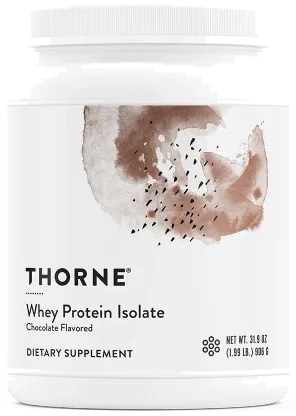
Thorne Whey Protein Isolate Chocolate Flavored Review
Thorne Whey Protein Isolate - Chocolate is presented as a great tasting, high-quality whey protein designed for athletes, aging individuals, and anyone who needs additional support for maintaining healthy muscle mass. The page headline reads 21 grams of bioavailable protein with flavors and sweeteners derived from natural sources, and the product is marked NSF Certified for Sport. Each serving is one scoop, the container holds 30 scoops, and the listed price is $65 for 30 scoops. Each scoop supplies 25 grams of Whey Protein Isolate along with 94 mg of calcium, 1 mg of iron, 30 mg of a bromelain and papain blend, 200 mg of potassium, and 105 mg of sodium. The page lists calcium, iron, bromelain and papain blend, potassium, sodium, and whey protein isolate as key ingredients, and states that the flavor is derived from cocoa and other natural flavors. The other ingredients listed are xanthan gum, alkalized cocoa powder, carboxymethylcellulose gum, evaporated cane juice sugar, chocolate flavor, and rebaudioside A from stevia. The same whey protein isolate is also sold in a Vanilla flavor, and this page sells the chocolate version. The frequently asked questions explain that whey protein isolate has higher protein content and lower fat and lactose content than whey protein concentrate, and that its additional purification may support better absorption and be easier to tolerate for people sensitive to lactose. The page says the formula includes added bromelain and papain, two natural enzymes derived from pineapple and papaya, which are included to aid digestion and protein assimilation. It states that the product provides all nine essential amino acids, making it a complete protein to support muscle protein synthesis and recovery. Thorne describes its testing approach as checking each ingredient for identity, purity, and potency, and screening finished products for contaminants such as heavy metals, pesticides, and harmful microbes. The NSF Certified for Sport mark is explained as indicating testing for compliance with label claims and the absence of nearly 300 substances banned by major athletic organizations. The warnings on the page include a California Proposition 65 notice about risk of reproductive harm from lead exposure, an allergy warning that the product contains an ingredient derived from milk, and advice that pregnant individuals consult a health-care practitioner before use. The page states there are no known adverse interactions or contraindications at the publication date. It also notes that results vary by individual and that supplements work gradually to support long-term health.
We don’t sell supplements. We help you make decisions and get the best price.
Lowest prices
We may earn a commission from some store links. How we choose.
Finding the lowest prices at the stores now. This takes a few seconds.
Products with nearly the same formula (Matched on the main ingredients)
Study, Trial or Testing Result Summary
Members Only33 human studies · 8 improved
3 of these 33 human studies gave the ingredient by drip, not by mouth.
This powder is mainly whey protein isolate, listed at 25 grams per scoop, but no studies on whey protein were provided, so its main ingredient could not be judged here. The studies we have cover only the small minerals in the label. Calcium alone did not build muscle. A two-year trial in 1434 children found no change in strength or jumping [1]. A 12-week trial in 66 teenage girls found no change in muscle performance [2]. Reviews found no muscle benefit from calcium itself [3][4]. Some mixed supplements that also held protein and creatine did increase lean mass, but calcium's own part could not be separated [5][6]. Iron here is a trace 1 milligram, far below the 325 milligrams that gave strength gains in volleyball players [7]. A larger trial found iron did not improve muscle mass or strength [8]. Potassium did not improve muscle strength, power or mass in two placebo-controlled trials in older adults [9][10]. The enzyme blend is hidden in a small 30 milligram blend and was not studied here. Animal and cell studies are never counted.
See all 33 studies →Hide the studies
- Across seven trials of 349 older people with weak bones and low muscle, strength training raised muscle mass, grip strength and protein intake, but calcium intake did not change significantly.Effects of Strength Training on Body Composition, Physical Performance, and Protein or Calcium Intake in Older People wi…
- In a review of nine reviews covering 128 studies, calcium supplements had only modest effects on bone mineral content and no muscle benefit was reported for calcium itself, though cheese and yogurt were linked to better grip strength.Nutrients and food supplements for the prevention of musculoskeletal diseases: an umbrella review.
- In a review of 45 mostly cross-sectional studies in older adults, no link was found between calcium and muscle mass, strength, physical performance or sarcopenia.Minerals and Sarcopenia in Older Adults: An Updated Systematic Review.
- A review of 10 mostly observational studies in older adults found one study linking higher iron intake with better physical performance, with no trial evidence for iron on muscle.Minerals and Sarcopenia; The Role of Calcium, Iron, Magnesium, Phosphorus, Potassium, Selenium, Sodium, and Zinc on Musc…
- In 1434 children aged 6 to 9, two years of an after-school program with 380 mg daily calcium-rich snacks and exercise raised bone stiffness in one group but did not change muscle strength or vertical jump.Beat osteoporosis - nourish and exercise skeletons (BONES): a group randomized controlled trial in children.
- In 244 men and women aged 50 and older, 3 months of potassium bicarbonate lowered bone turnover and calcium loss in urine but had no significant effect on muscle strength or function compared with placebo.Potassium Bicarbonate Supplementation Lowers Bone Turnover and Calcium Excretion in Older Men and Women: A Randomized Do…
- In 158 people with fibromyalgia and chronic fatigue, a diet and lifestyle program raised dietary iron and protein intake and improved muscle mass index, but iron was not given on its own.Effectiveness of the SYNCHRONIZE + Brief Intervention in Improving Mediterranean Diet Adherence, Nutritional Quality and…
- In 156 older women with low muscle mass, 1500 mg daily of calcium-HMB for 12 weeks did not add to the effects of resistance training on muscle quality compared with placebo.β-Hydroxy-β-Methylbutyrate Supplementation May Not Enhance Additional Effects of Exercise on Muscle Quality in Older Wom…
- In 148 men aged 70 and over with low testosterone, 20 weeks of calcium, vitamin D and protein with resistance training and testosterone improved chair stand performance versus no intervention, but calcium's own effect could not be separated.Beneficial effects of exercise, testosterone, vitamin D, calcium and protein in older men-A randomized clinical trial.
- In 148 iron-deficient kidney transplant recipients, four intravenous doses of 500 mg ferric carboxymaltose over 24 weeks did not improve walking distance, muscle mass or strength compared with placebo.Intravenous ferric carboxymaltose and exercise capacity in iron-deficient kidney transplant recipients: a randomised, pl…
- In 128 healthy adults aged 65 and older, 24 weeks of potassium bicarbonate did not improve muscle power, physical performance or muscle mass compared with placebo, though blood levels of a growth hormone marker (IGF-1) were higher.Independent effects of whey protein and alkali supplementation on muscle health in healthy older adults: factorial rando…
- In 105 older outpatients at risk of malnutrition, a nutrient-rich drink for 12 weeks raised calcium intake and increased muscle mass in women, but muscle strength and physical performance did not differ from standard care.The effect of 12-weeks Nutritional supplementation on Nutritional Intake and Status among Indonesian Older Outpatients w…
- In 92 iron-deficient surgery patients who all received intravenous iron, adding oral phosphate for 30 days made no difference to core muscle strength.Ferric carboxymaltose with or without phosphate substitution in iron deficiency or iron deficiency anemia before electiv…
- In 80 older women at risk of sarcopenia doing 32 weeks of training, lower dietary iron was linked with poorer sit-to-stand performance in the high-speed resistance group only, but iron was not given as a supplement.Nutritional intake as a determinant of high-speed resistance and multicomponent training efficacy on strength in older w…
- In 43 malnourished people with liver cirrhosis, 3 g a day of calcium HMB for 12 weeks did not change fat-free mass compared with the supplement without it, though handgrip strength trended upward.Randomized Clinical Trial: Effects of β-Hydroxy-β-Methylbutyrate (HMB)-Enriched vs. HMB-Free Oral Nutritional Supplement…
- In 40 young men doing 8 weeks of resistance training, calcium HMB did not improve muscle thickness, strength or power more than placebo.Leucine Metabolites Do Not Enhance Training-induced Performance or Muscle Thickness.
- In 40 resistance-trained young men over 8 weeks of training, calcium HMB did not reduce training-related inflammation or change muscle thickness or strength compared with placebo.Leucine metabolites do not attenuate training-induced inflammation in young resistance trained men.
- In 26 healthy young adults doing 10 weeks of resistance training, a supplement with whey protein, leucine, creatine, calcium citrate and vitamin D twice daily increased lean body mass more than placebo (+4.1 vs +2.8 kg), but calcium's own effect cannot be separated.The Effect of a Multi-ingredient Supplement on Resistance Training-induced Adaptations.
- Over 10 weeks of resistance training, a multi-ingredient supplement containing calcium citrate increased the size of fast muscle fibers more than a collagen control, though calcium's effect could not be separated from the other ingredients.The Effect of Multi-Ingredient Protein versus Collagen Supplementation on Satellite Cell Properties in Males and Females…
- In 24 older adults, a single dose of 3 g calcium beta-hydroxy-beta-methylbutyrate added to 40 g whey boosted muscle protein synthesis in older women and reduced muscle protein breakdown, but the effect was not seen in men.The Effect of β-Hydroxy-β-Methyl Butyrate (HMB) upon Acute Fed-State Muscle Protein Turnover in Older Men and Women: A R…
- In 22 elite female volleyball players, 325 mg of ferrous sulphate daily for 11 weeks prevented a drop in iron levels and gave greater strength gains than no iron (total mean strength +26.2% vs +10.9%).Iron supplementation prevents a decline in iron stores and enhances strength performance in elite female volleyball play…
- In 21 children with kidney disease and mild anemia, 12 weeks of iron sulfate made no significant difference in muscle mass or grip strength compared with no iron.Pilot pragmatic clinical trial of iron therapy in children with anemia of chronic kidney disease (FeTCh-CKD).
- In 12 male weight trainers, a single dose of potassium-magnesium aspartate taken before a resistance workout did not lower blood ammonia or improve bench press performance to failure compared with vitamin C.Effect of acute potassium-magnesium aspartate supplementation on ammonia concentrations during and after resistance trai…
- In people with sarcopenia given iron (sodium ferrous citrate, 29 or 57 mg) plus 5-aminolevulinic acid for 12 weeks, muscle mass index did not differ from placebo, but hand grip strength increased or tended to increase, with no consistent changes in other measures.Efficacy and Safety of 5-Aminolevulinic Acid Combined with Iron on Skeletal Muscle Mass Index and Physical Performance o…
- In 66 adolescent girls, about 1300 mg daily calcium from milk for 12 weeks did not change body composition or muscle performance, though resistance training did improve them and milk with training improved bone density.Resistance Training and Milk-Substitution Enhance Body Composition and Bone Health in Adolescent Girls.
- In 30 people with rheumatoid arthritis and anemia, treatment with erythropoietin plus intravenous iron sucrose (given weekly when iron was low) raised hemoglobin and muscle strength and lowered fatigue, though there was no control group.Effect of recombinant human erythropoietin and intravenous iron on anemia and disease activity in rheumatoid arthritis.
- In 23 young women with iron deficiency anemia, 8 weeks of 160 mg daily iron as ferrous sulfate improved muscle endurance but not muscle strength or aerobic fitness, in an uncontrolled study without a placebo group.Efficacy of 8-week oral iron supplementation on fatigue and physical capacity in young women with iron deficiency anemia…
- In a large UK Biobank cross-sectional study of about 68,000 adults averaging 64 years old, higher dietary iron intake was linked to stronger handgrip in women, though this study cannot show that iron causes the difference.Associations between diet and handgrip strength: a cross-sectional study from UK Biobank.
- In a cross-sectional study of 425 adults eating omnivore, lacto-ovo vegetarian or vegan diets, those taking iron supplements had a lower percentage of muscle mass and higher C-reactive protein, an inflammation marker. This is an association and does not prove iron caused the difference.The Relevance of Plant-Based Diets and Micronutrient Supplementation for Body Composition: Data from the VeggieNutri Cro…
- In 392 adults with knee osteoarthritis, higher dietary potassium intake was linked to greater lower limb muscle strength over 24 months.Associations of Dietary Macroelements with Knee Joint Structures, Symptoms, Quality of Life, and Comorbid Conditions in …
- In 233 Vietnamese women who had immigrated to South Korea, iron intake and skeletal muscle mass both decreased between baseline and follow-up. The study did not isolate iron's effect on muscle.Dietary changes in Vietnamese marriage immigrant women: The KoGES follow-up study.
- In 53 Chinese men and women aged 18 to 35, calcium intake was similar across age and sex groups, and the study found only correlations between bone, body composition, and muscle strength, with no intervention tested.Muscle-Bone Interactions in Chinese Men and Women Aged 18-35 Years.
- Six volunteers training intensely in a hot climate on a daily potassium intake of 100 mEq ended up with a mean potassium deficit of 517 mEq, mostly from sweating, while lean body mass rose.Pathophysiology of intense physical conditioning in a hot climate. I. Mechanisms of potassium depletion.
Review Totals and Summary
Members Only2,646 reviews · 100% positive
Overall, Thorne Whey Protein Isolate in chocolate gets a mostly positive response, with about 11 ratings across the stores that sell it. Buyers like the taste, mixing and ingredient quality, while price and one report of chalkiness are the main reservations. **What buyers say it did for them:** Most use it to top up daily protein, and a few say it fits easily into their routine. One reviewer says it "helps me when I need to add extra protein" in the day. Another calls it "very effective for my overall protein needs." One finds the whey isolate easy to digest, according to the store summary. **What they complain about:** The complaints are few. One reviewer says the powder "tastes chalky" and that the "taste is not great," even though the ingredients and protein quality are good. The same reviewer calls it "pretty expensive." No other problems are reported, and nothing in the reviews mentions digestion trouble or mixing trouble. **Taste, smell and form:** Taste draws the most praise. Reviewers describe "a fabulous rich chocolate taste" and a flavor "without being overly sweet or artificial." Another says it is "very light" and tasty, and one notes it is "not so sweet." Mixing is also praised: it blends easily with water or milk, with "no clumps or chalky texture" according to one buyer. The individual packets are a selling point for travel and gym bags. One reviewer finds the sachets less messy than a tub, with no loose powder on the countertop. Taste is not unanimous, though, because of the one chalky report. **Value for money:** Price is the weak spot. One reviewer calls the powder expensive, and another says the sachets cost more than Thorne's tub containers. That second reviewer still rates the sachets "the best" for being less messy. One buyer who traveled with the packets plans to repurchase in the large size next time, which suggests the tub may be the cheaper way to buy it. **Who it suits and who it did not:** It seems to suit people who care about clean, high-quality ingredients and want a chocolate powder that is not too sweet. It also suits travelers and gym-goers who want single-serve packets, and people who want an easy mixer. Several reviewers say they will buy it again. It seems less suited to anyone on a tight budget, or to someone who is sensitive to chalky textures, since one buyer found it that way. Those who dislike the extra cost of sachets may prefer the tub. Reviews of other forms of this product were left out, and this summary covers the powder only.
Biohacker Summary
Members Only10 of 10 recommend it
The panel's main ingredient here covers several minerals, and potassium drew the most attention: four of the ten uses or recommends it, mostly through sugar free electrolyte drinks taken first thing in the morning and during workouts, for hydration and exercise performance. Others recommend getting more from foods like bananas and potatoes, and one gave a daily need of 4,700 milligrams and linked low intake to cramps, tiredness and higher blood pressure. Iron was mixed: some recommend testing and supplementing for women who are deficient, one reported less soreness in training after starting it, one took 10 milligrams of heme iron, and one stopped after years of supplements failed to raise his levels, while two warned that excess iron or assuming anemia means low iron can mislead. Calcium came up for bone health, with a suggested 1,000 to 1,200 milligrams a day and calcium carbonate or calcium citrate as supplement forms, though several panelists only mentioned it as a common dietary gap.
See all 10 biohackers →Hide the biohackers
Dr. Eric Berg · Iron · neutral
- Identifies iron as the Achilles' heel of cancer, as it is needed for its DNA to replicate.
- States that people need more potassium than any other mineral, yet most people aren’t getting enough.
- Explains that potassium is essential for peristalsis, the pumping action through the colon, and without it, things can sit there, leading to constipation.
- Explains that the normal requirements for potassium are 4,700 mg every single day, and that very few people get half of that amount. They describe potassium's role in the sodium potassium pump, which is essential for cellular electricity, muscle contraction, and heart function. Deficiency can lead to tiredness, muscle cramps, heart palpitations, or rising blood pressure.
- Recommends increasing potassium to restore balance and support healthy blood pressure.
- Warns that bone loss cannot be fixed with just calcium, as bone is primarily collagen with other essential minerals.
- States that potassium is the most important electrolyte and that most people are not getting enough of it, needing around 4,700 mg daily, or even more, to avoid issues like fatigue, muscle cramps, heart palpitations, high blood pressure, and fluid retention.
- Dr. Eric Berg states that potassium is essential for health, supporting healthy muscles, nerves, and heart function, but warns that getting too much, especially from supplements, can be dangerous.
- Dr. Eric Berg states that most people are getting nowhere near enough potassium to balance the amount of sodium they’re already eating, implying a recommendation for increased potassium intake.
- Explains that potassium relaxes blood vessels, keeps elasticity in arteries, lowers adrenaline, supports the sympathetic nervous system, protects the endothelial layer of arteries, increases nitric oxide, and keeps insulin receptors sensitive.
- Was very successful in practice using potassium for hypertension, noting that bodies need 4700 mg of potassium every single day.
- States that low potassium can lead to constipation because potassium controls the smooth muscles of the body, affecting the contraction and relaxation of muscles in the colon.
- Mentions that grass-fed liver has heme iron, the most bioavailable form of iron that prevents anemia.
- Dr. Berg warns that too much iron can be damaging to the body and advises focusing on food sources to avoid overconsumption.
Thomas DeLauer · Potassium · uses
- Uses Element's cans which contain 100 milligram potassium, finding that electrolytes help his workout performance.
- Uses Element's 100 mg potassium cans first thing in the morning to prime his day and help with workout performance.
- Compares iron content in spinach (2.7mg) and beef (2.6mg), but emphasizes that beef's heme iron absorbs at about 25%, while spinach's non-heme iron absorbs at 2-8%.
- Notes that milk contains 120mg of calcium, while sardines contain 351mg, highlighting a 3x difference.
- Recommends Element's ready-to-drink sparkling electrolyte drinks as a low or zero-calorie soda replacement that provides 1,000 milligrams of sodium, 200 milligrams of potassium, and 60 milligrams of magnesium.
- Uses Element Electrolytes for about eight years, noting they contain 1000 mg sodium, 200 mg potassium, and 60 mg magnesium, and help curb appetite without adding many calories.
- Recommends iron from meat, specifically red meat and beef liver, stating that it is a crucial part of the mechanistic triad for thyroid hormone function and is iron-dependent for iodine incorporation into thyroid hormone.
- Recommends getting calcium, along with vitamin D, zinc, and magnesium, from foods like sardines, as they are important for inflammatory pathways in the gut.
- Personally drinks Element's pink lemonade or sparkling drinks, which contain 1,000 mg sodium, 200 potassium, and 60 magnesium, to hydrate and feel satiated, curbing hunger without stopping the ghrelin response.
- Sometimes pivots to straight potassium supplementation when generally depleted.
- Uses Element ready-to-drinks as a perfect electrolyte blend to start his day, noting that they contain 500 mg of sodium, 100 mg of potassium, and 30 mg of magnesium, and are slightly carbonated.
- Mentions potassium as an important electrolyte but suggests there's another layer to performance beyond just focusing on it.
- Explains that eating sardines with their soft bones provides a serious hit of calcium, which is a perfect combination for bones and may contribute to satiety.
- States that potassium is important for hydration, skin repair, and fluid balance in the skin, and recommends countering sodium intake with potassium.
Ben Greenfield · Potassium · uses
- Says he is drinking LMNT, which contains sodium, potassium, and magnesium, and states that he actually drinks this stuff.
- Recommends Celtic Sea Salt's new electrolyte drink 'Hydrate' for replenishing electrolytes and trace minerals lost through sweat, noting it contains 70 naturally occurring trace minerals, magnesium, taurine, and potassium, with no added sugar, artificial colors, or synthetic ingredients.
- Recommends testing for and replenishing iron if levels are low, as it can affect the ability to maintain or preserve muscle, especially for those on GLP-1s.
- Notes that one can eat iron-rich foods or supplement with iron, but still feel exhausted if iron is not the missing piece, emphasizing that focusing on a single mineral in isolation can support a number on a lab test rather than the system itself.
- Is considering whether he needs a calcium supplement because lead can displace calcium in bones, affecting bone strength.
- Mentions iron as a common deficiency.
- Mentions calcium as a common deficiency.
- Recommends a nutritious diet including iron, as it is critical for brain development.
- Recommends adequate intake of calcium for bone strength.
- Is using calcium chloride mixed with PRP before injecting for the P-shot.
- Notes that the guidelines mention iron supplementation for infancy and early childhood.
- Started thinking about getting more heme-based iron in his diet after a podcast about reasons people feel fatigue.
- Warns that modern society has flipped the narrative on iron intake, leading people to consume excessive amounts (20-50 mg) through an iron-fortified diet, which the body cannot assimilate, leading to storage in tissues and disrupting iron physiology, contributing to aging.
- Advises people to stop taking calcium supplements as part of the Root Cause Protocol.
Dr. Mark Hyman · Iron · neutral
- Mentions iron as an existing biomarker that plays a role in mental health, which Function Health includes in their measurements.
- Warns that potassium bromate, a dough conditioner banned in the EU, UK, and Canada, is still allowed in U.S. bread.
- Notes that a woman patient had very low iron.
- States that they get the whole picture when it comes to iron, looking at ferritin, iron reserves, iron in the blood, iron saturation, and iron binding capacity to spot problems before full-blown anemia.
- States that potassium plays a critical role in nerve signaling and muscle contraction, especially in the heart, and low levels can lead to dangerous irregular heart rhythms.
- Notes that calcium is in bones but is also essential for nerves, muscles, and the heart, and low levels can affect muscle function and heart rhythm.
- Notes that meds flush out potassium.
- States that with potassium, water can fully cross the cell membrane and get inside where it's needed for intracellular hydration.
- States that green leafy vegetables are great sources of calcium.
- Mentions iron as an example of a common nutritional deficiency.
- Notes that many Americans are deficient in iron, which affects mood and brain function.
- Recommends testing Iron as a biomarker before training for fitness.
- Recommends using targeted electrolyte support, advising to look for products with meaningful amounts of sodium, potassium, and magnesium, low sugar content, and avoidance of artificial colors, flavors, and sweeteners.
- Warns that potassium bromate, a chemical dough conditioner, has been linked to cancer, oxidative stress, DNA damage, and reproductive harm in animal studies.
Siim Land · Iron · neutral
- Mentions that iron is a mineral necessary for making collagen.
- Lists potatoes and fruit as sources of Potassium.
- Lists dairy and sardines as sources of Calcium.
- States that excess iron promotes oxidative stress and inflammation, which increases heart disease risk.
- Notes that Boron reduces calcium/magnesium loss.
- Notes that bananas have potassium but there are at least 8 other foods with more potassium than bananas.
- States that potassium is the most abundant intracellular cation that helps to maintain intracellular fluid volume and that without it, one greatly increases the risk of hypertension, cardiovascular disease, diabetes, and stroke.
- Notes that iron deficiency is found in children with premature graying of hair and that some people get gray hair due to iron deficiency.
- Recommends a high calcium intake for bone health.
- Recommends ensuring sufficient iron intake, especially during pregnancy and early life, to prevent mental developmental and cognitive issues.
- States his iron level is 103 micrograms per deciliter, which he considers a good result, and advises that men should aim for lower iron levels to reduce the risk of heart disease and aging.
- Places iron in the 'junk tier', warning that high iron levels are associated with heart disease, mortality, and liver disease, and advises caution with supplementation, especially for men with high iron.
- Places calcium supplementation in the 'bad tier' due to its association with increased cardiovascular events, recommending dairy or bones as easier ways to get calcium, though it can be useful for postmenopausal women with low bone density.
- Warns that high iron levels are associated with increased risk of mortality and reduced lifespan, and that iron in excess is bad for maximum longevity. He states that iron levels slightly on the lower end, around 60 to 90 micrograms per deciliter, are associated with the lowest mortality risk, and that iron below 45 and above 145 micrograms per deciliter is associated with increased risk of mortality.
Peter Attia · Potassium · recommends
- States there is some evidence that increasing dietary potassium through potassium-rich foods like bananas and potatoes, rather than supplements, can lower blood pressure.
- Recommends calcium as one of the 'big three' micronutrients for bone health, suggesting a daily intake of 1,000 to 1,200 milligrams, which can be supplemented with calcium carbonate or calcium citrate.
- Explains that bone is 50 to 70% mineral, predominantly calcium, and that virtually all of the body's calcium is contained within bone, making bone important for calcium homeostasis.
- Recommends iron supplements for women of reproductive age who are iron deficient.
- Recommends calcium for bone health, stating that teenagers probably need about 1000 milligrams a day.
- Discusses bone acting as a reservoir for calcium and how resorption and formation release calcium into the blood when needed.
- Notes that deficiencies in certain vitamins and minerals, such as iron, can be a cause of hair loss in women.
- Delves into the crucial yet often overlooked topic of iron and iron deficiency.
- Explains that humans consume about 10 to 20 milligrams of iron per day, absorbing roughly 10% of that, which is 1 to 2 milligrams per day, perfectly offsetting the 1 to 2 milligrams lost daily.
- Peter emphasizes the importance of consuming an adequate amount of iron daily to prevent deficiency.
- Notes that bone is 50 to 70 percent mineral, with calcium being the predominant mineral, and virtually all of the body's calcium is contained within bone.
- Notes that evolutionary ancestors consumed much more potassium than modern humans and suggests adding it back to the diet, ideally through whole foods.
- Recommends getting about a gram of calcium a day from organic bone meal, which provides calcium hydroxyapatite, the form humans are meant to consume.
- Speculates that lower iron levels in women due to their menstrual cycle may offer a protective benefit against heart disease, citing data that metabolically deranged men benefit from therapeutic phlebotomy.
Andrew Huberman · Potassium · uses
- Uses Element, an electrolyte drink with sodium, magnesium, and potassium in correct ratios and no sugar, to ensure adequate hydration and electrolytes, especially when starting days fast or during physical exercise.
- States that Iron is one of the critical nutrients with the best evidence for cognitive function and reducing the risk of dementia.
- Uses Element, which contains potassium in the correct ratios, to ensure proper hydration and electrolyte intake for brain and body function.
- Mentions potassium as an electrolyte.
- Uses Element, an electrolyte drink with sodium, magnesium, and potassium in correct ratios and no sugar, to ensure adequate hydration and electrolytes, drinking it first thing in the morning and during physical exercise.
- Uses Element, an electrolyte drink with sodium, magnesium, and potassium in correct ratios and no sugar, to ensure he is hydrated and has sufficient electrolytes. He drinks it first thing in the morning and during physical exercise, especially on hot days.
- Uses Element, an electrolyte drink with sodium, magnesium, and potassium but no sugar, to ensure adequate hydration and electrolytes, especially when waking up and during exercise.
- Warns that excess iron will increase the number of senescent cells in the body, which accumulate as people get older and cause inflammation and cancer. He notes that people who are healthy and have a fairly vegetarian diet often have slightly low iron levels but super amounts of energy.
- Uses LMNT, an electrolyte drink with sodium, magnesium, and potassium in correct ratios and no sugar, to ensure adequate hydration and electrolytes for brain and body function, especially when starting his day fast or during physical exercise.
- Uses Element, which contains potassium, for proper hydration and electrolyte balance.
- Ensures adequate intake of sodium, magnesium, and potassium, which are vital electrolytes for the functioning of all body cells, especially neurons, by drinking Element.
- Uses Element, an electrolyte drink with sodium, magnesium, and potassium, to ensure adequate hydration and electrolytes for optimal brain and body function, especially when waking up and during physical exercise.
- Notes that about 50% of the population is iron deficient.
- Mentions that the podcast will review the role of iron in treating depression.
Bryan Johnson · Iron · stopped
- Has had low iron for 11 years and despite eating meat and trying all forms of iron supplementation at different times and sequences, none of it worked to raise his iron or ferritin levels.
- Had low iron for 11 years, with ferritin averaging 38 ng/mL, and has finally boosted it back to healthy levels.
- Recommends calcium as a mineral that, along with phosphorus, magnesium, and boron, is deposited to fortify the bone structure after the collagen scaffold is in place.
- Agrees that a little extra calcium is probably okay, especially for women, to really hit home for bone mineral density.
- Takes 10 milligrams of heme iron to get his iron levels up, as they are borderline.
- Recommends adequate Iron for hair health, noting it is in the Blueprint stack.
- Recommends prioritizing calcium intake for postmenopausal women to help maintain bone density and reduce the risk of osteoporosis.
- Bryan Johnson takes Calcium daily as part of his Longevity Mix, which supports healthy bones and teeth.
- Recommends potassium during the luteal phase to help reduce water retention and bloating.
Dr. Rhonda Patrick · Calcium · neutral
- Mentions that kale delivers calcium, a micronutrient many diets fall short on.
- Recommends getting enough potassium, noting that most people get too much sodium and not enough potassium.
- Recently found out he needed to get on an iron supplement and noticed he gets less sore in his training after taking it.
- Advises that menstruating women should ensure they are getting enough iron.
- Notes additional gaps in calcium.
- Warns that iron is not an innocuous supplement and should not be taken aggressively without proper testing, as it can be complicated and has significant downsides if levels are not understood.
- Reports that alcohol use disorder is associated with a 20-50% greater prevalence of Calcium deficiency.
- States that maintaining a high potassium intake is important for hypertension.
- Dr. Patrick explains that breast milk is incredibly low in iron, and by six months, infants can develop iron deficiency anemia, so pediatricians recommend introducing iron-rich complementary foods at that time.
- Rhonda discusses Dr. Lithgow's work on how excess dietary iron affects protein homeostasis in worms, noting that increased iron levels in the diet accelerated aging and the accumulation of insoluble proteins.
- Around 38% doesn't meet the requirement for calcium.
- Takes a calcium-magnesium pill because he believes people tend to be short of both and that the body cares about the ratio of these similar molecules.
- Recommends getting enough potassium from veggies, bananas, and fruit because the body cares about the sodium-potassium ratio.
- Dr. Patrick states that her smoothie, containing avocado and banana, has around 5,800 milligrams of potassium, which meets the adequate intake requirement for maintaining normal blood pressure and decreasing the risk of kidney stones.
Dave Asprey · Iron · warns
- Warns that if a doctor diagnoses anemia, one should not assume they just need more iron, as low hemoglobin doesn't always mean low iron and the issue can sometimes be how well the body is using iron.
- Notes that when energy intake is too low for training demand, nutrient intake often falls short, especially for iron, which is associated with impaired recovery.
- Notes that when energy intake is too low for training demand, nutrient intake often falls short, especially for calcium, which is associated with reduced bone health.
- Explains that calcium provides the raw material for bones, but it isn't a standalone input and needs a whole system to be effective.
- Notes that people take calcium for their bones.
- Warns that taking calcium without vitamin D, A, and K2 can lead to calcium going into tissues, causing bone spurs and other issues, and recommends a two-to-one ratio of calcium to magnesium.
- Recommends ensuring iron levels are good as it is a cofactor that can help thyroid function, especially with conversion issues.
- Recommends having more potassium during a fast to increase mineral intake.
- States that people who are salt-sensitive hypertensives usually need more potassium.
- Explains why electrolytes, especially sodium, potassium, and magnesium, are foundational for recovery.
- States that potassium is a really important electrolyte for everyone, but the demand is significantly higher for people with nervous system, immune system, and endocrine system dysregulation.
- Recommends taking calcium citrate during a high oxalate meal to bind the oxalate in the gut.
- Recommends using potassium citrate, if tolerated, to raise urinary citrate and block crystal formation.
- Notes that the potassium in the Vineia blood flow hydration product is from coconut water.
RAL Summary
Members OnlyTier 4 for Muscle and Strength
The ineffective grade rests on trace minerals (calcium, iron, potassium) instead of the main ingredient, 25 g of whey protein isolate, for which no studies were given. So it is graded Tier 4, as the studies disagree.
- Emerging: not enough evidence to rank higher yet.
Where the evidence disagrees: 19 of the 33 human studies found no effect.
More Details
Members OnlyBody systems · Combine with · Possible side effects
Body systems: Musculoskeletal system, Digestive system
Combine with: Whey protein isolate is a fast-digesting, leucine-rich complete protein that stimulates muscle protein synthesis, so it fits muscle building well. To enhance results, pair it with creatine monohydrate (3-5 g daily), which has strong evidence for increasing strength, lean mass, and training performance. Adding vitamin D3 with K2 supports muscle function and bone health, and magnesium glycinate aids recovery, sleep, and muscle relaxation. Omega-3 fish oil (EPA/DHA) may reduce exercise-related inflammation and support anabolic sensitivity, especially with age. Additional leucine or EAAs can help when total daily protein is low, and a digestive enzyme blend or probiotic may help those who experience bloating. Take the whey within about two hours after resistance training, or any time to meet daily protein targets of roughly 1.6-2.2 g/kg body weight, and combine it with progressive resistance training and sufficient calories and sleep.
Possible side effects: No major side effects reported; one buyer found the powder chalky.
Supplement Facts
Total Carbohydrates 4 g · Calcium 69 mg · Iron 1 mg
| Calories | 100 | |
| Total Fat | 1 g | |
| Cholesterol | 10 mg | |
| Total Carbohydrates | 4 g | |
| Protein | 21 g | |
| Calcium | 69 mg | |
| Iron | 1 mg | |
| Sodium | 105 mg | |
| Potassium | 200 mg | |
| Proprietary Blend | 30 mg | † |
Other ingredients: Whey Protein Isolate, alkalized Cocoa powder, Flavors, Sunflower Lecithin, Cane Juice Sugar, Evaporated, Stevia extract, Xanthan Gum, Carboxymethylcellulose Gum.
Directions: Suggested use: Mix 1 packet with at least 8 ounces of water, juice, or preferred beverage daily or as recommended by your health-care practitioner.
Barcode (UPC) 693749006381 · Label source: NIH label database · Report a label change
Show entire label

More muscle and strength products
Members OnlyThe highest ranked for the same goal
Read more
Our articles on this subject
Graded November 5, 2026 by the Reverse Age Lab evidence engine, from human studies, real reviews and our biohacker panel. How we grade. Is this medical advice? No. Rala organizes the published evidence; go over any change with your doctor, especially if you take meds.
Privacy policyConsumer health dataAffiliate disclosureTermsDo Not Sell or Share My Personal InformationCookie settings