
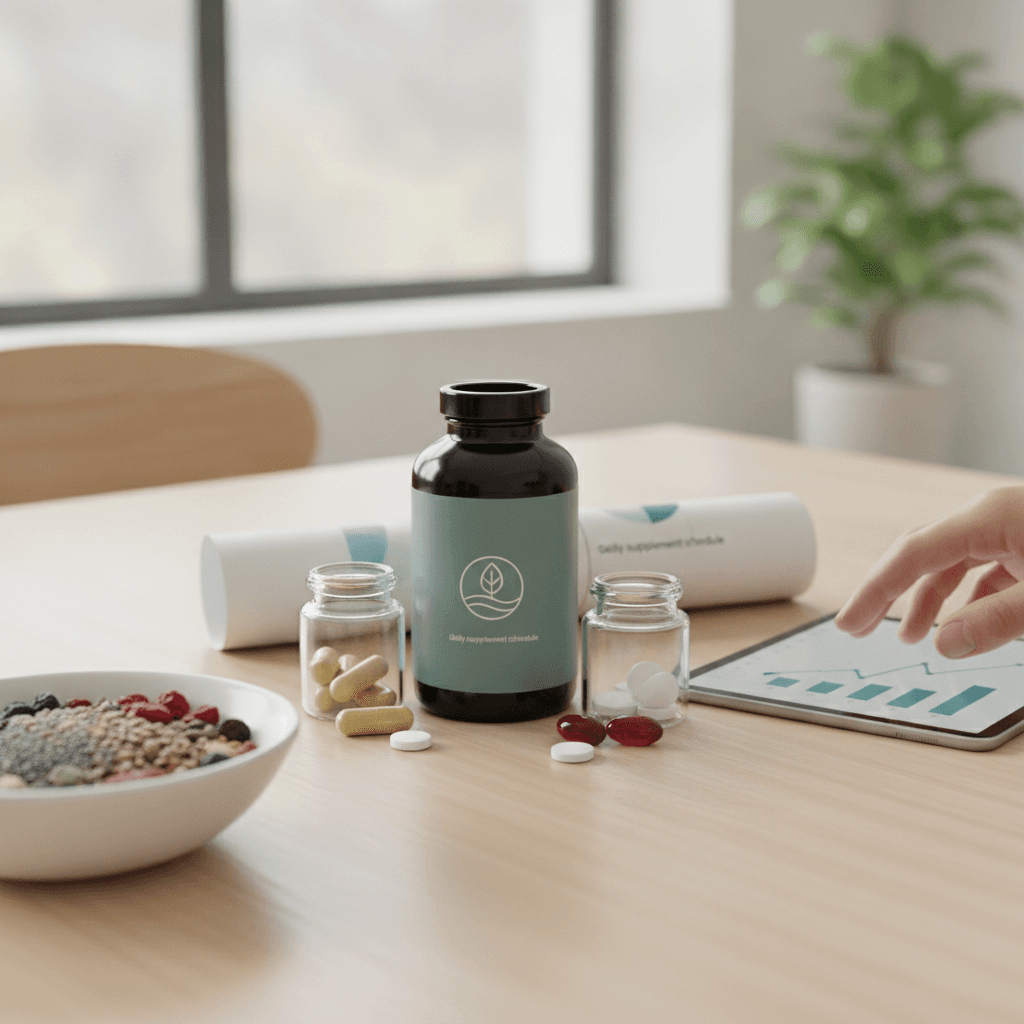
Walk into any pharmacy and you will find hundreds of daily health supplements, each promising more energy, better sleep, or a longer life. Most people end up with a cabinet full of half-used bottles and no real plan. A few supplements have genuine human evidence behind them, many do almost nothing, and the difference is rarely what the marketing tells you.
The short answer: a daily routine earns its place by filling a measured gap or supporting a specific goal. The basics with human evidence are vitamin D if you test low, omega-3 if you rarely eat fish, magnesium if you run short, creatine, and protein and fiber from food first. Skip hidden dose blends and mega doses. Test, change one thing, retest.
This is a practical, evidence-first guide to building a daily supplement routine that actually earns its place, without wasting money on hype. These are the best daily supplements, judged on human trials.
Key takeaways
A daily supplement earns its place by filling a measured gap or supporting a specific goal.
The best daily supplements with human evidence are vitamin D if you test low, omega-3 if you rarely eat fish, magnesium, creatine, plus protein and fiber from food first.
Skip hidden dose blends and mega dose formulas.
FDA testing found 776 supplements tainted with hidden drugs over nine years.
Test, change one thing, retest.
What Daily Health Supplements Should Actually Do
A supplement is meant to do exactly what the name says, supplement a solid diet rather than replace one. The realistic jobs of a daily routine are narrow and worth being clear about. A good supplement fills a genuine nutritional gap, supports a specific goal you have, or corrects a measured deficiency. That is it.
The bar that matters is human evidence. Plenty of compounds look promising in a petri dish or a mouse study and do nothing measurable in people. Throughout this guide the question is always the same, what holds up in human research, and for whom? It is a real bar: FDA testing found 776 supplements tainted with hidden drugs over nine years (Tucker et al., 2018). Our rules are on the methodology page.
Supplement | Who needs it | Evidence |
|---|---|---|
Vitamin D | Only if you test low | No benefit in adults who are not deficient |
Omega-3 (EPA and DHA) | If you rarely eat fatty fish | Modest reduction in cardiovascular events across 13 trials |
Magnesium | Common shortfall | Low intake linked to inflammation and metabolic disease |
Creatine | Most adults | Strength plus memory and processing speed benefits |
Protein and fiber | Almost everyone | Protein supports muscle with age; psyllium lowered LDL across 28 trials |
The best daily supplements with real human evidence
Most of the value in a daily routine comes from a handful of well-studied basics, not an exotic stack.
Vitamin D
Vitamin D deficiency is common, especially for people who spend most of their time indoors or live in northern climates. When you are genuinely low, supplementing supports bone health, immune function, and overall wellbeing. The key word is low, since this is a supplement worth taking if a blood test shows you need it, not a megadose to take blindly. In the VITAL trial, vitamin D did not prevent cancer or heart disease in unselected adults (Manson et al., 2019), which is why testing first matters. It absorbs better with a fat containing meal (Dawson-Hughes et al., 2015).
Omega-3 Fatty Acids
If you rarely eat fatty fish, omega-3s, EPA and DHA, are one of the better-supported additions for cardiovascular and general health. They are a reasonable, evidence-informed way to fill a real gap in most modern diets. A meta-analysis of 13 trials found modest reductions in heart attack and cardiovascular death with EPA and DHA (Hu et al., 2019).
Magnesium
Many people fall short on magnesium, which is involved in hundreds of processes from muscle function to sleep quality. For those who are low, supplementing is inexpensive, well-tolerated, and supported by reasonable evidence. Low intake is common and tied to inflammation and metabolic disease (Rosanoff et al., 2012); citrate and other organic forms absorb better than oxide (Walker et al., 2003). Details in magnesium for sleep, stress and healthy aging.
Creatine
Often dismissed as a gym supplement, creatine is one of the most studied compounds in existence and is increasingly looked at for cognitive and healthy-aging support, not just strength. It is cheap, safe for most people, and unusually well-researched. The International Society of Sports Nutrition position stand covers safety and dosing (Kreider et al., 2017), and a review of six trials found short term memory and reasoning benefits (Avgerinos et al., 2018).
Protein and Fiber (Food First)
The two things most people are actually short on are not exotic at all, enough protein to maintain muscle as they age and enough fiber for gut and metabolic health. A protein supplement or added fiber can help, but whole food should do most of the work. Higher protein intake supports muscle and function with age (Journal of Cachexia, Sarcopenia and Muscle, 2022), and psyllium lowered LDL cholesterol in a meta-analysis of 28 trials (Jovanovski et al., 2018).
The Ones That Are Mostly Hype
The supplement industry spends heavily on marketing, and a lot of products are sold on a compelling story rather than human data. Be skeptical of proprietary anti-aging blends that hide their doses, mega-dose formulas that assume more is always better, and any product promising a dramatic transformation it never measures or a cure for a condition. Early-stage compounds can be genuinely interesting, but interesting is not the same as proven. Treat exciting headlines as hypotheses, and keep your money on what is actually studied.
How to Build a Daily Routine That Works
A good routine is less about adding more and more about being deliberate. Start from your actual needs, ideally informed by bloodwork, rather than from whatever is trending. Pay attention to timing, since some nutrients absorb better with food and fat while others are better away from meals. Timing rules are in the best time to take your vitamins and supplements.
Watch for interactions and redundancy, because stacking several products can mean doubling up on the same ingredient or creating conflicts. And insist on quality, looking for third-party testing and a Certificate of Analysis that confirm what is on the label is actually in the bottle and free of contaminants. The goal is a short, intentional list you will actually stick to. About 15 percent of older adults are at risk of a major drug interaction, often from supplements (Qato et al., 2016). Budget rules are in how to build a supplement stack without wasting money.
Diagnose, Act, Retest
The most reliable way to know whether a supplement is doing anything is to measure. Establish a baseline with a blood panel, make a focused change, hold it for a few months, then retest. That loop turns guesswork into evidence and keeps you from paying for things that are not helping.
Let Rala Build Your Protocol
Figuring out which supplements fit your body, your diet, and your goals, in the right combinations and without conflicts, is exactly the problem that makes most people give up. Reverse Age Lab was built to solve it. Rala, our patented AI, reviews the human studies and real reviews behind supplements, diet, and exercise, then turns them into one personalized daily protocol built around you and organized so the pieces work together, and helps you refine it as you retest. We do not sell supplements. We tell you what actually works. Build your protocol free at ReverseAgeLab.net.
Ready to build yours? Reverse Age Lab sells no supplements. Start your 7 day free trial and Rala builds one daily protocol around your goals and test results, or check any product with the free research tool.
Related reading:How to evaluate evidence based supplements · Do you need a personalized supplement plan? · 15 best longevity supplements
Frequently Asked Questions
How many supplements should I take a day?
There is no magic number. The right amount is the smallest set that addresses your actual needs and goals, which for many people is just a few well-chosen basics. More pills is not better, and a large stack often means wasted money and a higher chance of redundancy or interactions.
What is the best time of day to take supplements?
It depends on the supplement. Fat-soluble nutrients like vitamin D and omega-3s are generally absorbed better with a meal that contains fat, while some minerals are better taken away from others to avoid competition. Consistency matters more than perfection, so pick a routine you can actually keep.
Are more expensive supplements better?
Not necessarily. Price often reflects marketing and packaging more than quality. What matters is the dose, the form, and independent verification, so a modestly priced product with third-party testing and a published Certificate of Analysis beats an expensive one with a good story and no proof.
Which supplements actually have human studies behind them?
A relatively short list, including the basics covered above, has solid human research, while many trendy compounds rely mostly on lab or animal data. The reliable move is to anchor your routine in what is studied in people and treat everything else as experimental.