
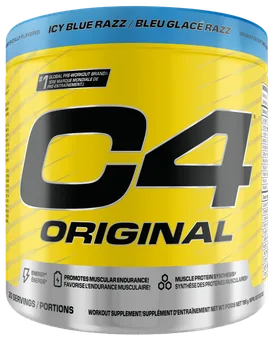
Cellucor C4 Original Pre-Workout Review
C4 Original Pre-Workout Powder from Cellucor is a pre-workout blend built to deliver sustained energy, endurance, and focus for hard training sessions. Each serving provides 200mg of caffeine and 2g of CarnoSyn Beta-Alanine, which the brand says supports muscular endurance. The brand states that the formula is designed for people who want to power through even the toughest sets. The product is presented as having been fueling athletes and fitness enthusiasts for over a decade. The listed key features include Hard Hitting Energy, with 200mg of caffeine for explosive energy in the gym. Muscular Endurance is supported by CarnoSyn Beta-Alanine for endurance during demanding workouts. AI-Powered Peptides refers to PeptiPump, which the page describes as an AI-powered designer peptide found exclusively in C4. Enhanced Focus comes from Huperzine combined with caffeine, which the brand says helps keep the user sharp from the first rep to the last. The page also lists Incredible Flavor, with a variety of flavors and zero sugar or artificial colors. The brand says C4 is backed by 20 years of sports nutrition expertise. The product is marketed to gym-goers and strength trainees, to people doing high-intensity workouts and cardio, and to athletes and fitness enthusiasts in general. The usage directions say to mix one scoop with 6 to 8 ounces of water and consume it 20 to 30 minutes before a workout. Beginners may start with half a scoop to assess their tolerance. The page warns that the product is intended only for healthy adults aged 18 or older. It should not be used by people who are pregnant or nursing, who take nitrates for chest pain, or who take PDE-5 inhibitors. Users are advised to consult a healthcare professional if they take meds, meds, meds, pseudoephedrine, or other medications, or if they have certain medical conditions. The product contains caffeine and should not be combined with other caffeine or stimulant sources. Users should stop use two weeks before surgery. The page also notes trademark and patent information for CarnoSyn, PeptiPump, NO3-T, and Velox. The statements have not been evaluated by the Food and Drug Administration, and the product is not intended to diagnose, treat, cure, or prevent any disease. The page displays a size of 30 servings and offers a subscription option.
We don’t sell supplements. We help you make decisions and get the best price.
Lowest prices
Lowest cost per month first, in stock, at 1 serving a day. Checked Nov 3.
- iHerbLowest$21.92 a bottle$21.92/moBuy at iHerb (opens in a new tab)
- Vitacost$21.92 a bottle$21.92/moBuy at Vitacost (opens in a new tab)
- Cellucor$29.99 a bottle of 30 count$29.99/moBuy at Cellucor (opens in a new tab)
Study, Trial or Testing Result Summary
Members Only30 human studies · 13 improved
This product is graded on caffeine, the only ingredient on the label we have. The label lists 8.9 grams of caffeine per serving, which looks like a recording error, since the store listing gives 150 milligrams. The listing also names beta-alanine, creatine and citrulline, which were not reviewed here. Caffeine taken before training reliably gives a small boost in strength and lifting performance, but it has not been shown to build more muscle over time. A review of fourteen studies found single doses improved muscle strength and endurance, with the biggest strength gains at higher doses [1]. A review of 21 earlier reviews found caffeine improved strength, endurance, power and jumping, mostly in young men [2]. Even very low doses slightly helped strength and lifting speed [3]. Several reviews found the gains mainly in upper body strength, such as bench press, and not in leg strength [4][5]. In a six week trial of 28 trained young adults, daily caffeine did not increase muscle size, strength or endurance more than a placebo [6]. In short, expect a stronger workout on the day, not extra muscle growth from the caffeine itself. Animal and cell studies are never counted.
See all 30 studies →Hide the studies
- In 34 studies, a single serving of energy drink improved muscle strength and endurance, jumping and sport-specific actions but not sprinting, and the gains were linked to taurine dose rather than caffeine dose.Acute effects of caffeine-containing energy drinks on physical performance: a systematic review and meta-analysis.
- In ten strength and ten power studies, caffeine slightly improved maximal strength and jump power, with a significant gain for upper body strength but not for lower body strength.Effects of caffeine intake on muscle strength and power: a systematic review and meta-analysis.
- A review of 21 meta-analyses found caffeine improved muscle strength, muscle endurance, power and jumping, with moderate quality evidence, mostly in young men.Wake up and smell the coffee: caffeine supplementation and exercise performance-an umbrella review of 21 published meta-…
- In nineteen placebo-controlled trials, caffeine improved bench press endurance and maximum strength in healthy adults, but showed no significant effect on leg press performance or perceived exertion.Effects of caffeine supplementation on muscle endurance, maximum strength, and perceived exertion in adults submitted to…
- Across twelve trials of very low caffeine doses (0.9 to 2 mg per kg body weight), caffeine slightly improved muscular strength, muscular endurance and lifting speed during resistance exercise compared with placebo.Exploring the minimum ergogenic dose of caffeine on resistance exercise performance: A meta-analytic approach.
- Across fourteen studies, a single dose of caffeine capsules improved muscle strength and muscle endurance, especially in men, with the biggest strength gains at 6 mg per kg body weight or more taken 45 minutes before exercise.Effects of Acute Ingestion of Caffeine Capsules on Muscle Strength and Muscle Endurance: A Systematic Review and Meta-An…
- Across 21 studies, caffeinated chewing gum taken about 5 to 25 minutes before exercise slightly improved muscular strength and jump height but had no significant effect on muscular endurance.Fast-Acting Caffeine: Does Caffeinated Chewing Gum Enhance Muscular Strength, Endurance, and Jumping Performance? A Syst…
- In a review of 29 studies of short-term high-intensity exercise, six of eleven resistance training studies showed significant benefits from caffeine, and some studies showed worse performance in repeated bouts.Efficacy of acute caffeine ingestion for short-term high-intensity exercise performance: a systematic review.
- In 54 resistance-trained men, a single 300 mg dose of caffeine or coffee taken 30 minutes before testing did not improve strength more than placebo, though both reduced the drop in sprint power.Effects of coffee and caffeine anhydrous on strength and sprint performance.
- In 43 middle-aged adults doing resistance training for 6 weeks, a caffeinated pre-workout supplement gave the same gains in muscle size and strength as carbohydrate alone, apart from a larger drop in waist size.Pre-workout multi-ingredients or carbohydrate alone promote similar resistance training outcomes in middle-aged adults: …
- In 40 healthy young women, four weeks of three small cups of Turkish coffee daily did not change fat-free mass or skeletal muscle mass compared with no caffeine, and raised blood pressure and heart rate and worsened sleep.Short-Term Turkish Coffee Consumption Elevates Cardiovascular Risk Markers, Decreases Leptin Levels, and Impairs Sleep Q…
- In 29 active women, caffeine at 6.5 mg per kg body mass before strength sessions increased total repetitions compared with placebo, with no added benefit from combining it with a carbohydrate mouth rinse.Caffeine Supplementation or Carbohydrate Mouth Rinse Improves Performance.
- In 28 trained young adults over 6 weeks of resistance training, 3 mg per kg per day of caffeine alone did not produce any between-group differences in muscle size, strength or endurance compared with placebo.Effects of Creatine and Caffeine Supplementation During Resistance Training on Body Composition, Strength, Endurance, Ra…
- In 28 young adults doing 4 weeks of low-load wrist training with blood flow restriction, caffeine taken 1 hour before each session at 6 mg per kg did not add to strength gains, though it improved fine control of force release.Neuromuscular adaptations to caffeine supplementation in low-load resistance training with blood flow restriction.
- In 20 men doing bench press sets to failure, caffeine before exercise made the lowering phase faster, so each set took less time under tension, without reducing power in the lifting phase.The acute effects of caffeine intake on time under tension and power generated during the bench press movement.
- In 20 male lifters and recreational athletes in a crossover trial, caffeine at 6 mg per kg improved muscular strength, muscular endurance and jump height compared with placebo, with similar effects in trained and untrained men.Are Caffeine's Effects on Resistance Exercise and Jumping Performance Moderated by Training Status?
- In 19 participants, chewing caffeinated gum with 200 mg of caffeine before Romanian deadlifts increased peak and average power compared with placebo gum.Acute enhancement of Romanian deadlift performance after consumption of caffeinated chewing gum.
- In 17 resistance-trained men, one dose of caffeine (6 mg per kg body weight) taken an hour before training raised squat strength by 2.8 percent and medicine ball throw power by 4.3 percent versus placebo, but did not improve bench press strength or muscular endurance.Caffeine ingestion acutely enhances muscular strength and power but not muscular endurance in resistance-trained men.
- In 17 recreationally active men, a single 300 mg caffeine dose taken in the morning did not significantly improve repeated sprint times or lower-body power compared with placebo or no pill, though it lowered perceived exertion.Effects of Acute Caffeine Ingestion on Morning Strength, Power and Repeated Sprint Measures in Males: A Standardized App…
- In 16 strength-trained men who already used caffeine daily, single high doses of 9 or 11 mg per kg body weight did not improve bench press strength or muscular endurance, and the 11 mg per kg dose slightly reduced peak bar velocity.The Effects of High Doses of Caffeine on Maximal Strength and Muscular Endurance in Athletes Habituated to Caffeine.
- In 15 healthy adults, a single dose of caffeine (5 mg per kg body weight) increased breathing muscle strength compared with placebo.Effects of caffeine on inspiratory muscle function.
- In 14 resistance-trained men, rinsing for 5 seconds with a 750 mg caffeine solution (not swallowed) increased bench press repetitions to failure and lowered perceived exertion, but did not change one-rep max strength.High Dose of Caffeine Mouth Rinse Increases Resistance Training Performance in Men.
- In 13 trained women, a single 3 mg per kg caffeine dose increased mean bar velocity at 60 percent of one-rep max by small amounts in the early and late follicular phases of the menstrual cycle, with no other significant differences from placebo.The Effect of Caffeine on the Velocity of Half-Squat Exercise during the Menstrual Cycle: A Randomized Controlled Trial.
- In 12 highly resistance-trained men, a single morning dose of caffeine (3 mg per kg body weight) raised squat and bench press strength and power about 4.6 to 5.7 percent above placebo, bringing morning performance up to afternoon levels.Caffeine ingestion reverses the circadian rhythm effects on neuromuscular performance in highly resistance-trained men.
- In 12 resistance-trained men taking 400 mg of caffeine daily for 7 days, exercise performance did not improve compared with placebo, though thinking tests improved when caffeine was combined with creatine nitrate.The Effect of Creatine Nitrate and Caffeine Individually or Combined on Exercise Performance and Cognitive Function: A R…
- In 11 female collegiate athletes, a single dose of caffeine (6 mg per kg body weight) improved jump height compared with placebo, but did not improve maximal strength measures.The Effects of Caffeine on Jumping Performance and Maximal Strength in Female Collegiate Athletes.
- In 25 resistance-trained men, a single dose of caffeine (6 mg per kg body weight) increased knee extension peak torque and power compared with placebo, but did not improve knee flexion strength.Examining the Effects of Caffeine on Isokinetic Strength, Power, and Endurance.
- Over 4 weeks of bench press training, 16 participants taking caffeine before each session gained the same one-rep max strength as the placebo group, but their bar speed improved across a wider range of loads.Pre-exercise Caffeine Intake Enhances Bench Press Strength Training Adaptations.
- In 12 participants, a single dose of caffeine (3 mg per kg body weight) before a bench press workout increased bar speed, power output and total work across the session compared with placebo.Caffeine Increases Muscle Performance During a Bench Press Training Session.
- In a cross-sectional study of 2085 adults aged 40 to 87, drinking more coffee was linked to lower odds of low muscle mass, with the lowest odds at 2 or more cups a day; this association does not prove coffee causes the difference.Coffee consumption and skeletal muscle mass: WASEDA'S Health Study.
Review Totals and Summary
Members Only9,246 reviews · 87% positive
Cellucor C4 Original Pre-Workout is a widely recognized supplement, with about 9246 ratings across various stores. The majority of feedback is positive, with 71% of starred reviews giving it 4 or 5 stars, indicating a generally favorable customer experience. **What it did for buyers** Customers frequently report significant boosts in energy, focus, and endurance during their workouts. Many feel more motivated and experience increased intensity in their training sessions. Users describe a "solid boost of energy without jitters or a crash" and feeling "very energized a few hours after." The product is also credited with improving stamina and providing an "explosive energy!" without causing a racing heart for many. The beta-alanine ingredient often causes a noticeable tingling sensation, which some users enjoy as a sign it's working. **Complaints** The most common complaint revolves around the product's consistency upon arrival. Many customers received tubs where the powder was "clumped so hard it was like one ball" or "rock hard" instead of a fine powder. This issue is often attributed to moisture getting into the product, possibly due to poor storage by sellers, with some advising to "buy it from Walmart, not third party sellers." This clumping makes the product difficult to use and is seen as a sign of low quality by affected buyers. **Taste and form** The Watermelon flavor is overwhelmingly popular and well-received. Reviewers consistently describe it as "refreshing, not too sweet," and "palatable," effectively masking any typical bitterness of supplements. It generally mixes well without clumping when fresh. The product comes in a powder form with a standardized dosage per scoop, and a practical scooper is included in the tub. Some users also appreciate the availability of individual packets. **Value for money** Opinions on value are somewhat mixed but lean positive. While some acknowledge the "price is high, but it's worth it" for the benefits received, others note the "price creeping higher" and being "more expensive than others." However, many still consider it affordable and a good investment given its effectiveness and quality. **Who it suits** This pre-workout appears to suit a broad range of individuals, from "beginners and experienced lifters" looking for an edge. It's ideal for those who "need an extra boost" before training and seek a reliable energy source without experiencing jitters or headaches. However, individuals sensitive to caffeine are advised to reduce their dosage, and those who receive a clumpy product are understandably dissatisfied.
Biohacker Summary
Members Only10 of 10 recommend it
Caffeine is the main ingredient, and the panel is split between using it and cautioning about it. Most of the ten take it for focus, alertness, and fat burning around fasted exercise, and doses mentioned run from 100 to 150 milligrams up to 100 to 400 milligrams, with 150 to 200 milligrams before a short nap and 300 milligrams slow release in the morning for jet lag. Several pair it with L-theanine for smoother focus and less jitters, and one also pairs it with Alpha GPC and MCT for long stretches of mental work. Many stress timing, saying to stop by noon or after lunch because late caffeine cuts deep sleep, and others warn it can raise stress, restlessness, anxiety, and an afternoon crash, or should be cut before trying to conceive. One panelist came off caffeine for a year, and another says his company stopped using it in a skincare product.
See all 10 biohackers →Hide the biohackers
Dave Asprey · Caffeine · uses
- Loves coffee, has the caffeine molecule tattooed on his arm, drinks it every morning, and says it does amazing things for your brain and for how long you can live, but it can't clear most brain fog on its own.
- Created Danger Coffee, a mineral-enriched, lab-tested, mold-free coffee that delivers rich flavor and clean caffeine without all the junk, and recommends it to others.
- Dave Asprey's lab proved that caffeine is a flow hack and the only known substance to actually make you flow prone. Coffee will make you more flow prone.
- Dave explains why the 1:2 ratio of caffeine to L-theanine beats coffee alone for working memory, accuracy, and calm, sustained concentration.
- States that his entire career started on caffeine and he uses it every morning, but notes it's like a loan from your future self, leading to an afternoon crash.
- Dave Asprey's company used caffeine, which is a safe ingredient, but they stopped using it because it doesn't provide the type of results and change in the skin that newer ingredients do.
- States that caffeine is one of his superpowers and increases the rate of ketone formation, which fuels neurons.
- Once I’ve hydrated and taken my creatine, I reach for Danger Coffee for caffeine and essential minerals in one cup.
- Uses caffeine, noting it blocks adenosine to increase norepinephrine and dopamine signaling, fueling the prefrontal cortex for focus. He mentions it got him through business school and is part of his longevity journey.
- Does not believe caffeine is a nootropic, considering it just a stimulant.
Thomas DeLauer · Caffeine · neutral
- Explains that caffeine from green tea mobilizes fatty acids, which can be converted into ketones, providing a ketone boost, especially in a fasted or low-carb state.
- Warns that treating brain fog with caffeine without addressing underlying inflammation is ineffective and likely to make the situation worse.
- Notes that caffeine significantly increased fat metabolism and fat oxidation during exercise, especially at lower intensities, and that adding coffee around an exercise bout led to more calories and fat burned.
- Says that caffeine significantly increased fat metabolism and that at low intensity cardio or exercise caffeine works better at mobilizing and utilizing fat.
- Might have some caffeine before fasted training.
- Recommends caffeine as a must on the fasting day to create a low-grade energy demand that forces the body to favor lipolysis.
- Recommends drinking 150 to 200 mg of caffeine immediately before a 20-minute nap to enhance alertness and performance, as the caffeine peaks when the nap has cleared adenosine.
- States that caffeine is probably the most studied ergogenic aid with a profound effect on fat mobilization, suggesting that simple is better.
- Mentions that people try cutting out caffeine when dealing with sleep issues, but it's not always the root cause.
- Warns that consuming more than 50-60 mg of caffeine in the first hour after waking stacks a stimulant on top of the body's natural cortisol-driven alertness, leading to a sharp spike and mid-morning crash, and building tolerance faster.
Andrew Huberman · Caffeine · uses
- Used caffeine, taking 400 milligrams, to improve his mood and physical vigor during mundane tasks like swimming, noting that it made life not so bad and allowed him to rip through the water.
- Mentions caffeine in a discussion about supplement use.
- Discusses caffeine timing as a tool related to sleep.
- He recommends caffeine, in coffee or tea form, or in tablet or capsule form at lower dosages than found in coffee and tea, as a reasonable way to explore stimulant-based approaches for enhancing cognitive function and focus.
- Huberman states that caffeine can improve focus and concentration, with a general useful range of 100 to 400 milligrams, and most people do well with 100 to 200 milligrams prior to focused work.
- Discusses caffeine as a tool for improving attention, noting its impact on focus and sleep.
- Mentions that coffee and tea produce caffeine, which were likely defense chemicals, and that plants learned it was better to alter consciousness than kill predators outright.
- Discusses caffeine and its health benefits.
- Recommends caffeine as a tool to increase motivation and dopamine.
- Huberman explains that regular ingestion of caffeine at safe levels of about 100 to 250 mg increases the number of D2 and D3 dopamine receptors, making circulating dopamine more potent.
Dr. Rhonda Patrick · Caffeine · neutral
- Explains that caffeine can activate AMPK, a cellular energy sensor involved in fat burning and glucose regulation, which helps muscle cells take up glucose and promotes using fatty acids for energy.
- Recommends pairing caffeine with L-theanine to enhance alertness and focus while mitigating anxiety and jitteriness, suggesting a dose of 100 to 150 mg of caffeine.
- Recommends pairing coffee with L-theanine to enhance cognitive performance, noting that L-theanine can help balance caffeine’s stimulatory effects.
- Recommends cutting out caffeine in the three months before conception for both men and women, as it affects sperm.
- Recommends caffeine for alertness and focus, especially when combined with L-theanine to smooth out the response and maintain cognitive benefits, suggesting a practical dose of 100-150 mg.
- Recommends cutting down or eliminating caffeine when actively trying to conceive.
- Warns that a very high dose of caffeine, around 350 mg pre-workout, may blunt some of creatine's performance benefit due to opposite effects on muscle relaxation.
- Self-administers 350 mg of caffeine in a bolus right after returning from mass and his workout, and before eating, noting that he likes dark roast Starbucks.
- The newest literature on Caffeine dose and its link to multiple cardiometabolic disease risk reduction shows that even the ≥400 mg group was healthier than 0 mg.
- Explains that caffeine works by blocking adenosine, a molecule that builds up and makes one feel tired, and that timing coffee intake is about leveraging adenosine biology for peak cognitive alertness.
Siim Land · Caffeine · recommends
- Recommends stopping caffeine earlier to improve sleep.
- Notes that polyphenolic compounds in coffee, both decaf and regular caffeinated, can influence cellular stress pathways and have been seen to increase autophagy activity in mice, with regular coffee appearing more potent due to caffeine's additional energetic stress.
- Recommends moving caffeine intake earlier in the day because having it too late can disrupt sleep, especially for slow metabolizers.
- Recommends not having caffeine after lunch, noting that 400 mg 4 hours before bed reduced deep sleep by approximately 30 minutes in a trial, although he personally has a fast caffeine metabolism.
- Warns that combining a large dose of glycine with caffeine can amplify negative experiences, as caffeine independently increases arousal and can cause restlessness, anxiety, and increased heart rate.
- States that regular coffee promotes visceral fat loss, and going from low or zero intake to moderate intake increases fat loss due to caffeine and polyphenols.
- Suggests that higher caffeine intake might be useful for older people because caffeine raises cortisol, and consuming it in the morning contributes to circadian regulation.
- States that caffeine has proven benefits for increasing exercise performance when used correctly and at the right time.
- States that caffeine raises blood pressure, but mostly if one is not used to consuming it, and habitual caffeine consumers develop tolerance to these effects.
- Quotes a tweet suggesting that without caffeine, civilization would be 100 years behind.
Ben Greenfield · Caffeine · stopped
- Came off caffeine for a year after his separation.
- Quit caffeine in the same year he quit testosterone replacement therapy and alcohol.
- Uses caffeine, such as coffee or green tea, in his morning fasted fat-burning session to slightly increase the oxidation of fats.
- Advises against relying on caffeine for morning energy, suggesting that natural sugar-based stimulants combined with hydration and meditation can provide sufficient wakefulness.
- Recommends Caffeine, noting that it can improve focus, mood, and training, help control appetite, raise calories burned, and reduce fatigue.
- Notes that 3 mg/kg of caffeine increases fat oxidation by 31%, and 5 mg/kg increases it by 51% compared to a placebo.
- Caffeine on its own isn’t particularly impressive as an ergogenic aid, but when combined with taurine, there are significant increases in power production.
- Mentions that caffeine can help mitigate the negative effects of a caloric deficit on lean muscle mass and metabolism.
- Has talked before about caffeine as a supplement that seems to assist with sleep deprivation.
- Warns that energy drinks can deliver large doses of caffeine quickly, which may overstimulate the heart and cause abnormal heart rhythms and electrocardiogram changes, especially in children.
Dr. Mark Hyman · Caffeine · warns
- Discusses with patients their caffeine consumption, suggesting that too much caffeine can artificially increase their stress response.
- Recommends stopping caffeine by noon.
- States that caffeine's effect on ADHD depends on the person, as it can help focus but also activate irritation or stress, and its impact is related to individual caffeine metabolism.
- Warns that drinking coffee first thing in the morning before eating layers caffeine on top of already elevated stress hormones, providing unsustainable energy and setting up for an afternoon crash.
- Notes that caffeine is one of the things that drives the hormone imbalance causing PMS.
- States that drinking coffee on an empty stomach, which is how most people do it, is probably not the best thing as it gives a jolt of caffeine and adrenaline before eating.
- Warns that caffeine, alcohol, and spicy foods can be potent triggers for hot flashes, and excess caffeine should be avoided.
- Warns that adding fiber does not cancel out the negative effects of caffeine and other processed additives.
- Warns that high caffeine intake, especially coffee, can contribute to dehydration by increasing fluid loss and masking fatigue, leading to a deficit if not balanced with sufficient water intake.
- Warns that caffeine without adequate protein creates blood sugar chaos, sending a stress signal to the brain and hindering healing.
Dr. Eric Berg · Caffeine · warns
- Warns that caffeine can keep you awake and advises to watch out for hidden sources of caffeine.
- Stimulating the body with caffeine can actually make fatigue worse.
- Dr. Berg warns that stimulating the body with caffeine can actually make fatigue worse.
- Warns that too much caffeine is a common cause of worry, indecision, fear, and tension, and that it depletes vitamin B1, negatively affecting the nervous system.
- Warns that even a lot of caffeine in the morning can inhibit melatonin at night.
- Warns that coffee does not give you energy; instead, caffeine binds to adenosine receptors, inhibiting sleep signals and merely preventing sleepiness.
- States that caffeine can affect the ability to absorb magnesium and cause a deficiency.
- Warns that drinking caffeinated beverages later in the day can keep you awake because the liver needs to detoxify the caffeine.
- Warns that consuming caffeine can worsen tinnitus, citing a person who noticed this effect.
- Stimulating the body with caffeine can actually make fatigue worse.
Bryan Johnson · Caffeine · uses
- Drinks coffee when starting to fade, ensuring the last cup is between 10 and 12 hours before bed so caffeine doesn't affect sleep.
- Used 300 mg of caffeine in the morning as part of their jet lag recovery.
- Uses 300 mg of slow release caffeine in the morning as part of a jet lag recovery protocol.
- Notes that coffee affects the gut, which then affects the brain, and that it is the coffee bean, not the caffeine, doing most of the work.
- Notes that the culture in DC involves running on caffeine, along with alcohol and sleep deprivation, leading to poor nutrition and an unhealthy environment.
- Warns that caffeine has a 6-hour half-life, so consuming it later in the day will leave a significant amount in the body at bedtime, recommending consumption earlier in the day.
- Recommends consuming no caffeine past noon due to its 6-hour half-life, suggesting that if sleep is nailed, caffeine might not be needed.
- Warns against stimulants like caffeine for sleep, advising to have the last cup of coffee before noon if going to bed at 10:00 p.m.
- Advises that if one is going to drink caffeine, they should try to have it earlier in the day and experiment to find the right time that doesn't disrupt their sleep.
- Has stopped all caffeine, as it has helped him improve his sleep.
Peter Attia · Caffeine · uses
- States that he needs two to three times the normal dose of any medication or drug to feel an effect, including caffeine, and can drink four cups of coffee without feeling anything.
- Mentions data suggesting caffeine might be more helpful in the luteal phase to help with fatigue components.
- Uses caffeine in combination with Alpha GPC, MCT, and Theanine, often adding it to coffee for long periods of cognitive work.
- Finds Alpha GPC works well with caffeine, and he puts a product containing Alpha GPC, MCT, and caffeine into his coffee for long periods of cognitive work.
- Mentions that experimenting with the timing of caffeine is a great idea for sleep.
- Warns that decaffeinated coffee can contain significant amounts of caffeine and advises cutting off all coffee, including decaf, by 11 a.m. for better sleep quality.
- Explains that caffeine is problematic because it blocks adenosine receptors, leading to a 'caffeine crash' when it wears off and adenosine floods the receptors, causing sleepiness.
- States that caffeine does not wake him up, which contributed to his belief that he did not have an addiction gene.
- States that caffeine does not wake him up.
- Warns that constantly consuming caffeine and Red Bull to turn up the sympathetic dial is a sign that the sympathetic system isn't working as it should, possibly due to overstimulation from stress.
RAL Summary
Members OnlyTier 3 for Muscle and Strength
More Details
Members OnlyBody systems · Combine with · Possible side effects
Body systems: Muscular system, Nervous system
Combine with: To further enhance muscle building and recovery alongside C4 Original Pre-Workout, consider stacking it with a high-quality protein powder (such as whey or casein) to support muscle repair and growth, especially post-workout. Essential Amino Acids (EAAs) or Branched-Chain Amino Acids (BCAAs) can further aid in muscle protein synthesis and reduce breakdown. Omega-3 fatty acids are beneficial for reducing exercise-induced inflammation and supporting overall joint health, which is crucial for consistent training. Additionally, a multivitamin or specific micronutrients like Vitamin D3 and Magnesium can support overall physiological functions, bone health, and muscle function, contributing to optimal performance and recovery.
Possible side effects: The caffeine studies reported no major side effects. No written reviews could be read, so nothing is known about the side effects reviewers mention.
Supplement Facts
Includes 0g Added Sugars 0 g · Vitamin B6 3.4 mg · Folate 100 mcg DFE
| Calories | 10 | |
| Total Carbohydrate | 1 g | <1% |
| Total Sugars | 0 g | |
| Includes 0g Added Sugars | 0 g | 0% |
| Vitamin B6 (as Pyridoxal-5-Phosphate) | 3.4 mg | 200% |
| Folate (as 6S-5-Methyltetrahydrofolate calcium salt) | 100 mcg DFE | 25% |
| Vitamin B12 (as Methylcobalamin) | 6 mcg | 250% |
| Choline (as Choline Bitartrate) | 225 mg | 41% |
| Muscular Endurance & Performance Booster | 4.5 g | † |
| CarnoSyn® Beta-Alanine | 2 g | † |
| Velox® Patented Performance Blend | 1.2 g | † |
| L-Citrulline | 1.2 g | † |
| L-Arginine | 1.2 g | † |
| PeptiPump® Bioactive Lentil peptides | 100 mg | † |
| Creatine Nitrate (as NO3-T®) | 1 g | † |
| Explosive Energy & Focus Complex | 205 mg | † |
| Caffeine Anhydrous | 200 mg | † |
| Toothed Clubmoss (Huperzia serrata) aerial parts extract (std. 1% Huperzine A) | 5 mg | † |
Other ingredients: Other Ingredients: Citric Acid, Malic Acid, Silicon Dioxide, Natural & Artificial Flavors, Calcium Silicate, Sucralose, Acesulfame Potassium, Spirulina Extract (color).
Label source: Cellucor · Report a label change
Show entire label
More muscle and strength products
Members OnlyThe highest ranked for the same goal
Read more
Our articles on this subject
Graded October 26, 2026 by the Reverse Age Lab evidence engine, from human studies, real reviews and our biohacker panel. How we grade. Is this medical advice? No. Rala organizes the published evidence; go over any change with your doctor, especially if you take meds.
Privacy policyConsumer health dataTermsDo Not Sell or Share My Personal InformationCookie settings