
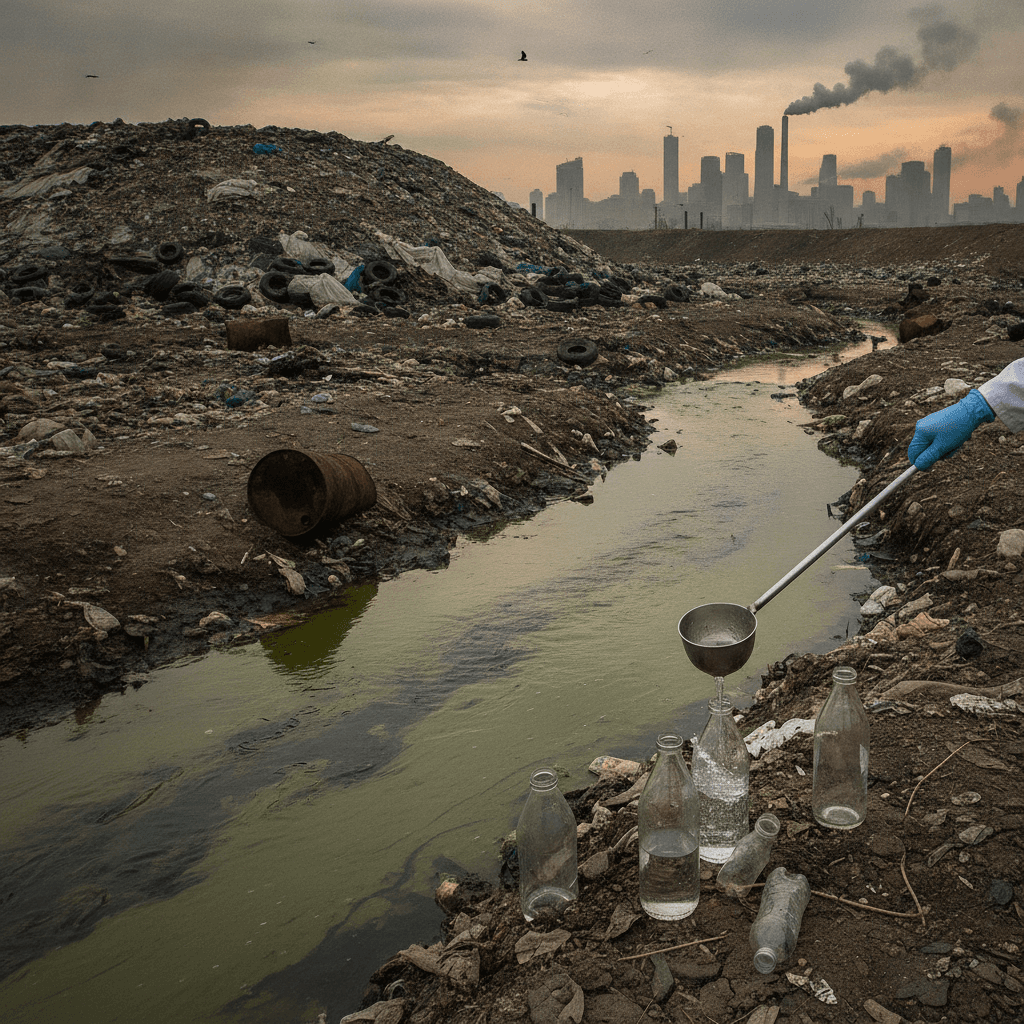
Researchers in Dhaka, Bangladesh, found heavy metal contamination in water samples near urban landfills. Most sites showed water unsuitable for drinking, with lead being a primary concern.
Source: Preprint, 12 water samples from three landfill-influenced zones. Posted before peer review: other scientists have not yet checked it, and results can change before it is published.
What was found
A study in Dhaka, Bangladesh, found heavy metal contamination in urban water systems near landfills. Researchers collected 12 water samples from three zones influenced by landfills and analyzed them for physicochemical parameters and heavy metals, including iron (Fe), manganese (Mn), and lead (Pb).
The Water Quality Index (WQI) classified 67% of the sampling sites as poor to unsuitable for drinking purposes. Spatial analysis showed contamination gradients radiating from the landfill zones, with metal concentrations generally decreasing further away from waste disposal sites.
Lead was identified as the most critical concern, exceeding the World Health Organization (WHO) guideline value of 0.01 mg/L at 75% of the sampling locations. The maximum lead concentration found was 0.18 mg/L in zones close to landfills. Iron and manganese also exceeded guideline rates at 58% and 50% of sites, respectively.
How it was done
Researchers collected 12 water samples in October 2025 from three major landfill-influenced zones: Matuail, Amin Bazar, and Kodda. They used an integrated approach combining the Water Quality Index (WQI), GIS-based spatial analysis, and exploratory data-driven modeling.
Exploratory statistical and machine-learning-assisted analyses were used to examine potential relationships between parameters, but their predictive performance was limited by the small sample size. These analyses suggested that electrical conductivity, organic load, and site-proximity factors were influential variables.
What it does not show
The findings should be interpreted with caution due to the limited sample size of 12 water samples. The study involved single-season sampling, which may not reflect year-round conditions. There is also uncertainty associated with the spatial interpolation methods used.
What happens next
The study highlights lead contamination as a priority public health concern requiring immediate monitoring and mitigation in Dhaka's landfill-adjacent communities.
Who was talking about it
- Earth.com on the news (2026-11-13): Earth.com reported that scientists discovered a hidden 'aging clock' in human blood that can predict future diseases and early death. See the post
The source
This is news, reported from the source above. It is not medical advice and not a recommendation. Talk to your doctor or pharmacist before you change any medicine or supplement.