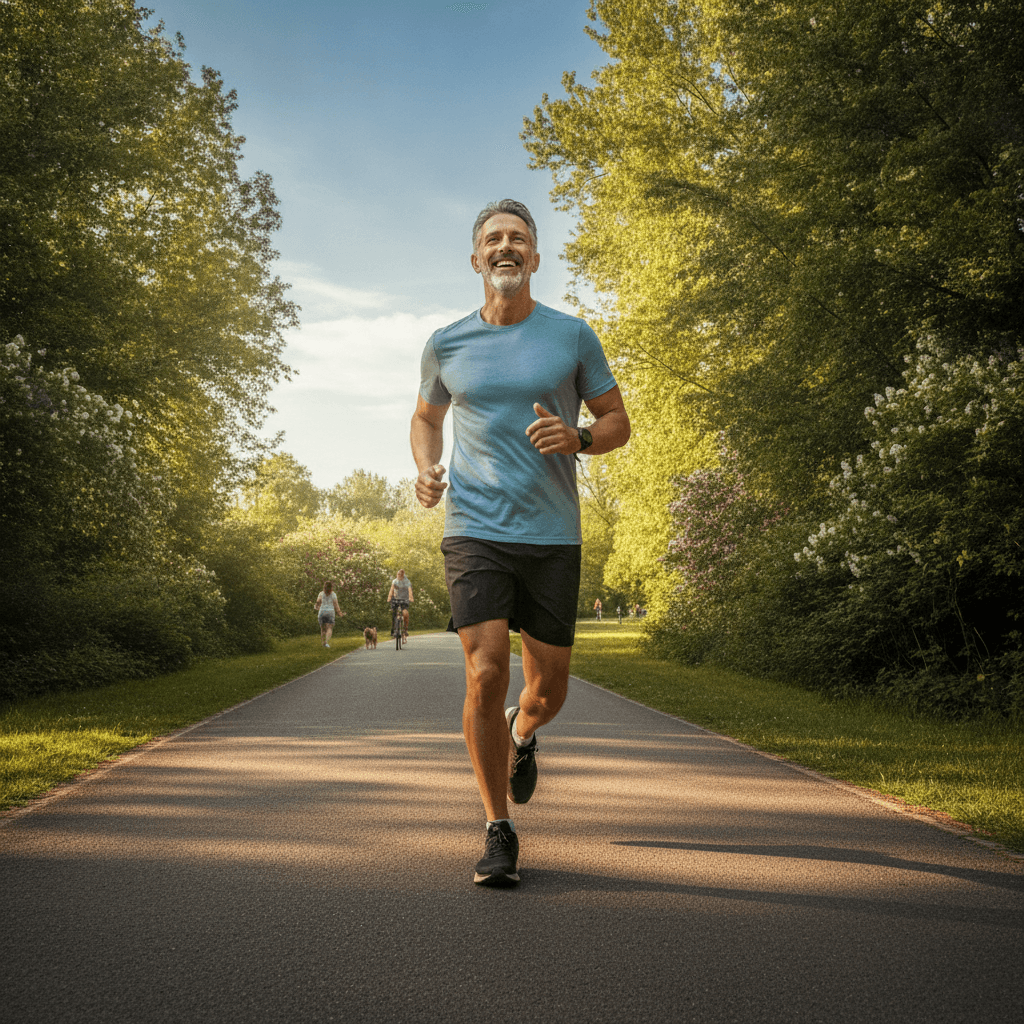
The best exercise to lose weight, in the human trials, depends on what is being measured. Aerobic exercise (walking, jogging, cycling) lowered body weight and waist size more than strength training did. Strength training added muscle and helped hold on to it during dieting. The two together did best in some trials and no better than aerobic exercise alone in others. Whatever the type, the weight lost from exercise on its own was smaller than most people expect: a few pounds over six months in most pooled results.
Below you'll find why exercise alone moves the scale so little, what strength training, cardio and daily movement each did in the trials, a side-by-side table, where the trials disagree and who should check with a doctor first. The last part shows how the Exercise box in a Daily Protocol fits with food and supplements.
Why Exercise Alone Changes Weight Less Than Most People Expect
A pooled analysis of 14 randomized trials of aerobic exercise alone, covering 1,847 people, found that programs lasting six months lowered weight by 1.6 kg (3.5 lb) and waist size by 2.1 cm, and programs lasting 12 months lowered weight by 1.7 kg (3.7 lb) and waist size by 2.0 cm. Its authors called isolated aerobic exercise a modest weight-loss tool, with small gains in blood pressure and blood fats (Thorogood 2011). An overview of 12 pooled analyses and 149 studies put the average loss from exercise training between 1.5 and 3.5 kg for weight and 1.3 to 2.6 kg for body fat. It found no significant effect of exercise on keeping weight off afterwards, though that rested on a single review (Bellicha 2021).
Part of the gap is that bodies adjust. In 411 inactive, overweight women who exercised under supervision for six months, weight loss matched what the exercise energy predicted at 72 and 136 minutes a week, but at 194 minutes a week the women lost only about half of the predicted amount. Their waists shrank in every exercise group, whatever happened to the scale (Church 2009). A follow-up of two six-month trials of 414 people found that those who lost the least in the first four weeks ended up losing less overall and lost less than their exercise predicted, and in one trial they ate more (Dorling 2021).
Exercise does most when it sits next to a change in eating. In eight trials of 1,022 people, programs combining diet and activity lost 5.3 kg more than activity-only programs at three to six months and 6.3 kg more at 12 to 18 months. Against diet-only programs the combined ones lost no more at three to six months and 1.7 kg more at 12 months (Johns 2014). For the eating side, see our intermittent fasting guide.
Strength Training, Cardio and Daily Movement: What Each Does
Cardio (aerobic exercise)
The largest pooled analysis is 116 randomized trials of supervised aerobic training lasting at least eight weeks, in 6,880 adults with overweight or obesity. For every 30 minutes a week of aerobic exercise, body weight fell by 0.52 kg, waist by 0.56 cm and body fat by 0.37 percentage points, and the area of visceral fat (the fat around the organs) fell by 1.6 cm². The declines continued in a roughly straight line up to 300 minutes a week. At 150 minutes a week of moderate to vigorous effort, waist size and body fat dropped by amounts the authors called clinically important, while they said more than 150 minutes might be needed for weight itself. Mild to moderate side effects, mostly muscle and joint complaints, occurred in about 2 more people per 100 (Jayedi 2024).
Interval training, short hard efforts with rests, gave similar results. In 13 trials comparing it with steady moderate exercise, both lowered fat mass and waist size, neither beat the other, and interval training took about 40% less time. The fat loss was seen with running and not with cycling, and body weight itself did not change (Wewege 2017). The overview of 12 pooled analyses likewise found no difference between the two when the energy used was equal (Bellicha 2021).
Strength training
Across 114 trials of 4,184 people with overweight or obesity, strength training alone lowered body fat by 1.6 percentage points and fat mass by 1.0 kg compared with people who did not train, and added 0.8 kg of lean mass. Strength training combined with eating less lowered fat mass by 5.3 kg while keeping lean mass, and strength plus aerobic exercise lowered fat mass by 1.4 kg, all against groups with no program (Lopez 2022). In the head-to-head trial in the next section, the strength group gained weight, because the muscle it added outweighed the little fat it lost.
Daily movement
Steps are the easiest form of exercise to count. A pooled analysis of nine pedometer-based walking programs with no diet change, covering 307 people, found an average loss of 1.27 kg (2.8 lb), about 0.05 kg a week over a median of 16 weeks; longer programs lost more. The studies were small, and the analysis included cohort studies as well as randomized trials (Richardson 2008). In a 24-week randomized trial of 602 adults with a body mass index of 25 or more, step goals with games and social incentives raised daily steps by 637 to 920 more than in the comparison group; weight was not its main measure, and the gain in steps shrank once the games stopped (Patel 2019).
Best Exercise to Lose Weight, Side by Side: Strength, Cardio and Daily Movement
| Type | Calories and time | Muscle | Human evidence |
|---|---|---|---|
| Cardio | 4 to 14 kcal per kg a week; 72 to 194 minutes in two trials | No gain | 0.52 kg less weight and 0.56 cm less waist per 30 minutes a week |
| Interval training | About 40% less time than steady cardio | Not reported | Same fat and waist loss as steady cardio |
| Strength training | Calories not measured the same way; 180 minutes a week in one trial | +0.8 to 1.1 kg lean mass | 1.0 kg less fat mass; weight did not fall in the head-to-head trial |
| Both together | About 314 minutes a week in one trial, twice cardio alone | +0.8 kg lean mass | 2.4 kg less fat mass, not clearly more than cardio alone |
| Daily steps | No set session; +600 to 900 steps a day | Not measured | 1.27 kg lost over a median 16 weeks |
What the Human Trials Found, Including Where Results Were Small
The cleanest head-to-head test is STRRIDE AT/RT: 119 inactive, overweight or obese adults were assigned for eight months to strength training, aerobic training or both. Aerobic training lowered body weight by 1.76 kg and fat mass by 1.66 kg, with no change in lean mass. Strength training raised body weight by 0.83 kg, lowered fat mass by a non-significant 0.26 kg and added 1.09 kg of lean mass. The combined program lowered body weight by 1.63 kg and fat mass by 2.44 kg and added 0.81 kg of lean mass. The aerobic and combined groups did not differ from each other, even though the combined group trained about twice as long, and both lost more than the strength group (Willis 2012).
A pooled analysis of 15 trials in 741 people adds to this. Aerobic training beat strength training by 1.15 kg for weight, 1.10 cm for waist and 1.15 kg for fat mass, while strength training added 1.26 kg more lean mass. The combined programs beat strength alone by 2.03 kg for weight, 1.57 cm for waist and 1.88 kg for fat mass, and the authors concluded combined training was the most efficacious. Both sets of results are against strength training; the abstract does not report combined against aerobic alone, which is the comparison STRRIDE tested and found no difference in (Schwingshackl 2013).
For fat around the organs, a network analysis of 84 trials in 4,836 people found that aerobic exercise of at least moderate effort, strength training, both together and interval training all lowered visceral fat. Vigorous aerobic exercise and interval training ranked highest for visceral fat, weight, body fat and waist, and strength training ranked lowest. Strength training lowered visceral fat in men and in people with under 40% body fat, but not in women or in people with 40% or more (Chen 2024).
Strength training looks different when people are also eating less. In 160 older adults with obesity on a weight-management program for six months, body weight fell by 9% in all three exercise groups. Lean mass fell by 5% with aerobic exercise alone, 3% with both and 2% with strength training alone, and a physical performance score rose most in the combined group (21%, against 14% in each of the others). Injuries to muscles and joints were among the exercise-related adverse events (Villareal 2017).
Where the trials disagree comes down to what is counted. Measured on the scale, aerobic exercise leads. Measured in lean mass, strength training leads. Measured in fat mass and waist size, the pooled results favor aerobic exercise over strength alone, and the evidence that doing both beats aerobic exercise alone is mixed. Nearly all of these trials were supervised programs of 8 to 26 weeks in adults with overweight or obesity, so they cannot say what happens in people at a healthy weight, over several years or in home routines.
What Our Weight and Metabolism Goal Pages Add
None of the exercise results above come from our supplement grades, and we do not use supplement studies to rank exercise. Our goal pages cover the pill side: of the 55 ingredients we graded for Weight and Metabolism for Women, 27 improved in human studies, 20 showed no effect and 8 have too few studies or none; for Weight and Metabolism for Men, 35 of 78 improved, 24 showed no effect and 19 have too few studies or none. Our supplements for weight management guide sets out which of them have human trials behind them, and you can browse every goal we grade.
Who Should Check With a Doctor First
The pooled trials report side effects, and they are mostly in muscles and joints: in the aerobic analysis, about 2 more people per 100 had a mild to moderate complaint, and the diet-and-exercise trial in older adults reported muscle and joint injuries (Jayedi 2024; Villareal 2017). Talk to your doctor before starting or stepping up if you have chest pain, shortness of breath at low effort, dizziness or fainting, or pain in a joint or your back. Ask too if you take meds that affect blood pressure, heart rate or blood sugar, are pregnant, are older and have been inactive for a long time, or have been told to avoid hard exercise. The trials above recruited adults with overweight or obesity, so they say little about anyone outside that group.
What This Means for Your Daily Protocol
Rala, the AI behind Reverse Age Lab, builds each member one Daily Protocol covering supplements, diet, sleep and exercise from their Health Profile and goals. The Exercise box sits beside the Diet and Sleep boxes: it shows the first lines of Rala's suggestions, built from the exercise you tell Rala you do now and your goals, and opens to the whole text. That keeps movement alongside food, sleep and supplements in one place, with each supplement checked against your meds. Blood work is optional.
To see which supplements have human studies for weight and metabolism, open the goal pages above. Build My Protocol – 7-Day Free Trial.
Is this medical advice? No. This guide sets out published trials of exercise and body weight; it is not a diagnosis, and Rala isn't a medical device or a clinician. Talk to your doctor before changing your exercise a lot, especially if you take meds.
Bottom Line: Which Exercise for Which Goal
In the human trials, exercise on its own lowered weight by a modest amount: about 1.5 to 3.5 kg over months. Each goal had a different leader. For the scale and the waist, aerobic exercise did most, with about 150 minutes a week the amount at which the authors called the drops in waist and body fat clinically important. For the same results in less time, interval training matched steady cardio. For lean mass, and for holding on to muscle while eating less, strength training did most. For physical function in older adults who were dieting, doing both did best. Daily steps added a smaller loss still, in small programs. Whether doing both adds fat loss over aerobic exercise alone is the point on which the trials disagree.
Frequently Asked Questions
Is cardio or weights better for weight loss?
For the scale and the waist, cardio did more: 1.15 kg more weight loss and 1.10 cm more waist loss than strength training across 15 pooled trials. For muscle, strength training did more, adding 1.26 kg more lean mass. In one eight-month trial, adding strength training to cardio did not lower fat mass significantly more than cardio alone.
How much exercise does it take to lose weight?
Pooled aerobic trials found about 0.52 kg of weight lost per 30 minutes a week, continuing up to 300 minutes a week, with 150 minutes at moderate to vigorous effort giving clinically important drops in waist and body fat. In one trial of women, 194 minutes a week produced about half the weight loss the energy used predicted. Programs that added diet changes to activity lost 5.3 kg more than activity-only programs at three to six months.
What is the best exercise to lose belly fat?
None of these trials tested exercises aimed at the belly alone; they measured whole-body programs. Waist size and visceral fat fell with aerobic exercise (1.6 cm² of visceral fat and 0.56 cm of waist per 30 minutes a week), and vigorous aerobic exercise and interval training ranked highest for visceral fat. Strength training lowered it in men but not in women in one network analysis.
Can I lose weight with exercise alone?
A little. Six-month aerobic programs lowered weight by about 1.6 kg in 14 pooled trials, and waist size fell even when weight did not. Combined diet and activity programs lost 5.3 kg more than activity-only ones at three to six months and 6.3 kg more at 12 to 18 months.
What is the best exercise to lose weight at home?
The pooled aerobic analysis included only supervised training, and most strength trials used machines, so none of them tested a home routine. Walking is the closest: pedometer walking programs lost about 1.3 kg over a median of 16 weeks in small studies.
Sources
Thorogood A, Mottillo S, Shimony A et al. Isolated aerobic exercise and weight loss: a systematic review and meta-analysis of randomized controlled trials. The American Journal of Medicine, 2011. PubMed.
Bellicha A, van Baak MA, Battista F et al. Effect of exercise training on weight loss, body composition changes, and weight maintenance in adults with overweight or obesity: an overview of 12 systematic reviews and 149 studies. Obesity Reviews, 2021. PubMed.
Church TS, Martin CK, Thompson AM et al. Changes in weight, waist circumference and compensatory responses with different doses of exercise among sedentary, overweight postmenopausal women. PLoS One, 2009. PubMed.
Dorling JL, Höchsmann C, Fearnbach SN et al. Initial weight change and long-term changes in weight and compensation during supervised exercise training. Medicine and Science in Sports and Exercise, 2021. PubMed.
Johns DJ, Hartmann-Boyce J, Jebb SA et al. Diet or exercise interventions vs combined behavioral weight management programs: a systematic review and meta-analysis of direct comparisons. Journal of the Academy of Nutrition and Dietetics, 2014. PubMed.
Jayedi A, Soltani S, Emadi A et al. Aerobic exercise and weight loss in adults: a systematic review and dose-response meta-analysis. JAMA Network Open, 2024. PubMed.
Wewege M, van den Berg R, Ward RE et al. The effects of high-intensity interval training vs. moderate-intensity continuous training on body composition in overweight and obese adults: a systematic review and meta-analysis. Obesity Reviews, 2017. PubMed.
Lopez P, Taaffe DR, Galvão DA et al. Resistance training effectiveness on body composition and body weight outcomes in individuals with overweight and obesity across the lifespan: a systematic review and meta-analysis. Obesity Reviews, 2022. PubMed.
Richardson CR, Newton TL, Abraham JJ et al. A meta-analysis of pedometer-based walking interventions and weight loss. Annals of Family Medicine, 2008. PubMed.
Patel MS, Small DS, Harrison JD et al. Effectiveness of behaviorally designed gamification interventions with social incentives for increasing physical activity among overweight and obese adults across the United States: the STEP UP randomized clinical trial. JAMA Internal Medicine, 2019. PubMed.
Willis LH, Slentz CA, Bateman LA et al. Effects of aerobic and/or resistance training on body mass and fat mass in overweight or obese adults. Journal of Applied Physiology, 2012. PubMed.
Schwingshackl L, Dias S, Strasser B et al. Impact of different training modalities on anthropometric and metabolic characteristics in overweight/obese subjects: a systematic review and network meta-analysis. PLoS One, 2013. PubMed.
Chen X, He H, Xie K et al. Effects of various exercise types on visceral adipose tissue in individuals with overweight and obesity: a systematic review and network meta-analysis of 84 randomized controlled trials. Obesity Reviews, 2024. PubMed.
Villareal DT, Aguirre L, Gurney AB et al. Aerobic or resistance exercise, or both, in dieting obese older adults. The New England Journal of Medicine, 2017. PubMed.