
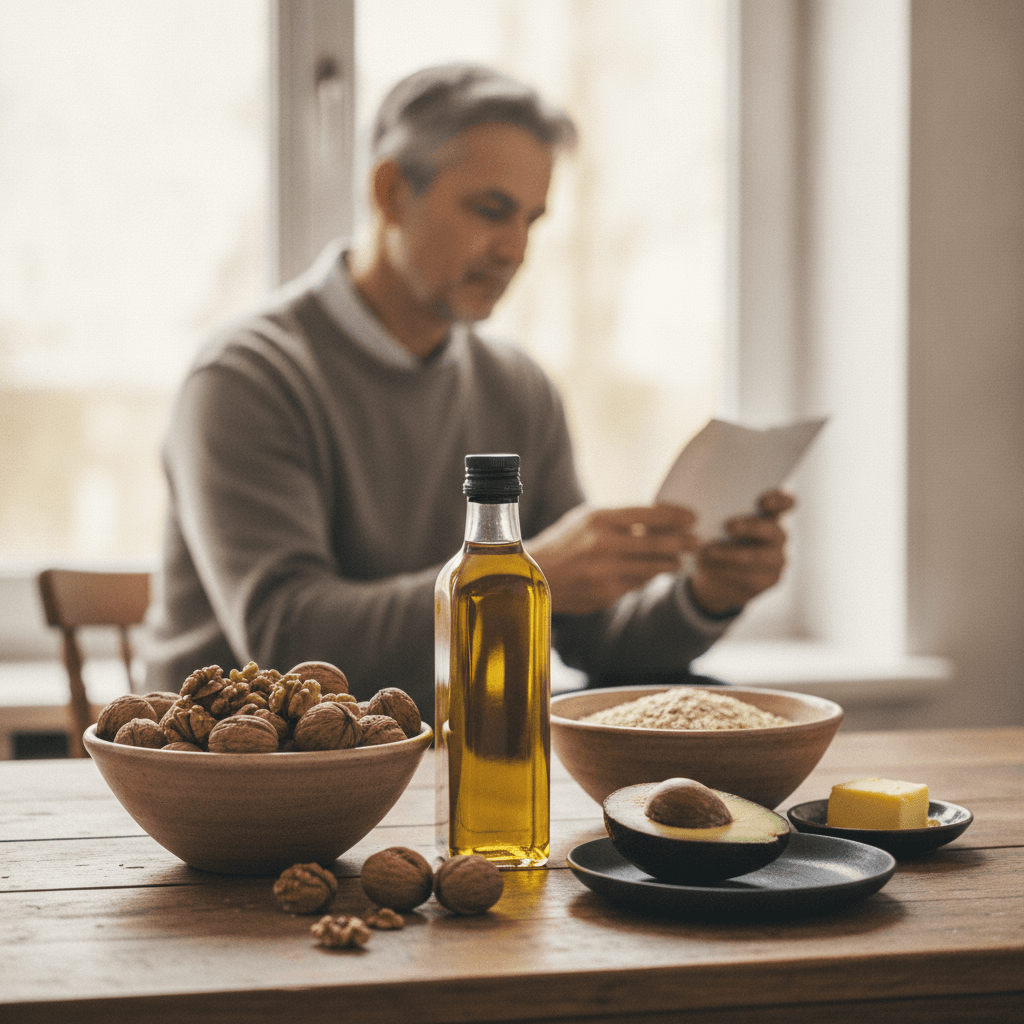
The foods that raise LDL cholesterol the most in controlled trials are the ones high in saturated fat and trans fat: butter, palm oil, and in several analyses coconut oil, plus partially hydrogenated oils. Dietary cholesterol, added sugars and a compound in unfiltered coffee raise LDL by smaller amounts. In the trials below, one food or swap typically moved LDL by about 5 to 20 mg/dL, and replacing saturated fat with unsaturated fat has the most trial evidence behind it.
Below you'll find the foods that raised LDL in randomized trials and how much, a table of swaps that lowered it, what happened to heart disease in trials that reduced saturated fat, and what to know about how far food alone moves LDL. Trial results are given in the unit each paper used; 1 mmol/L of LDL equals about 38.7 mg/dL.
Foods That Raise LDL: What Controlled Trials Measured
| Food or ingredient | What the trials found for LDL | Study |
|---|---|---|
| Butter | 50 g a day for 4 weeks raised LDL 0.38 mmol/L (about 15 mg/dL) more than the same amount of olive oil, and 0.42 mmol/L more than coconut oil, in 91 adults | Khaw 2018 |
| Coconut oil | In 16 trials, 10.47 mg/dL higher LDL than nontropical vegetable oils (and 4.00 mg/dL higher HDL); in the one head-to-head trial above, no different from olive oil | Neelakantan 2020 |
| Palm oil | 0.24 mmol/L (about 9 mg/dL) higher LDL than vegetable oils low in saturated fat; 0.31 mmol/L in randomized trials only | Sun 2015 |
| Trans fat | LDL 0.37 mmol/L (14 mg/dL) higher than on an olive-oil-type fat (oleic acid), and HDL 0.17 mmol/L (7 mg/dL) lower | Mensink 1990 |
| Dietary cholesterol | LDL 6.7 mg/dL higher across 14 trials; the rise was no longer significant at doses above 900 mg a day | Berger 2015 |
| Eggs | LDL 5.55 mg/dL higher, HDL 2.13 mg/dL higher and the LDL-to-HDL ratio unchanged, compared with low-egg diets | Rouhani 2018 |
| Added sugars | Higher against lower sugar intakes: LDL 0.12 mmol/L (about 5 mg/dL) higher and triglycerides 0.11 mmol/L higher, independent of weight change | Te Morenga 2014 |
| Red and white meat | LDL and apolipoprotein B higher than with nonmeat protein, whatever the saturated fat content; red and white meat did not differ significantly | Bergeron 2019 |
| Unfiltered coffee (cafestol) | Pure cafestol at 61 to 64 mg a day for 28 days raised LDL 0.57 mmol/L (22 mg/dL) in 10 men | Urgert 1997 |
The sources are Khaw 2018, Neelakantan 2020, Sun 2015, Mensink 1990, Berger 2015, Rouhani 2018, Te Morenga 2014, Bergeron 2019 and Urgert 1997. Each deserves a few details.
Saturated fat: butter, palm oil and coconut oil
Saturated fat is the best-established dietary driver of LDL. In a meta-analysis of 60 controlled trials, replacing saturated fat with cis unsaturated fat (the kind in olive, canola and nut oils) lowered the ratio of total to HDL cholesterol, while replacing it with carbohydrate did not change that ratio (Mensink 2003). Butter raised LDL most in the trial above, and the pooled analysis of palm oil found LDL rose as expected from its saturated fat content.
Coconut oil is the one place the trials disagree. The pooled analysis of 16 trials found it raised LDL against nontropical oils, but in the 4-week trial of 91 adults coconut oil and olive oil gave the same LDL and butter was higher than both. The 4-week trial was small, and the pooled analysis mixed comparison oils and trial lengths, so neither settles it. What both agree on is that coconut oil raised HDL as well.
Trans fat
The classic trial gave healthy adults diets that differed in the type of fat. Trans fat raised LDL and lowered HDL, so the authors concluded its effect on blood fats was at least as unfavorable as that of saturated fat (Mensink 1990). HDL on the saturated-fat diet was the same as on the olive-oil-type diet, so trans fat was the one that moved both numbers the wrong way.
Dietary cholesterol and eggs
Dietary cholesterol raised LDL in trials by 6.7 mg/dL on average, a small amount. In 17 cohorts with 361,923 people dietary cholesterol was not significantly associated with coronary artery disease, ischemic stroke or hemorrhagic stroke (Berger 2015). Eggs raised LDL by 5.55 mg/dL but also raised HDL, leaving the ratio unchanged (Rouhani 2018). The review's own conclusion was that the studies were too varied to say what dietary cholesterol does to heart disease risk.
Added sugars and refined carbohydrates
Higher sugar intakes raised LDL by 0.12 mmol/L and triglycerides by 0.11 mmol/L across 39 trials, and the relation held even when body weight did not change (Te Morenga 2014). The American Heart Association's advisory adds that replacing saturated fat with mostly refined carbohydrates and sugars "is not associated with lower rates of CVD and did not reduce CVD in clinical trials" (Sacks 2017).
Meat
In a controlled-feeding trial, LDL cholesterol and apolipoprotein B were higher on red meat and on white meat than on nonmeat protein sources, and this was independent of how much saturated fat the diets contained. The increase was mainly in large LDL particles, and the results did not favor white meat over red (Bergeron 2019).
Unfiltered coffee
Cafestol, a compound found in unfiltered coffee brews, raised LDL in a small crossover trial of 10 healthy men taking a pure dose, and the effect grew with dose (Urgert 1997). It is a result for a pure compound at a fixed dose, not for a cup of coffee, and it shows how a food outside the usual "fat" list can move LDL.
Swaps That Lowered LDL in Trials
| Swap or addition | What the trials found | Study |
|---|---|---|
| Unsaturated vegetable oil in place of saturated fat | Trials that did this reduced cardiovascular disease by about 30%, per the American Heart Association's review; safflower and rapeseed (canola) oil ranked highest for lowering LDL among 13 oils and solid fats in 54 trials | Sacks 2017; Schwingshackl 2018 |
| Olive oil in place of butter | LDL 0.38 mmol/L (about 15 mg/dL) lower at 50 g a day for 4 weeks | Khaw 2018 |
| Cheese in place of butter, at equal fat | Cheese gave lower LDL than butter and did not raise LDL compared with the usual diet over 6 weeks | Hjerpsted 2011 |
| Nonmeat protein in place of meat | Lower LDL and apolipoprotein B than red or white meat | Bergeron 2019 |
| Tree nuts, each daily serving | LDL 4.8 mg/dL lower per serving a day in 61 trials with 2,582 people; larger effects at 60 g a day or more | Del Gobbo 2015 |
| Oat beta-glucan, 3 g a day or more | LDL 0.25 mmol/L (about 10 mg/dL) lower, more so when LDL started higher | Whitehead 2014 |
Details are in Mensink 2003, Schwingshackl 2018, Hjerpsted 2011, Del Gobbo 2015 and Whitehead 2014. Two features of these results are worth noting. First, what you replace the saturated fat with matters: unsaturated fat helped, refined carbohydrate and sugar did not. Second, nuts and oats lowered LDL by adding something, not only by removing something, and both effects were measured in the range of 5 to 10 mg/dL.
For the full eating patterns built from these swaps, see our heart healthy diet guide and our best diet for high cholesterol guide, and for what a practical week looks like against your own blood work, how to lower LDL cholesterol.
Did Cutting Saturated Fat Change Heart Disease in Trials?
A 2020 Cochrane review of 15 randomized trials with about 59,000 people found that reducing saturated fat for at least two years lowered combined cardiovascular events by 21% (risk ratio 0.79, 95% CI 0.66 to 0.93; 11 trials). The same review found little or no effect on all-cause mortality (risk ratio 0.96) or on cardiovascular mortality (0.95), and small reductions in LDL cholesterol, total cholesterol, weight and BMI. In primary prevention, 56 people had to reduce saturated fat for about four years for one to avoid a cardiovascular event (Hooper 2020). It found no evidence of harm from the reduction, and greater drops in cholesterol went with greater drops in risk.
How Far Food Alone Moves LDL
The effects above are averages, and individual responses vary. Each change in these trials is small: single foods moved LDL by about 5 to 20 mg/dL. Several together can add up, but for someone whose LDL is far above range, food alone may not be enough. A blood test is the only way to know your own number. If your LDL is high, if heart disease runs in your family at a young age, or if you take cholesterol meds, ask a doctor before changing how you eat or stopping anything, because food is one part of the picture and genetics and other factors are the others.
Our Cholesterol goal page grades the ingredients and products people take for it against human studies; this article covers the food side, and you can browse every goal we grade.
Frequently Asked Questions
What foods raise LDL the most?
In the trials above, trans fat, butter, palm oil and, in pooled analyses, coconut oil raised LDL most, by roughly 9 to 15 mg/dL against comparison fats. Eggs, dietary cholesterol and added sugars raised it by smaller amounts, about 5 to 7 mg/dL. Cafestol from unfiltered coffee raised it by 22 mg/dL, but that was a pure compound in 10 men.
What foods raise LDL and lower HDL?
Trans fat did both in the classic feeding trial: LDL went up 14 mg/dL and HDL down 7 mg/dL compared with an olive-oil-type fat. Saturated fats did not lower HDL in that trial.
What foods raise LDL and triglycerides?
Added sugars. Across 39 trials, higher sugar intakes raised LDL by 0.12 mmol/L and triglycerides by 0.11 mmol/L, independent of weight change.
Do eggs raise LDL cholesterol?
Slightly. Pooled trials found eggs raised LDL by 5.55 mg/dL and HDL by 2.13 mg/dL, leaving the LDL-to-HDL ratio unchanged. Whether that changes heart outcomes was not tested in those trials.
Is butter worse than olive oil for LDL?
In the one head-to-head trial, yes: 50 g a day of butter raised LDL 0.38 mmol/L more than olive oil over four weeks. Cheese at the same fat content did not raise LDL compared with the usual diet.
Does coconut oil raise LDL?
Pooled trials say yes, by about 10 mg/dL against nontropical vegetable oils. One 4-week trial found it equal to olive oil for LDL. It also raised HDL in both.
Sources
Hooper L, Martin N, Jimoh OF et al. Reduction in saturated fat intake for cardiovascular disease. Cochrane Database of Systematic Reviews, 2020. PubMed.
Sacks FM, Lichtenstein AH, Wu JHY et al. Dietary fats and cardiovascular disease: a presidential advisory from the American Heart Association. Circulation, 2017. PubMed.
Mensink RP, Zock PL, Kester AD, Katan MB. Effects of dietary fatty acids and carbohydrates on the ratio of serum total to HDL cholesterol and on serum lipids and apolipoproteins: a meta-analysis of 60 controlled trials. The American Journal of Clinical Nutrition, 2003. PubMed.
Khaw KT, Sharp SJ, Finikarides L et al. Randomised trial of coconut oil, olive oil or butter on blood lipids and other cardiovascular risk factors in healthy men and women. BMJ Open, 2018. PubMed.
Neelakantan N, Seah JYH, van Dam RM. The effect of coconut oil consumption on cardiovascular risk factors: a systematic review and meta-analysis of clinical trials. Circulation, 2020. PubMed.
Sun Y, Neelakantan N, Wu Y et al. Palm oil consumption increases LDL cholesterol compared with vegetable oils low in saturated fat in a meta-analysis of clinical trials. The Journal of Nutrition, 2015. PubMed.
Schwingshackl L, Bogensberger B, Benčič A et al. Effects of oils and solid fats on blood lipids: a systematic review and network meta-analysis. Journal of Lipid Research, 2018. PubMed.
Mensink RP, Katan MB. Effect of dietary trans fatty acids on high-density and low-density lipoprotein cholesterol levels in healthy subjects. The New England Journal of Medicine, 1990. PubMed.
Berger S, Raman G, Vishwanathan R et al. Dietary cholesterol and cardiovascular disease: a systematic review and meta-analysis. The American Journal of Clinical Nutrition, 2015. PubMed.
Rouhani MH, Rashidi-Pourfard N, Salehi-Abargouei A et al. Effects of egg consumption on blood lipids: a systematic review and meta-analysis of randomized clinical trials. Journal of the American College of Nutrition, 2018. PubMed.
Te Morenga LA, Howatson AJ, Jones RM, Mann J. Dietary sugars and cardiometabolic risk: systematic review and meta-analyses of randomized controlled trials of the effects on blood pressure and lipids. The American Journal of Clinical Nutrition, 2014. PubMed.
Bergeron N, Chiu S, Williams PT et al. Effects of red meat, white meat, and nonmeat protein sources on atherogenic lipoprotein measures in the context of low compared with high saturated fat intake: a randomized controlled trial. The American Journal of Clinical Nutrition, 2019. PubMed.
Urgert R, Essed N, van der Weg G et al. Separate effects of the coffee diterpenes cafestol and kahweol on serum lipids and liver aminotransferases. The American Journal of Clinical Nutrition, 1997. PubMed.
Hjerpsted J, Leedo E, Tholstrup T. Cheese intake in large amounts lowers LDL-cholesterol concentrations compared with butter intake of equal fat content. The American Journal of Clinical Nutrition, 2011. PubMed.
Del Gobbo LC, Falk MC, Feldman R et al. Effects of tree nuts on blood lipids, apolipoproteins, and blood pressure: systematic review, meta-analysis, and dose-response of 61 controlled intervention trials. The American Journal of Clinical Nutrition, 2015. PubMed.
Whitehead A, Beck EJ, Tosh S, Wolever TM. Cholesterol-lowering effects of oat β-glucan: a meta-analysis of randomized controlled trials. The American Journal of Clinical Nutrition, 2014. PubMed.