
A heart healthy diet is built mostly from vegetables, fruit, whole grains, beans, nuts, fish and olive oil, with little salt, processed meat or added sugar. In controlled trials, eating this way lowered blood pressure within eight weeks and LDL cholesterol within four. In a trial of 7,447 older adults, a Mediterranean diet with extra olive oil or nuts saw about 30% fewer major heart and blood-vessel events than a low-fat diet.
This guide sets out the four eating patterns with the best trial evidence and the foods that did the work in them. It also gives a simple day of meals and shows where supplements fit. For blood pressure on its own, see our DASH diet guide. For cholesterol, see the best diet for cholesterol and how to lower LDL cholesterol.
Heart Healthy Diet at a Glance: The Patterns the Trials Back
These four ways of eating were tested in randomized trials, so the results come from comparison with another diet, not from people's food diaries.
| Pattern | What you eat | What the trial showed |
|---|---|---|
| DASH | Vegetables, fruit and low-fat dairy, with less saturated and total fat | Blood pressure 5.5/3.0 mm Hg lower than a typical American diet after 8 weeks in 459 adults, and 11.4/5.5 lower in those who started with high readings (Appel 1997) |
| DASH with less salt | The same, with less sodium | Systolic pressure 7.1 mm Hg lower in people with normal readings and 11.5 lower in people with high readings than a typical diet high in salt, in 412 adults (Sacks 2001) |
| Mediterranean | Extra-virgin olive oil or nuts, vegetables, fruit, beans, fish and whole grains | About 30% fewer major heart and blood-vessel events than a reduced-fat diet in 7,447 adults at high risk, over about five years (Estruch 2018) |
| Portfolio | Plant sterols, soy protein, oats, barley and psyllium fiber, and almonds | LDL cholesterol down 28.6% in four weeks, close to the 30.9% of a cholesterol-lowering med in the same trial of 46 adults (Jenkins 2003) |
Taking supplements too? Check them against each other and your meds.
The Foods That Did the Work in a Heart Healthy Diet
Vegetables, fruit and beans
Both DASH diets were rich in vegetables and fruit. In the first DASH trial, a diet that only added vegetables and fruit lowered systolic pressure by 2.8 mm Hg; adding low-fat dairy and cutting fat doubled the effect to 5.5 (Appel 1997). Beans and lentils sit in the Mediterranean and portfolio diets as the main plant protein.
Oats, barley and other soluble fiber
Oats carry a soluble fiber called beta-glucan. Across 58 trials of 3,974 people, a median of 3.5 g of oat beta-glucan a day lowered LDL cholesterol by 0.19 mmol/L, about 7 mg/dL (Ho 2016). Psyllium is the other well-studied soluble fiber; our psyllium page and soluble fiber page show the human studies.
Nuts
Across 61 trials of 2,582 people, each daily serving of tree nuts lowered LDL cholesterol by 4.8 mg/dL, with stronger effects at about 60 g a day (Del Gobbo 2015). The type of nut mattered less than the amount. Nuts were one of the two foods added in the Mediterranean trial.
Olive oil
The other was extra-virgin olive oil, used freely for cooking and dressing. The olive-oil group had 3.8% major events against 4.4% in the reduced-fat group (Estruch 2018). Our olive oil page lists the human studies by goal.
Fish
The American Heart Association suggests one to two seafood meals a week, especially in place of less healthy foods (Rimm 2018). Salmon, sardines, mackerel and trout carry the most omega-3 fats.
Plant sterols and stanols
Plant sterols are found in small amounts in nuts, seeds and vegetable oils, and in larger amounts in fortified spreads, yogurt drinks and supplements. Across 124 studies, 0.6 to 3.3 g a day lowered LDL cholesterol by 6% to 12%, with little added above about 3 g (Ras 2014). See our plant sterols page.
Less salt
Cutting sodium lowered blood pressure on both the typical diet and the DASH diet, and the two together did more than either alone (Sacks 2001). Most salt comes from packaged and restaurant food, not the salt shaker.
The American Heart Association Diet in 10 Points
The American Heart Association's 2021 dietary guidance sums up a heart healthy diet in ten features (Lichtenstein 2021):
Balance what you eat and drink with how active you are, to keep a healthy weight.
Eat plenty of fruit and vegetables, in a wide variety.
Choose whole grains over refined grains.
Choose healthy protein: mostly plants such as beans and nuts, fish and seafood, low-fat dairy, and lean, unprocessed meat if you eat meat.
Use liquid plant oils such as olive oil instead of tropical oils and animal fats.
Choose minimally processed foods over ultra-processed ones.
Keep added sugar low in food and drinks.
Choose and prepare foods with little or no salt.
Limit alcohol, and don't start drinking if you don't.
Follow this wherever food is made or eaten: at home, at work and eating out.
A Heart Healthy Diet Plan for One Day
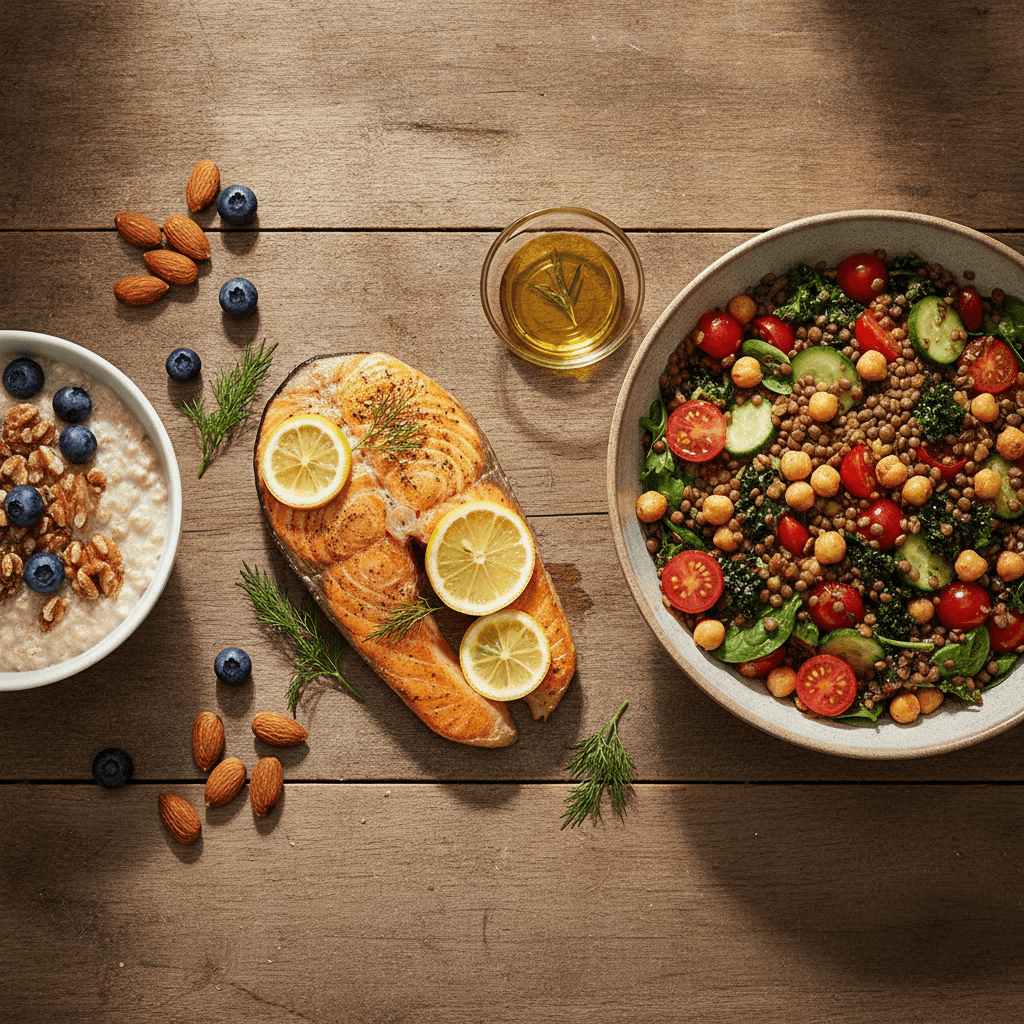
This sample day puts the trial foods on a plate. It is a pattern to adapt, not a prescription:
Breakfast: oatmeal cooked in milk or soy milk, topped with walnuts and berries.
Lunch: a lentil and vegetable salad with chickpeas, leafy greens, tomatoes, and an extra-virgin olive oil and lemon dressing.
Snack: a small handful of almonds and a piece of fruit.
Dinner: baked salmon or sardines, roasted vegetables and brown rice or barley, seasoned with herbs and garlic instead of salt.
Drinks: water, unsweetened tea or coffee; little or no alcohol.
Where Supplements Fit in a Heart Healthy Diet
In the trials above, food did the work. Some people add supplements on top. In the human studies we have graded:
For cholesterol: plant sterols and stanols show a clear improvement in 11 meta-analyses, berberine in 9 from 600 mg a day, and omega-3 fats in 4. Our Cholesterol page ranks the products against these studies.
For blood pressure: potassium shows a clear improvement in 3 meta-analyses (the largest of 34,961 people), hibiscus in 7, CoQ10 in 7, beet root in 2 and magnesium in 2. Our Blood Pressure page ranks the products.
See the potassium, hibiscus, berberine and omega-3 pages for the dose that worked in each set of studies.
If you take meds: salt substitutes are mostly potassium, and potassium, berberine and some other supplements can change how meds work or how the body handles them. Grapefruit can change how some meds are absorbed too. Check with your doctor or pharmacist before you add supplements or switch to a salt substitute, and see our guide to supplement and med interactions.
Build Your Heart Healthy Diet Into One Daily Protocol
Rala, the AI behind Reverse Age Lab, builds each member one Daily Protocol that covers food, exercise and supplements together. It checks every product you take against your meds and the upper limits, then fits it to your goals. Build my protocol, with food and supplements matched to my goals.
Is this medical advice? No. This guide sets out the published research on heart healthy eating; it is not a diagnosis, and Rala isn't a medical device or a clinician. Talk to your doctor before changing your diet in a big way, especially if you take meds.
Frequently Asked Questions
What is a heart healthy diet?
A way of eating built on vegetables, fruit, whole grains, beans, nuts, fish and olive oil, with little salt, processed meat, refined grains or added sugar. The DASH, Mediterranean and portfolio diets are the versions tested in trials.
What foods are good for the heart?
The foods that did the work in the trials: vegetables and fruit, oats and barley, beans and lentils, tree nuts, extra-virgin olive oil, fish one to two times a week, and foods with plant sterols. Less salt mattered too.
What is the best heart healthy diet?
The trials point to three: DASH lowered blood pressure most, the portfolio diet lowered LDL cholesterol most, and the Mediterranean diet with olive oil or nuts had the longest trial with fewer heart and blood-vessel events. They share most of their foods, so you can mix them.
How fast does a heart healthy diet work?
In the trials, blood pressure fell within eight weeks on DASH and LDL cholesterol fell 28.6% within four weeks on the portfolio diet. The Mediterranean trial followed people for about five years.
Sources
Appel LJ, Moore TJ, Obarzanek E et al. A clinical trial of the effects of dietary patterns on blood pressure. DASH Collaborative Research Group. New England Journal of Medicine, 1997. PubMed.
Sacks FM, Svetkey LP, Vollmer WM et al. Effects on blood pressure of reduced dietary sodium and the DASH diet. New England Journal of Medicine, 2001. PubMed.
Estruch R, Ros E, Salas-Salvadó J et al. A Mediterranean diet supplemented with extra-virgin olive oil or nuts and major heart and blood-vessel events. New England Journal of Medicine, 2018. PubMed.
Jenkins DJ, Kendall CW, Marchie A et al. Effects of a dietary portfolio of cholesterol-lowering foods vs a cholesterol-lowering med on serum lipids and C-reactive protein. JAMA, 2003. PubMed.
Ho HV, Sievenpiper JL, Zurbau A et al. The effect of oat β-glucan on LDL-cholesterol, non-HDL-cholesterol and apoB: a systematic review and meta-analysis of randomised-controlled trials. British Journal of Nutrition, 2016. PubMed.
Del Gobbo LC, Falk MC, Feldman R et al. Effects of tree nuts on blood lipids, apolipoproteins, and blood pressure: systematic review, meta-analysis, and dose-response of 61 controlled intervention trials. American Journal of Clinical Nutrition, 2015. PubMed.
Rimm EB, Appel LJ, Chiuve SE et al. Seafood long-chain omega-3 fatty acids and heart health: a science advisory from the American Heart Association. Circulation, 2018. PubMed.
Ras RT, Geleijnse JM, Trautwein EA. LDL-cholesterol-lowering effect of plant sterols and stanols across different dose ranges: a meta-analysis of randomised controlled studies. British Journal of Nutrition, 2014. PubMed.
Lichtenstein AH, Appel LJ, Vadiveloo M et al. 2021 dietary guidance to improve cardiovascular health: a scientific statement from the American Heart Association. Circulation, 2021. PubMed.