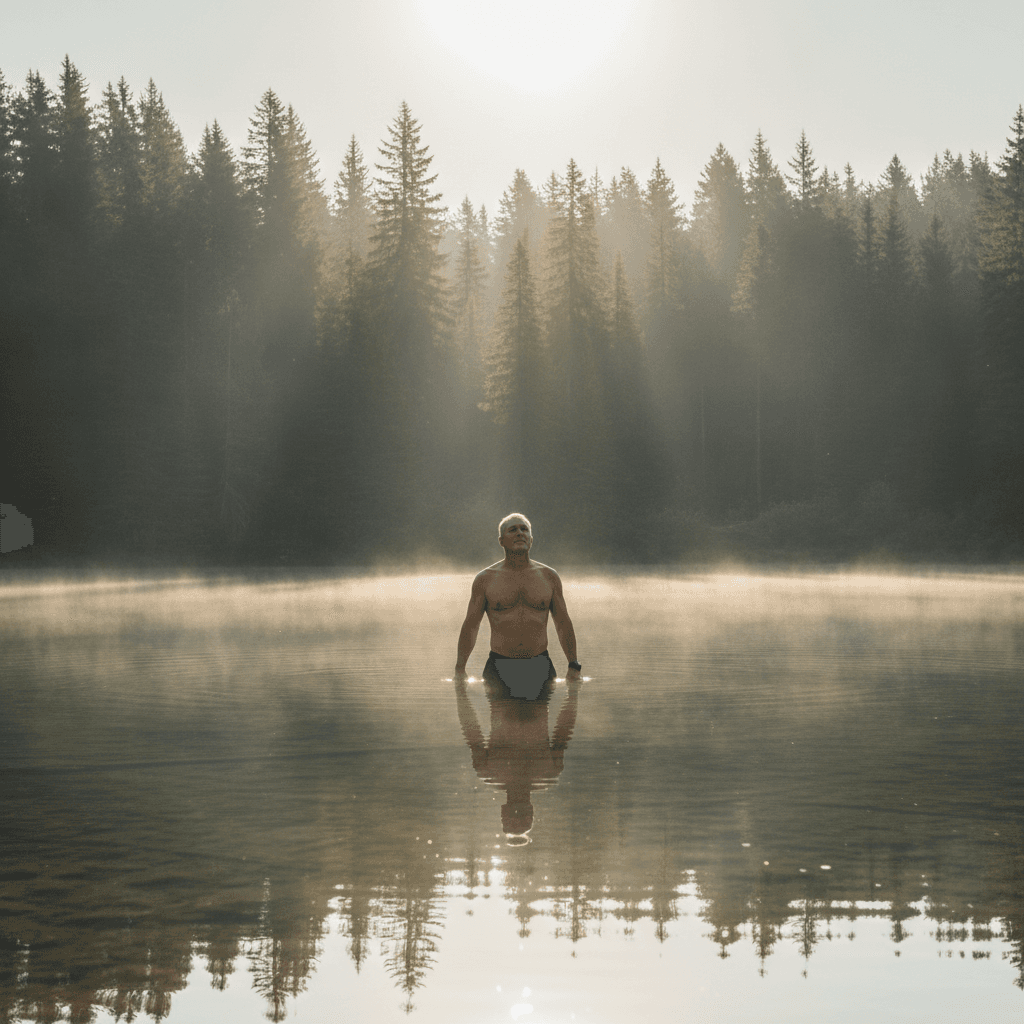
A cold plunge has a few real effects in human trials and many claims that run ahead of them. Cold water, in a plunge or a shower, sets off a sharp rise in noradrenaline and heart rate, and the cold water benefits that held up in randomized trials are modest: lower stress 12 hours later, fewer self-reported sick days from work with daily cold showers, and less muscle soreness after hard exercise. Mood did not clearly improve, and regular cold plunges after strength training led to smaller muscle gains.
Below you'll find what cold water does to the body in the first minutes, what each claim looks like in the trials, a table separating evidence from hype, the trade-off for anyone lifting weights, who should not try a cold plunge without asking a doctor, and how cold water fits next to habits with stronger evidence.
What a Cold Plunge Does to the Body in the First Minutes
The first minute or two in cold water brings the "cold shock" response: a gasp, fast breathing that you cannot easily control, and a jump in heart rate and blood pressure. It is a reflex triggered by the skin cooling quickly, and it is the main danger in cold water, because a gasp under water or a heart rhythm upset can follow (Datta 2006).
The hormone surge behind most of the claims was measured in young men sitting in water up to the neck for an hour. At 14°C (57°F), their noradrenaline rose by 530% and dopamine by 250%, their energy use rose by 350%, and heart rate and blood pressure rose a little. Cortisol, the main stress hormone, tended to fall rather than rise (Šrámek 2000). Those numbers are real, but they describe a full hour, not the two or three minutes of a typical plunge, and they show a change in blood levels, not a change in how people feel or function.
The body adapts quickly. A pooled analysis of 17 groups found that repeated immersions shrank the cold shock response, with the rise in heart rate about 14 beats a minute smaller and breathing calmer, and earlier work found this after about four immersions (Barwood 2024).
Cold Water Benefits: What a Cold Plunge Does in Human Trials
The best summary is a 2025 pooled analysis of 11 randomized trials with 3,177 healthy adults who used cold showers, ice baths or plunges at 7 to 15°C (45 to 59°F) for 30 seconds to two hours (Cain 2025). Its findings, claim by claim, follow, with the other trials that add to them.
Stress and sleep
Stress was lower 12 hours after cold water immersion, a large effect, but there was no change immediately, at one hour, at 24 hours or at 48 hours. Sleep quality and quality of life improved in the trials that measured them (Cain 2025). So the effect on stress appears to be short-lived and was seen at only one time point.
Sick days
In the largest single trial, 3,018 Dutch adults with no experience of cold showers ended their usual warm shower with 30, 60 or 90 seconds of cold water every day for 30 days, or carried on as normal. The cold shower groups reported 29% fewer days off work sick, but no fewer days of feeling ill. The length of the cold spell made no difference, and no serious side effects were reported (Buijze 2016). People knew which group they were in and reported their own sick days, so expectation may explain part of the result.
Mood
The 2025 pooled analysis found no clear effect on mood (Cain 2025). A 2026 review of 13 studies with 4,105 people, which also included winter swimming and studies without a comparison group, found results that leaned towards better mood, wellbeing and perceived stress. But the ranges were wide, most studies had a high risk of bias, and the effects shrank in the controlled studies alone. The authors concluded that the evidence does not show that cold water improves mood or stress (Ngandeu Schepanski 2026).
Inflammation and immunity
Cold water raised markers of inflammation immediately and one hour afterwards, an acute response rather than a calming one. Immune measures did not change in the hours after a plunge (Cain 2025). The fewer sick days in the shower trial is the only sign of a longer-term effect.
Muscle soreness after exercise
A pooled analysis of 28 studies in active people found that a cold water bath after hard exercise was better than other recovery methods for muscle soreness, and about the same for muscle power and flexibility. It beat active recovery, warm water and alternating hot and cold water for most measures, while cold air chambers did better for strength. Water temperature and time in the water made little difference (Moore 2023).
Metabolism and brown fat
Brown fat burns energy to make heat. In a Danish study, young men who swam in winter two to three times a week, with sauna sessions, burned more energy than non-swimmers when cooled, and the authors proposed winter swimming as a possible way to raise energy use (Søberg 2021). It compared two groups rather than testing cold water in a trial, and it measured energy use, not weight. No trial in the 2025 pooled analysis tested weight loss (Cain 2025).
Cold Plunge: Evidence vs Hype
| Claim | What the human studies show | How strong |
|---|---|---|
| Lowers stress | Lower 12 hours after; no change at other times | Moderate, short-lived |
| Fewer sick days | 29% fewer self-reported days off work; illness days unchanged | One large trial, self-reported |
| Better mood | No clear effect in randomized trials | Weak |
| Better sleep | Better sleep quality in the trials that measured it | Few trials |
| Less muscle soreness | Better than other recovery methods after hard exercise | Good, 28 studies |
| Builds muscle | Smaller muscle gains when used after strength training | Two trials against it |
| "Boosts dopamine" | Blood dopamine up 250% after an hour at 14°C | Real, but an hour, not a quick dip |
| Weight loss | More energy use in winter swimmers; no weight-loss trial | Not tested |
| Lowers inflammation | Inflammation markers went up in the first hour | Against the claim |
The Trade-Off if You Lift Weights
Cold water after strength training appears to blunt muscle growth. In a 12-week trial, 21 active men who sat in cold water for 10 minutes after each session gained less strength and muscle than men who did an active cool-down, and their muscle fibres did not grow (Roberts 2015). In a 7-week trial of 16 men, 15 minutes at 10°C (50°F) after each session left strength gains unchanged but blunted the growth of muscle fibres (Fyfe 2019). Both trials were small. If building muscle is the goal, the trials suggest keeping cold water away from the hours after lifting; for soreness after a race or a hard match, it did well.
Who Should Not Try a Cold Plunge Without Asking a Doctor
Cold water can be dangerous. The cold shock reflex, the sudden rise in heart rate and blood pressure, and the gasp are the reasons cold water is linked to drowning and to heart rhythm problems, and a review of the field found that some of the popular health claims rest on little more than anecdote (Tipton 2017; Datta 2006). Talk to your doctor first if you have a heart condition, chest pain, fainting spells or problems with blood pressure; if you take meds that affect heart rate or blood pressure; if you are pregnant; or if cold makes your fingers turn white or numb. Never plunge alone in open water, keep your head above water, and get out if you start shivering hard or feel confused.
How to Try a Cold Plunge if You Choose To
The trials give a rough guide. The simplest is the one used in the sick-day trial: end a normal warm shower with 30 to 90 seconds of cold water, where 30 seconds did as well as 90 (Buijze 2016). Plunge trials used 7 to 15°C (45 to 59°F), so water does not need to be ice cold (Cain 2025). Start with short exposures and give your body four or more sessions to adapt before going colder or longer (Barwood 2024), and save cold plunges for days you are not lifting weights if muscle is your goal.
Where Cold Water Fits Next to Habits With Stronger Evidence
If stress is the reason you are thinking about cold water, our Stress and Calm goal page shows each supplement studied for stress and calm, graded by the human studies behind it, and you can browse every goal we grade. If the aim is metabolism, eating patterns have a larger trial base than cold water: see our intermittent fasting guide. And if you have read that cold water helps digestion, our guide to improving gut health naturally covers the habits with human studies behind them.
Rala, the AI behind Reverse Age Lab, builds each member one Daily Protocol covering supplements, diet, sleep and exercise from their Health Profile and goals, with each supplement checked against your meds. Blood work is optional. Build My Protocol – 7-Day Free Trial.
Is this medical advice? No. This guide sets out published studies of cold water exposure; it is not a diagnosis, and Rala isn't a medical device or a clinician. Talk to your doctor before trying cold plunges, especially if you take meds or have any heart or blood pressure concerns.
Bottom Line
Cold water is a strong jolt to the body, with real changes in hormones and heart rate. In randomized trials it may help with short-term stress, sleep quality, self-reported sick days and soreness after hard exercise. It did not clearly improve mood, it raised inflammation markers at first, it has not been tested for weight loss, and after strength training it held back muscle growth. Short cold showers carry the least risk; cold plunges in open water carry the most.
Frequently Asked Questions
Are cold plunges good for you?
For healthy adults, a cold plunge may help with stress 12 hours later, sleep quality and muscle soreness after hard exercise, according to pooled trials. It did not clearly help mood, and after strength training it reduced muscle gains. The cold shock response makes it risky for people with heart or blood pressure problems.
What are the main cold water benefits backed by research?
Less muscle soreness after hard exercise has the most studies behind it (28 in one pooled analysis). Lower stress at 12 hours, better sleep quality and 29% fewer self-reported sick days with daily cold showers come from fewer trials. Claims about weight loss and lower inflammation are not supported by the trials so far.
Is a cold shower as good as a cold plunge?
No trial has compared them head to head. The sick-day result came from cold showers of 30 to 90 seconds, while most stress and recovery trials used baths or plunges at 7 to 15°C. A cold shower is the gentler option and easier to stop.
How long should a cold plunge be?
Trials ranged from 30 seconds to two hours, and in the recovery studies the time in the water made little difference. In the shower trial, 30 seconds did as well as 90. Short exposures, built up slowly, carry the least risk.
Does cold water help you lose weight?
It has not been shown to. Winter swimmers burned more energy when cooled than non-swimmers in one study, but no trial has tested cold water for weight loss.
Sources
Datta A, Tipton M. Respiratory responses to cold water immersion: neural pathways, interactions, and clinical consequences awake and asleep. Journal of Applied Physiology, 2006. PubMed.
Šrámek P, Šimečková M, Janský L et al. Human physiological responses to immersion into water of different temperatures. European Journal of Applied Physiology, 2000. PubMed.
Barwood MJ, Eglin C, Hills SP et al. Habituation of the cold shock response: a systematic review and meta-analysis. Journal of Thermal Biology, 2024. PubMed.
Cain T, Brinsley J, Bennett H et al. Effects of cold-water immersion on health and wellbeing: a systematic review and meta-analysis. PLoS One, 2025. PubMed.
Buijze GA, Sierevelt IN, van der Heijden BC et al. The effect of cold showering on health and work: a randomized controlled trial. PLoS One, 2016. PubMed.
Ngandeu Schepanski S, Batta F, Schröter M et al. Cold-water exposure and psychological outcomes in adults: a systematic review and meta-analysis. Frontiers in Physiology, 2026. PubMed.
Moore E, Fuller JT, Bellenger CR et al. Effects of cold-water immersion compared with other recovery modalities on athletic performance following acute strenuous exercise in physically active participants: a systematic review, meta-analysis, and meta-regression. Sports Medicine, 2023. PubMed.
Søberg S, Löfgren J, Philipsen FE et al. Altered brown fat thermoregulation and enhanced cold-induced thermogenesis in young, healthy, winter-swimming men. Cell Reports Medicine, 2021. PubMed.
Roberts LA, Raastad T, Markworth JF et al. Post-exercise cold water immersion attenuates acute anabolic signalling and long-term adaptations in muscle to strength training. The Journal of Physiology, 2015. PubMed.
Fyfe JJ, Broatch JR, Trewin AJ et al. Cold water immersion attenuates anabolic signaling and skeletal muscle fiber hypertrophy, but not strength gain, following whole-body resistance training. Journal of Applied Physiology, 2019. PubMed.
Tipton MJ, Collier N, Massey H et al. Cold water immersion: kill or cure? Experimental Physiology, 2017. PubMed.