
Lifespan extension is the research effort to make people, or laboratory animals, live longer than they otherwise would. In animals it has been shown many times: worms, flies and mice live longer on certain diets, genes and compounds. In people, no trial has yet shown that any pill, supplement or routine adds years to life, because such a trial would need decades. What the human evidence does show is large differences in life expectancy between people with different habits, a two-year trial in which eating less slowed one blood measure of aging, and a demographic analysis that calls a big jump in human lifespan this century implausible.
This guide goes through what the animal studies found and why their results travel poorly, what the human studies can and cannot say, where supplements stand, and the difference between living longer and living longer in good health.
Lifespan Extension: What the Term Means
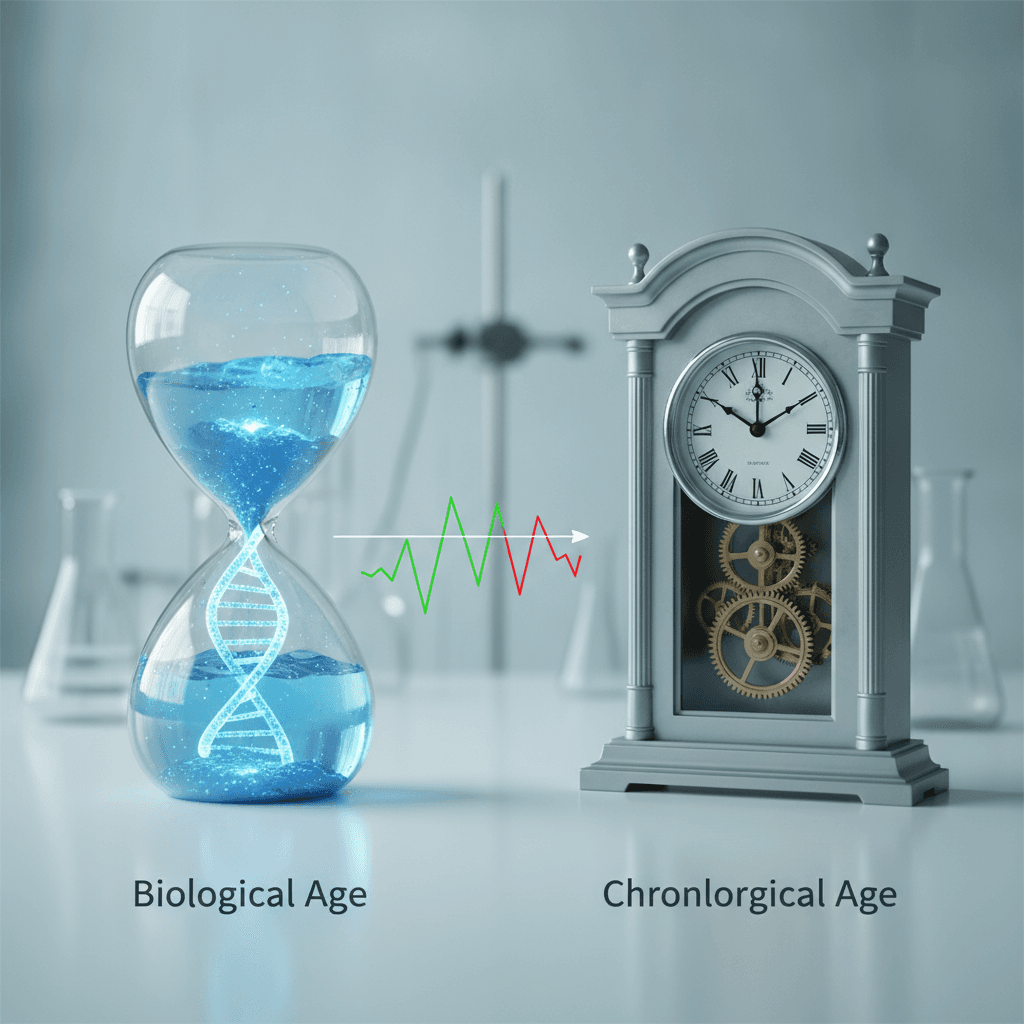
Lifespan is how long an organism lives. Life expectancy is the average number of years a group can expect to live, worked out from death rates. Healthspan is the part of life spent in good health. Research on lifespan extension asks whether the biology of aging itself can be slowed, so that many age-related problems arrive later at once. That idea, sometimes called the geroscience hypothesis, is the starting point of the human trial described below, and the authors of that trial say a conclusive test would need long follow-up of disease and death (Waziry 2023).
What the Animal Studies Show
Mice: Two Decades of a Testing Program
The US National Institute on Aging set up its Interventions Testing Program in 2004 to test candidate compounds in genetically mixed mice at more than one site, so that a result has to repeat. A 2025 review of the program counts 54 agents tested in more than 30,000 mice. Most compounds that extended lifespan worked mainly or only in male mice, and the dose and the age at which treatment started changed the result (Jiang 2025). Several of the compounds that worked are prescription meds, which is one more reason none of this is something to try at home.
Why Animal Results Travel Poorly
Two reviews show the limits. One compared results across species and found that lifespan studies in flies predicted mouse results only modestly, and studies in worms showed little predictive value for mice, so the authors urge caution about carrying results across species, people included (Bene 2023). Another reanalysed mouse studies and found that when the untreated control mice die young, a treatment can look more effective than it is; the authors propose trusting a result more when the controls lived close to 900 days or the treated mice lived well past that (Pabis 2024).
Monkeys and Eating Less
Eating fewer calories without malnutrition extends lifespan in most species studied. In rhesus monkeys two long studies disagreed: the University of Wisconsin study found better survival, the National Institute on Aging study did not. A joint analysis of both found that the health benefits held in monkeys and that the timing of onset and the diet changed the outcome (Mattison 2017).
What the Human Studies Show
The One Randomized Trial of a Slowing of Aging
In the CALERIE trial, 220 healthy adults of normal to slightly raised weight were assigned for two years to cut calories by 25% or to eat as usual. A later analysis of their blood found that the calorie-cut group's pace of aging, as measured by one DNA methylation measure called DunedinPACE, slowed. Several other blood "age clocks" did not change, and the effects were small (Waziry 2023). It measured a marker, not years of life, and it was not designed to.
Habits and Life Expectancy
The largest human numbers come from following people for decades. In two US cohorts of more than 123,000 adults followed for up to 34 years, five low-risk habits (never smoking, a body mass index of 18.5 to 24.9, at least 30 minutes a day of moderate or vigorous activity, moderate alcohol intake and a high diet quality score) went with a projected life expectancy at 50 that was 14.0 years longer for women and 12.2 years longer for men than having none of the five (Li 2018). These are observational: they compare people who already differ and cannot show that changing one habit adds a set number of years.
Two of the five have their own large analyses:
Smoking. In more than 200,000 US adults, current smokers lost more than 10 years of life expectancy compared with people who never smoked, and those who quit at 25 to 34, 35 to 44 or 45 to 54 gained about 10, 9 and 6 years compared with those who kept smoking (Jha 2013).
Steps. In 15 cohorts with 47,471 adults, more steps a day went with lower risk of death, levelling off at about 6,000 to 8,000 steps for adults 60 and older and 8,000 to 10,000 for younger adults (Paluch 2022).
How Far Human Lifespan Is Likely to Go
A demographic analysis of the longest-lived countries plus Hong Kong and the United States from 1990 to 2019 found that gains in life expectancy have slowed. It estimates that survival to 100 is unlikely to exceed 15% for women and 5% for men this century, and concludes that radical life extension is implausible unless the biology of aging can be slowed markedly (Olshansky 2024).
Where Supplements Stand
No supplement has been shown in a human trial to extend lifespan. The largest test of the idea is a review of 78 randomized trials with 296,707 people that found antioxidant supplements (beta-carotene, vitamin A, vitamin C, vitamin E and selenium) had no effect on death rates overall, and that beta-carotene and vitamin E seemed to increase them, as may higher doses of vitamin A (Bjelakovic 2012).
Ingredients sold for longevity, such as NMN or resveratrol, have human studies of blood markers and short-term measures, not of lifespan. Our ingredient pages grade each one by what its human studies found and show the tier, the doses that worked by form and what improved. Our healthy aging page ranks products against those studies.
Lifespan Extension vs Healthspan
Living longer and living longer in good health are different goals, and the studies above measure different things: the mouse studies count days of life, the CALERIE analysis measures a blood marker, and the cohort studies estimate years of life expectancy. For most people the near question is the healthspan one. Our articles on biological age, age reversal claims and the blue zones cover parts of it.
| Evidence | What it measured | What it found |
|---|---|---|
| Mouse testing program, 54 agents | Days of life | Some compounds extended life, mostly in males |
| Monkeys, two studies | Survival and health | Health benefits of eating less held; survival results differed |
| CALERIE trial, 220 adults, 2 years | Blood markers of aging | One pace-of-aging measure slowed a little; other clocks unchanged |
| Habit cohorts, 123,000 adults | Projected life expectancy | 12 to 14 more years with all five low-risk habits |
| Antioxidant trials, 296,707 people | Deaths | No benefit; some raised death rates |
Who Should Check With a Doctor First (People on Meds)
Talk to your doctor or pharmacist before cutting calories hard, starting a fasting routine or adding any supplement if you take meds, and before trying any compound sold on the strength of animal studies. Rala, the AI behind Reverse Age Lab, checks every product in your stack against your meds before it places anything in your protocol.
Is this medical advice? No. This guide describes studies; it is not a diagnosis or a treatment, and Rala isn't a medical device or a clinician. Animal results are not results in people.
See Where Your Own Stack Stands
If you take supplements for longevity, see what the human studies say about each one with Check My Stack, or let your Daily Protocol work from your health profile and your meds. Build My Protocol – 7-Day Free Trial.
Frequently Asked Questions
Has anything been shown to extend human lifespan?
No randomized trial has shown that a pill, supplement or routine adds years of life in people, because such a trial would take decades. Observational studies link habits such as not smoking, activity and diet quality to longer life expectancy, and one two-year trial of eating less slowed one blood marker of aging. If you take meds, ask your doctor or pharmacist first.
Does calorie restriction extend lifespan?
It extends lifespan in most animal species studied. In monkeys the health benefits held while survival results differed between two studies, and in people a two-year trial found a small slowing of one blood measure of aging, not a measure of years. If you take meds, ask your doctor or pharmacist first.
Do longevity supplements extend lifespan?
None has been shown to in a human trial. A review of 78 trials found antioxidant supplements had no effect on death rates, and beta-carotene and vitamin E seemed to raise them. If you take meds, ask your doctor or pharmacist first.
How long can humans live?
A demographic analysis estimates that survival to 100 is unlikely to exceed 15% for women and 5% for men this century, and calls radical life extension implausible unless aging itself can be slowed markedly. If you take meds, ask your doctor or pharmacist first.
Sources
Jiang N, Xu Z, Zhao S, et al. Sex as a major determinant of pro-longevity drug efficacy: a review of two decades of the NIA Interventions Testing Program. J Gerontol A Biol Sci Med Sci 2025. PubMed 40717358.
Bene M, Salmon AB. Testing the evidence that lifespan-extending compound interventions are conserved across laboratory animal model species. Geroscience 2023. PubMed 36637786.
Pabis K, et al. The impact of short-lived controls on the interpretation of lifespan experiments and progress in geroscience - Through the lens of the "900-day rule". Ageing Res Rev 2024. PubMed 39332712.
Mattison JA, et al. Caloric restriction improves health and survival of rhesus monkeys. Nat Commun 2017. PubMed 28094793.
Waziry R, et al. Effect of long-term caloric restriction on DNA methylation measures of biological aging in healthy adults from the CALERIE trial. Nat Aging 2023. PubMed 37118425.
Li Y, et al. Impact of healthy lifestyle factors on life expectancies in the US population. Circulation 2018. PubMed 29712712.
Jha P, et al. 21st-century hazards of smoking and benefits of cessation in the United States. N Engl J Med 2013. PubMed 23343063.
Paluch AE, et al. Daily steps and all-cause mortality: a meta-analysis of 15 international cohorts. Lancet Public Health 2022. PubMed 35247352.
Olshansky SJ, et al. Implausibility of radical life extension in humans in the twenty-first century. Nat Aging 2024. PubMed 39375565.
Bjelakovic G, et al. Antioxidant supplements for prevention of mortality in healthy participants and patients with various diseases. Cochrane Database Syst Rev 2012. PubMed 22419320.