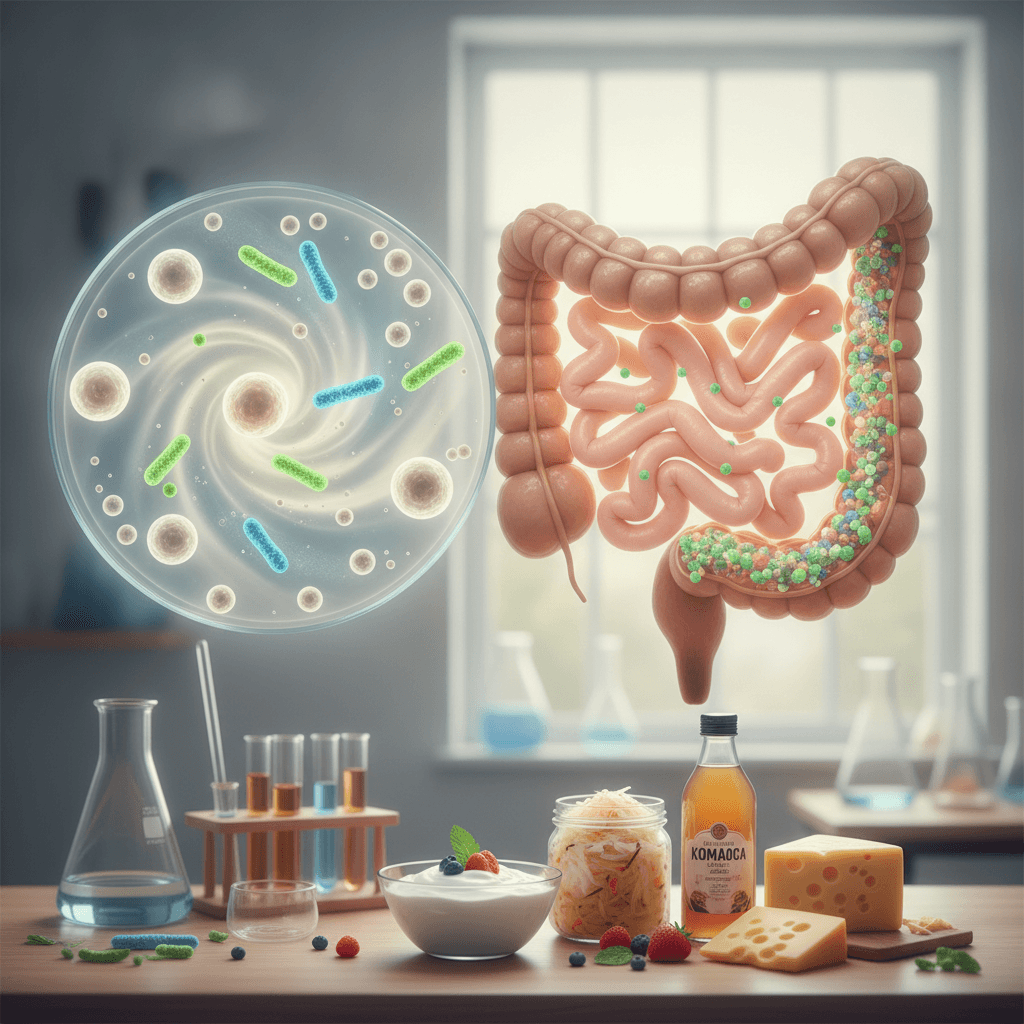

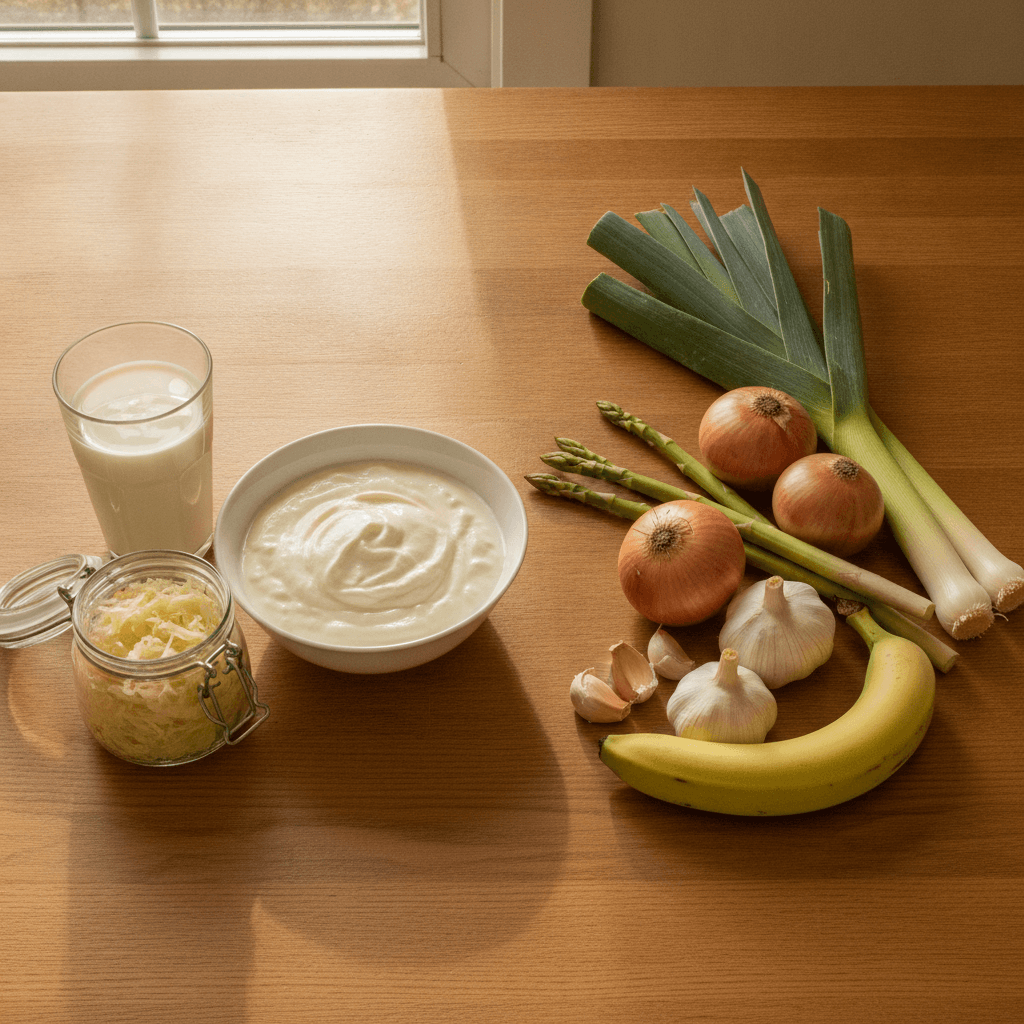
The difference between probiotics vs prebiotics is simple: probiotics are live microorganisms that benefit the person who takes them, and prebiotics are fibers and other compounds that the good bacteria already in your gut feed on. In the human studies we graded, probiotic strains showed clear improvements for gut bacteria balance and for gas and bloating. Prebiotic fibers raised the counts of good bacteria, but in the studies of inulin they did not ease digestion and bloating.
This guide sets the two side by side, with the foods that carry each, what the studies show, and when taking both makes sense. The probiotic products we graded are ranked on our probiotics page.
Probiotics vs Prebiotics at a Glance
| Probiotics | Prebiotics | |
|---|---|---|
| What they are | Live microorganisms that, in adequate amounts, benefit the person who takes them (Hill 2014) | Compounds the gut's own microbes use selectively, with a benefit to the person (Gibson 2017) |
| Examples | Lactobacillus, Bifidobacterium and Saccharomyces boulardii strains | Inulin, fructo-oligosaccharides (FOS) and galacto-oligosaccharides (GOS) |
| In food | Yogurt and kefir with live cultures, sauerkraut, kimchi, miso | Onions, garlic, leeks, asparagus, chicory root, slightly green bananas, oats, beans |
| What the human studies we graded show | Probiotic blends: a clear improvement for gut bacteria balance in up to 10 meta-analyses, the largest of 9,253 people; Saccharomyces boulardii for gas and bloating in 5 | Inulin: no effect for digestion and bloating in 56 studies; prebiotic blends: no effect for gut bacteria balance in 43 |
| Watch for | Results belong to the strain tested, not the species | Gas and bloating at higher doses |
Already taking a probiotic or a fiber? Check your stack for doubles.
What Probiotics Do
A probiotic is defined by what it does for the person: live microorganisms that, given in adequate amounts, confer a health benefit (Hill 2014). That benefit belongs to a strain, such as Lactobacillus rhamnosus GG, so two products with the same species on the label are not the same product.
In the human studies we graded, probiotic blends showed a clear improvement for gut bacteria balance in up to 10 meta-analyses, the largest of 9,253 people, from 100 million CFU a day. Saccharomyces boulardii, a probiotic yeast, showed a clear improvement for gas, bloating and irregular bowels in 5 meta-analyses, from 500 mg a day. Bifidobacterium longum showed one for gut bacteria balance in 2 meta-analyses. See the Lactobacillus rhamnosus GG, Bifidobacterium longum and Lactobacillus acidophilus pages for each strain's studies.
What Prebiotics Do
A prebiotic is food for the microbes already in your gut: a compound they use selectively, with a benefit to you (Gibson 2017). Most are fibers.
Across 64 studies of 2,099 healthy adults, fiber raised the gut's Bifidobacterium and Lactobacillus, and fructans (inulin and FOS) and GOS raised them most. It did not change the overall variety of gut bacteria (So 2018).
Raising good bacteria is not the same as feeling better. In the human studies we graded, inulin showed no effect for digestion and bloating across 56 studies, and prebiotic blends showed no effect for gut bacteria balance across 43. Fibers that ferment quickly can cause gas, so start low. See the inulin and FOS pages.
Fermented Foods vs Fiber: A Head-to-Head Trial
A Stanford trial gave healthy adults either a diet high in fermented foods or one high in fiber. The fermented-food diet steadily raised the variety of gut bacteria and lowered markers of inflammation. The high-fiber diet raised the bacteria's fiber-digesting enzymes, but the variety of bacteria stayed the same (Wastyk 2021). Our guide to improving gut health naturally covers the foods.
Should You Take Both? Synbiotics
A product with both is called a synbiotic: live microorganisms plus a substrate the gut's microbes use, with a benefit to the person (Swanson 2020). In the human studies we graded, pre and probiotic blends showed a clear improvement for gas, bloating and irregular bowels in 6 meta-analyses, the largest of 9,253 people.
A fourth term appears on labels too: postbiotics, which are microorganisms that are no longer alive, or parts of them, with a benefit to the person (Salminen 2021).
If you take meds or your immune system is weakened: ask your doctor before starting a probiotic, and check that any fiber is taken apart from meds, because fiber can slow how some are absorbed. Our guide to supplement and med interactions lists the common ones.
Which Fits Your Gut Goals
Rala, the AI behind Reverse Age Lab, ranks every probiotic and fiber you take against the human studies for your goals, checks each against your meds, and builds one Daily Protocol with food and supplements together. Build my protocol for gut health.
Is this medical advice? No. This guide sets out the published research on probiotics and prebiotics; it is not a diagnosis, and Rala isn't a medical device or a clinician. Talk to your doctor before you start, especially if you take meds.
Frequently Asked Questions
What is the difference between probiotics and prebiotics?
Probiotics are live microorganisms that benefit the person who takes them. Prebiotics are mostly fibers that feed the good bacteria already in your gut.
Should I take probiotics or prebiotics?
In the human studies we graded, probiotics showed clear improvements for gut bacteria balance and for gas and bloating, while inulin showed no effect for digestion and bloating. Prebiotic foods are still part of a gut-friendly diet.
What foods have prebiotics and probiotics?
Probiotics: yogurt and kefir with live cultures, sauerkraut, kimchi and miso. Prebiotics: onions, garlic, leeks, asparagus, chicory root, slightly green bananas, oats and beans.
Can prebiotics cause gas or bloating?
Yes. Fibers that gut bacteria ferment quickly, such as inulin, can cause gas, especially at higher doses. Starting low and building up slowly helps.
Sources
Hill C, Guarner F, Reid G et al. The International Scientific Association for Probiotics and Prebiotics consensus statement on the scope and appropriate use of the term probiotic. Nature Reviews Gastroenterology & Hepatology, 2014. PubMed.
Gibson GR, Hutkins R, Sanders ME et al. The ISAPP consensus statement on the definition and scope of prebiotics. Nature Reviews Gastroenterology & Hepatology, 2017. PubMed.
So D, Whelan K, Rossi M et al. Dietary fiber intervention on gut microbiota composition in healthy adults: a systematic review and meta-analysis. American Journal of Clinical Nutrition, 2018. PubMed.
Wastyk HC, Fragiadakis GK, Perelman D et al. Gut-microbiota-targeted diets modulate human immune status. Cell, 2021. PubMed.
Swanson KS, Gibson GR, Hutkins R et al. The ISAPP consensus statement on the definition and scope of synbiotics. Nature Reviews Gastroenterology & Hepatology, 2020. PubMed.
Salminen S, Collado MC, Endo A et al. The ISAPP consensus statement on the definition and scope of postbiotics. Nature Reviews Gastroenterology & Hepatology, 2021. PubMed.