
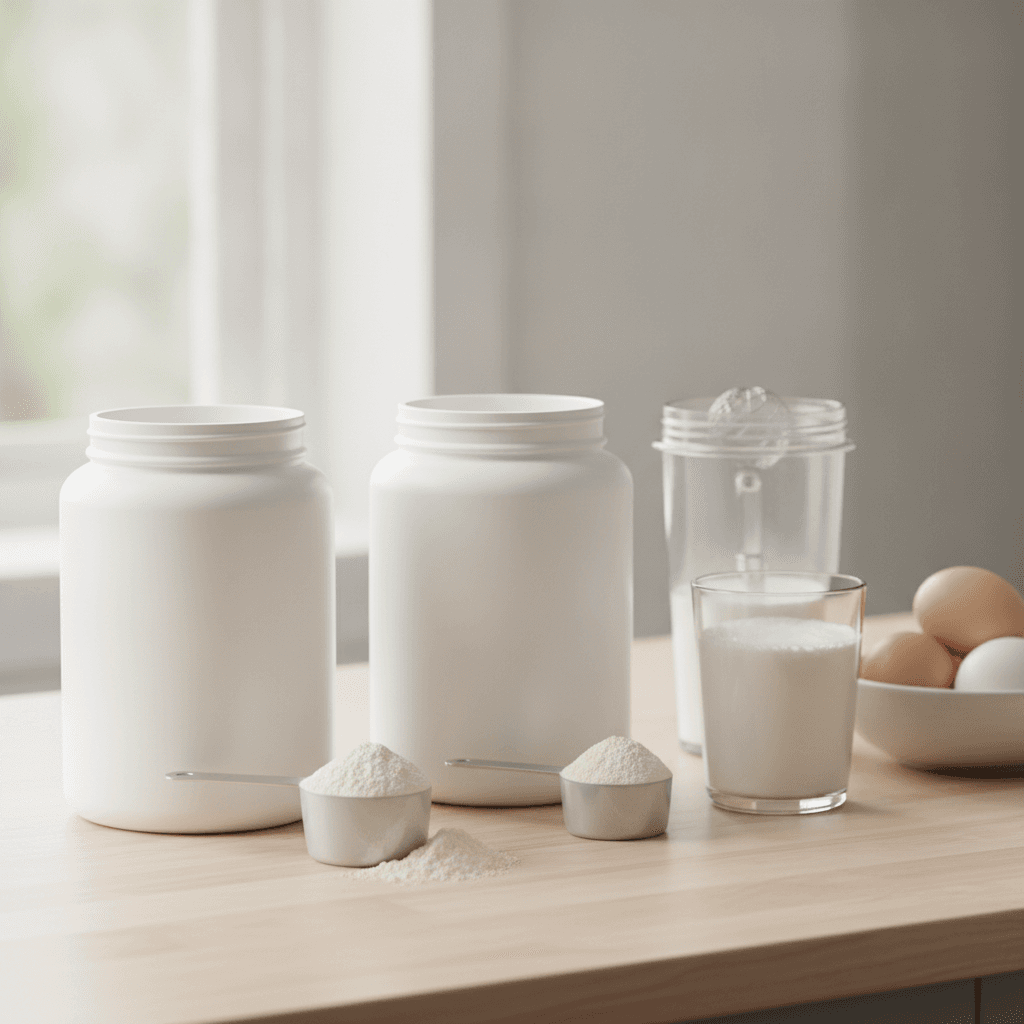
Whey isolate vs concentrate comes down to how far the protein is filtered: isolate is filtered further, so a scoop holds a little more protein and a little less carbohydrate and fat, while concentrate keeps a bit more of both. In our label database, whey powders named isolate hold a middle 25 g of protein in a 30 g scoop, against 24 g in a 33 g scoop for the rest, and no trial we found compared the two forms on muscle gains.
Below you'll find how each is made, what a serving holds, what lactose means for digestion, a side-by-side table, what the human studies found on muscle and recovery, and who should check with a doctor first. If you have searched "whey isolate or concentrate", this is the research behind the question; the choice stays yours.
What Whey Is and How Isolate and Concentrate Are Made
Whey is the watery part of milk that separates from the curds when cheese is made. It is dried into powder as whey protein concentrate, or filtered further to take out more of the fat, lactose (milk sugar) and carbohydrate and sold as whey protein isolate. Whey is one of the highest-quality proteins because it is rich in essential amino acids, including leucine, and is digested quickly (Devries 2015).
Many powders blend the two, and some add hydrolysate, which is whey broken into shorter pieces. The ingredient list says which: the first protein named is the one there is most of. Our whey protein page covers the studies, the doses that worked and the products ranked.
Protein Content, Fat and Carbs per Serving
We read the labels of on-market whey powders in our database. 32 name isolate and carry a full panel; the middle one gives 25 g of protein in a 30 g serving, which is 81% of the powder by weight, with 2 g of carbohydrate, 1 g of sugar and 1 g of fat. 63 do not name isolate (most are "100% whey" blends): the middle one gives 24 g of protein in a 33 g serving, or 72% by weight, with 4 g of carbohydrate, 2 g of sugar and 2 g of fat.
So the label gap is small: about 1 g of protein per serving, more carbohydrate and fat in the blends, and a larger scoop to get there. Flavourings and sweeteners add weight, which is why the share of protein by weight is a better number than the front of the tub. As examples, the Optimum Nutrition Gold Standard label lists a protein blend of whey protein isolate, concentrate and peptides at 24 g in a 30 g scoop with 3 g of carbohydrate, and the Legion Whey+ label lists a grass-fed whey protein isolate at 23 g in a 31 g scoop.
Lactose and Digestion: Who May Prefer Isolate
Lactose is the part of whey that gives some people gas, bloating or loose stools. Because isolate is filtered further, it usually holds less of it, which is why people who react to milk often try isolate first. A systematic review of 36 randomized studies found that 12 to 15 g of lactose, about a cup of milk, is well tolerated by most adults, and that the evidence for tiny amounts (0 to 2 g) over larger ones was insufficient (Shaukat 2010).
That 12 to 15 g is the yardstick. Most labels do not print a lactose figure, so the practical step is to ask the maker for grams of lactose per scoop. We found no trial that compared isolate with concentrate for digestive symptoms. Powders sold as lactose-free or with added lactase are a separate product again.
Whey Isolate vs Concentrate Side by Side: Protein per Serving, Lactose, Price per Gram, Taste and Mixability
| What you compare | Whey isolate | Whey concentrate or blend |
|---|---|---|
| Protein per serving (middle of our labels) | 25 g in a 30 g scoop (81% by weight, 32 labels) | 24 g in a 33 g scoop (72% by weight, 63 labels) |
| Carbohydrate, sugar, fat per serving | 2 g, 1 g, 1 g | 4 g, 2 g, 2 g |
| Lactose | Filtered further; usually lower | Usually higher; few labels print it |
| Price per gram of protein | Tub price ÷ (servings × protein per serving) | Same sum; blends are often listed for less |
| Taste and mixability | Not measured in any study we found | Not measured in any study we found |
| Effect on muscle in trials | No trial compared the two forms | No trial compared the two forms |
For price, work out the cost of a gram of protein, not of a scoop: a $40 tub of 30 scoops with 25 g of protein each costs about 5 cents a gram of protein ($40 ÷ 750 g). Each of our product pages has a Find the Lowest Price box that shows today's price in the stores we track, for example Dymatize ISO100 and Transparent Labs Grass-Fed Whey Protein Isolate. Taste and mixability come from buyer reviews, not trials.
What the Human Studies Found on Muscle and Recovery
The protein itself is what is studied for muscle. A pooled analysis of 49 trials with 1,863 people found that protein supplements on top of resistance training added 2.49 kg to the one-repetition-maximum lift and 0.30 kg of fat-free mass, and that the gain stopped growing beyond a total intake of 1.62 g per kilogram of body weight a day (Morton 2018). The International Society of Sports Nutrition puts 1.4 to 2.0 g per kilogram a day as enough for most people who exercise (Jäger 2017). Those numbers are about total protein, whichever form it comes in.
Our database grades 99 human results for whey and whey isolate on muscle and strength: 40 improved, 22 were mixed, 34 found no effect and 3 found a worse result. Of the improved results that record a dose, the most common was 40 g.
The few trials that name the form show little split between them. In a 12-week trial, 19 g of whey isolate and 26 g of soy isolate, matched for leucine, gave the same gains in lean mass and strength (Lynch 2020). In 14 resistance-trained people, 1.8 and 2.9 g per kilogram of protein a day, with a concentrate and isolate mix around each session, did not differ in performance over 10 days (Roberts 2017). And in 39 trained people, neither grass-fed nor conventional whey changed soreness or strength after hard leg work (Barenie 2024).
Who Should Check With a Doctor First
Whey is food, but a daily scoop or two adds a lot of protein. A pooled analysis of 28 trials found that higher protein intakes (at least 1.5 g per kilogram, 20% of calories or 100 g a day) did not change kidney filtration in healthy adults compared with normal intakes (Devries 2018). That finding is for healthy kidneys. If a doctor has told you to watch your protein or your kidneys, or you take meds, ask before adding whey. Anyone who reacts to milk should read the label's allergy line, since both forms come from milk.
This article summarizes published research on whey protein; it is not a diagnosis, and Rala isn't a medical device or a clinician. Talk to your doctor before adding a protein powder, especially if you take meds.
Bottom Line: Which One for Which Person
For a person who gets milk sugar symptoms, an isolate has less lactose per scoop and is the usual first one to try; the lactose studies suggest most adults handle 12 to 15 g, so a scoop of either is a small share of it. For a person who wants the most protein in the fewest grams, isolate gives about 1 g more per serving and less carbohydrate and fat, by our labels. For a person watching cost, concentrate and blends are often listed for less, so compare the price per gram of protein, not the tub. In trials, none of this showed a difference in muscle gain between forms; total daily protein and training did the work. So the practical questions are how many grams of protein a scoop holds, what the first protein on the list is, how much lactose the maker states, and what a gram of protein costs.
Check Your Protein Against Your Whole Stack
Your Daily Protocol adds up the protein and the other ingredients in every product you take, including shakes and blends, checks them against your meds and places each one at the right time of day. Build My Protocol – 7-Day Free Trial. You can also see how whey is graded for muscle on the Muscle and Strength page, or read how another popular sports supplement compares in creatine monohydrate vs HCl.
Frequently Asked Questions
Is whey isolate better than concentrate?
Isolate is filtered further, so by our labels it holds about 1 g more protein per serving and less carbohydrate and fat. We found no trial comparing the two for muscle gains.
Is whey isolate or concentrate better for muscle growth?
The pooled trials of protein supplements show gains in strength and muscle that stop growing beyond about 1.62 g per kilogram of body weight a day in total (Morton 2018). They do not split the result by form.
Which is better for lactose intolerance?
Isolate usually holds less lactose. Most adults tolerate 12 to 15 g of lactose (Shaukat 2010), so ask the maker for grams of lactose per scoop.
Is whey concentrate cheaper than isolate?
Concentrate and blends are often listed for less, but the price per gram of protein is what compares them: the tub price divided by servings times protein per serving.
Can I take whey if I take meds?
Ask your doctor first, especially if you have been told to limit protein or watch your kidneys. Higher protein did not change kidney filtration in healthy adults (Devries 2018).
Sources
Devries MC, Phillips SM. Supplemental protein in support of muscle mass and health: advantage whey. Journal of Food Science, 2015. PubMed.
Shaukat A, Levitt MD, Taylor BC et al. Systematic review: effective management strategies for lactose intolerance. Annals of Internal Medicine, 2010. PubMed.
Morton RW, Murphy KT, McKellar SR et al. A systematic review, meta-analysis and meta-regression of the effect of protein supplementation on resistance training-induced gains in muscle mass and strength in healthy adults. British Journal of Sports Medicine, 2018. PubMed.
Jäger R, Kerksick CM, Campbell BI et al. International Society of Sports Nutrition position stand: protein and exercise. Journal of the International Society of Sports Nutrition, 2017. PubMed.
Lynch HM, Buman MP, Dickinson JM et al. No significant differences in muscle growth and strength development when consuming soy and whey protein supplements matched for leucine following a 12 week resistance training program in men and women: a randomized trial. International Journal of Environmental Research and Public Health, 2020. PubMed.
Roberts J, Zinchenko A, Suckling C et al. The short-term effect of high versus moderate protein intake on recovery after strength training in resistance-trained individuals. Journal of the International Society of Sports Nutrition, 2017. PubMed.
Barenie MJ, Escalera A, Carter SJ et al. Grass-fed and non-grass-fed whey protein consumption do not attenuate exercise-induced muscle damage and soreness in resistance-trained individuals: a randomized, placebo-controlled trial. Journal of Dietary Supplements, 2024. PubMed.
Devries MC, Sithamparapillai A, Brimble KS et al. Changes in kidney function do not differ between healthy adults consuming higher- compared with lower- or normal-protein diets: a systematic review and meta-analysis. The Journal of Nutrition, 2018. PubMed.