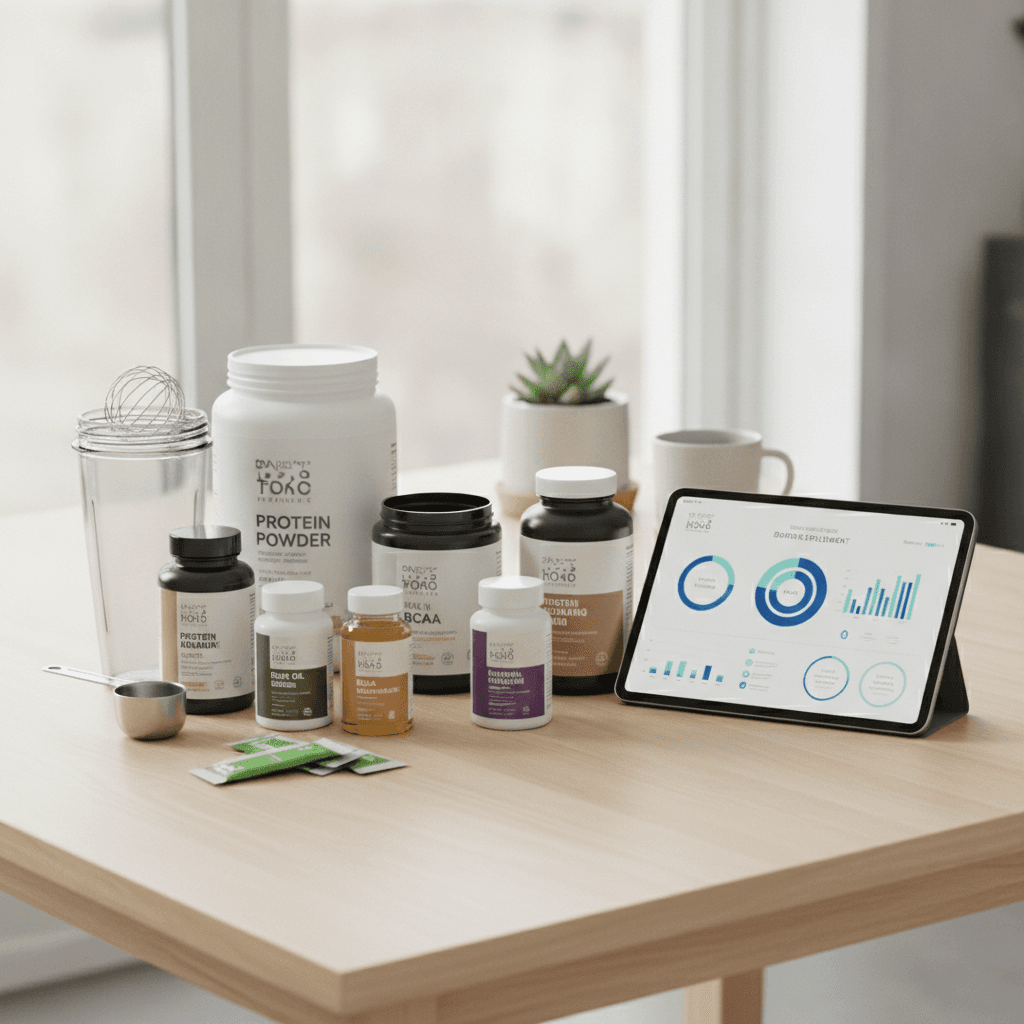

Biohacking supplements are the products and ingredients that people who track and tweak their own health take for strength, focus, stress, sleep or aging. Their human evidence varies widely: some have dozens of controlled trials behind them, such as creatine for strength, caffeine for attention and ashwagandha for stress, while others, such as NMN, rest mostly on blood markers. This guide shows how we judge them on human studies, the dose used and the form, where the evidence is strongest by goal, where it is thin, how our five grades and ten-biohacker panel fit together, and how to build a routine one change at a time.
The short answer: being popular among biohackers shows what people take, not whether human studies support it. Some of the best-known biohacking supplements have solid trial evidence for one goal and none for another; for others, the studies measure a marker in the blood, not an outcome you can feel.
Below you'll find what people mean by the term, how we judge a supplement, the goals where the human evidence is strongest, where it is thin, how our grades and our panel of ten biohackers are built, and a way to test a routine one change at a time. It names no product and gives no dose to take.
What People Mean by Biohacking Supplements
Biohacking is the habit of measuring yourself and adjusting sleep, food, exercise and supplements to see what changes; our practical guide to biohacking covers the idea itself. Biohacking supplements, sometimes called biohacker supplements, are what that crowd takes. If you are asking what supplements biohackers take, the answer runs from long-standing performance staples such as creatine and caffeine, through general-purpose nutrients such as magnesium and vitamin D, to a newer group aimed at aging, such as NMN, urolithin A and spermidine.
Why popularity is a poor test
What a well-known voice takes is information about habits, not about evidence. When researchers checked 80 randomly selected recommendations from each of two popular medical talk shows, the evidence supported 46% on one and 63% on the other, contradicted 15% and 14%, and could not be found for 39% and 24%; believable or somewhat believable evidence backed 33% and 53% [1]. In a study of 18 nitrate and beetroot supplements marketed in Europe, 55.6% used celebrities or influencers in their marketing and none presented external scientific endorsement [2]. These are different settings from our subject, and they make one point: a recommendation is not a result, so we read the studies and the panel separately.
How We Judge Them: Human Studies, the Dose Used and the Form
We start from published human studies of the ingredient itself, not the brand. Animal and cell studies are noted but never count as proof. For each study we record what was given (the form and the amount a day), to whom, for how long and for which goal, because the same ingredient can show an improvement for one goal and no effect for another. Creatine, for example, improved strength in our graded studies and showed no effect for the Energy goal. A study counts for a form only when it names the form it used, and a dose given by drip or injection is never shown as a dose that worked.
The dose matters as much as the ingredient: results at one amount do not carry to another, which our guide to reading a supplement dose sets out. Our free research tool runs the same check on a product you already take, and the methodology page describes the full method.
Where the Human Evidence Is Strongest, by Goal
These are cases where our pages show an ingredient as improved in human studies for a goal, with the most graded studies behind it. Each ingredient page shows the studies, the form and the doses by goal.
Muscle and Strength: creatine. More than 50 graded human studies. In a meta-analysis of 23 studies in adults under 50, creatine with resistance training added 4.43 kg to upper-body strength and 11.35 kg to lower-body strength compared with placebo; the gains were clear in men and not significant in women, though very few of the studies enrolled women [3].
Focus and Memory: caffeine. More than 60 graded human studies. In 31 placebo-controlled trials with 1,455 healthy adults, a single dose improved attention, with small gains in both accuracy and reaction time [4].
Stress and Calm: ashwagandha. Nearly 50 graded human studies. A meta-analysis of 12 randomized trials with 1,002 adults found lower stress levels than placebo, with the certainty of the evidence rated low and results that varied widely between trials [5].
Blood Sugar: berberine. More than 70 graded human studies; its page shows each form and the studies behind it.
Strong for one goal is not strong for all. Creatine, at the top for strength, shows no effect for the Energy goal in its graded studies, and citrulline shows no effect for either Energy or Muscle and Strength, which is why each result on our pages is tied to a goal.
Where the Evidence Is Thin
The weakest ground is the newest: ingredients sold for aging, where the studies often measure a marker in the blood rather than how people function.
NMN and NR. A systematic review of 33 human studies found that oral NMN and nicotinamide riboside consistently raised NAD-related blood markers and were generally well tolerated, but effects on functional and other healthspan outcomes were mixed and often null; its authors called clinical effectiveness for anti-aging or wellness outcomes inconclusive [6]. A meta-analysis in adults averaging over 60 found NMN did not significantly improve muscle mass, grip strength, walking speed or chair-stand performance [7]. Our comparison of NMN and NR goes further, and their pages are NMN and nicotinamide riboside.
Urolithin A and spermidine. They rest on small numbers of human studies, eight graded studies for spermidine and 23 for urolithin A at the time of writing, so their pages show the counts and the studies themselves.
Citrulline for endurance. A meta-analysis of nine trials with 158 healthy young adults found no significant difference in endurance performance after a single dose, and its authors called the evidence base small [8].
Thin does not mean useless. It means the human studies cannot yet say, and a page that shows few studies is a page that says so.
How Our Grades Are Built and How the Panel of Ten Biohackers Fits In
Every product is placed on one of five grades from the human studies of its ingredients and the reviews behind it, with what the panel says counted alongside. Pending is a status for a product nobody has asked about yet, not a sixth grade.
T1 Studied: human studies show measurable biological age reversal or rejuvenation on accepted biomarkers, and 66% or more of real reviews are positive.
T2 Researched: human studies show improvement in an aging-related function or a specific goal, and the reviews agree.
T3 Reviewed: strong review consensus with limited or early human study support.
T4 Emerging: a promising mechanism or animal data, thin human evidence and mixed reviews.
T5 Not Endorsed: the evidence contradicts the claims, or the reviews are negative.
The panel is a fixed group of ten well-known biohackers, read across their videos, podcasts, sites and posts: Andrew Huberman, Peter Attia, Rhonda Patrick, Dave Asprey, Ben Greenfield, Bryan Johnson, Mark Hyman, Siim Land, Eric Berg and Thomas DeLauer. For each ingredient we count how many of the ten name it, one vote each, and keep what each one said. The count is shown on the product and scored separately, so it never stands in for a study. Some of the ten sell products of their own. The ingredient pages show the count, for example "10 of 10 name it" for some forms.
Building a Routine One Change at a Time
A routine is easier to read when one thing changes at a time. Add a single product or change a single amount, keep the rest as it is, and write down the date, the product, the amount per serving, the time and a line on how you felt and slept. With two changes at once, a result cannot be traced to either. Checking each product against your goal on its ingredient page, and the amounts against the upper limits in our guide to reading a supplement dose, comes before adding the next.
A baseline blood panel is an optional extra: it gives later changes something to be compared with, but your health profile is enough to start. For the wider picture of how people combine supplements, diet, exercise and sleep, see our longevity overview, and browse the full list of goals to see which ingredients have studies behind each one.
Where Reverse Age Lab Fits
The stack check reads the labels of what you already take, adds up the totals, compares them with the upper limits and with your meds, and grades each product on the human studies, the reviews and the panel. Your Daily Protocol is then built from your health profile: your goals, meds, diet, exercise and sleep. It is educational, and it does not replace a pharmacist.
Check My Stack to run your list now, or Build My Protocol – 7-Day Free Trial. Your health profile is all it needs; blood work is optional.
Is this medical advice? No. This guide sets out what human studies found and how we grade them; it is not a diagnosis or treatment, and Rala isn't a medical device or a clinician. Talk to your doctor or pharmacist before adding a supplement, especially if you take meds.
Frequently Asked Questions
What are biohacking supplements?
They are the supplements people who track and adjust their own health take for strength, focus, stress, sleep or aging, from long-standing staples such as creatine and caffeine to newer ones such as NMN. The label describes who takes them, not how strong the evidence is; our guide to biohacking explains the practice. If you take meds, ask your doctor or pharmacist first.
Which ones have the most human evidence?
For their goals, creatine for strength, caffeine for attention and ashwagandha for stress each have dozens of graded human studies and pooled analyses [3] [4] [5]. The ingredient pages show the count, the form, the doses and the null results for each goal, since the same ingredient can show no effect for another goal. If you take meds, ask your doctor or pharmacist first.
Is it safe to combine several?
The studies and labels show that amounts add up across products: in one national survey, total intakes above the upper limit were rare for most nutrients, yet 10.3% of people exceeded it for niacin and 8.4% for zinc [9]. Some pairs also compete or clash; our guides cover supplement pairs that clash, supplements and medications that interact and ingredients taken twice, and what a checker cannot see is in our guide to what checkers miss. If you take meds, ask your doctor or pharmacist first.
Do I need a full stack?
The studies do not point to a full stack as a requirement. Each ingredient's studies stand on their own, so the grade for one ingredient does not depend on what else is in a routine. Goals, diet, exercise and sleep also change what a person takes, which is why our Daily Protocol starts from the health profile. If you take meds, ask your doctor or pharmacist first.
How are the grades built?
Each product is placed on one of five grades from the human studies of its ingredients and the real reviews behind it, and how many of the ten panel members name its ingredients is counted separately; the methodology page has the full rules. If you take meds, ask your doctor or pharmacist first.
Sources
[1] Korownyk C, et al. Televised medical talk shows: what they recommend and the evidence to support their recommendations: a prospective observational study. BMJ, 2014. PubMed 25520234
[2] Estevan Navarro P, et al. From labels to influencers: evaluating the alignment of nitrate and beetroot juice claims on sports supplement marketing with scientific consensus. Front Nutr, 2026. PubMed 42529644
[3] Wang Z, et al. Effects of creatine supplementation and resistance training on muscle strength gains in adults under 50 years of age: a systematic review and meta-analysis. Nutrients, 2024. PubMed 39519498
[4] Kløve K, Petersen A. A systematic review and meta-analysis of the acute effect of caffeine on attention. Psychopharmacology, 2025. PubMed 40335666
[5] Akhgarjand C, et al. Ashwagandha supplementation and stress: a systematic review and meta-analysis of randomized controlled trials (title shortened). Phytother Res, 2022. PubMed 36017529
[6] Gallagher C, Emmanuel OO. NAD+ supplementation for anti-aging and wellness: a PRISMA-guided systematic review of preclinical and clinical evidence. Ageing Res Rev, 2026. PubMed 41655607
[7] Prokopidis K, et al. The effect of nicotinamide mononucleotide and riboside on skeletal muscle mass and function: a systematic review and meta-analysis. J Cachexia Sarcopenia Muscle, 2025. PubMed 40275690
[8] Harnden CS, et al. Effects of citrulline on endurance performance in young healthy adults: a systematic review and meta-analysis. J Int Soc Sports Nutr, 2023. PubMed 37155582
[9] Fulgoni VL, et al. Foods, fortificants, and supplements: where do Americans get their nutrients? J Nutr, 2011. PubMed 21865568